
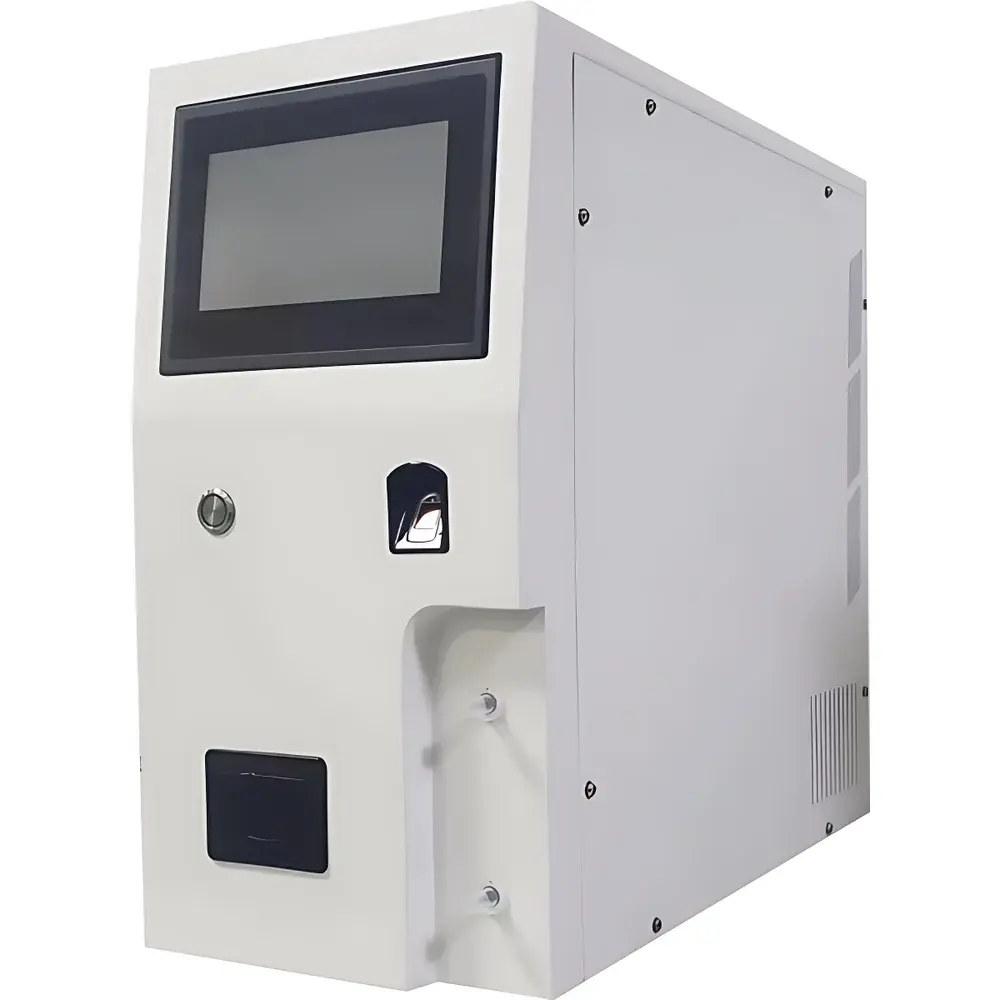
Jing Tuo RTQ-A Solvent Degassing System
| Brand | Jing Tuo Instrument |
|---|---|
| Origin | Tianjin, China |
| Manufacturer Type | Direct Manufacturer |
| Model | RTQ-A Solvent Degassing System |
| Vacuum Range | −95 kPa to −98 kPa |
| Membrane Pore Size | 0.01 µm – 0.2 µm |
| Membrane Surface Area | 15 m² |
| Degassing Efficiency | ≥85% (single-stage), ≥95% (dual-stage optional) |
| Flow Rate | 1 L/min |
| Outlet Temperature Range | Ambient to 50 °C |
| pH Compatibility | 1–14 |
| Max. Total Throughput | 50,000 L |
| Temp. Resolution | 0.01 °C |
| Flow Resolution | 0.001 L |
| Vacuum Resolution | 1 kPa |
| User Access Levels | 3-tier, 7-user |
| Audit Trail Capacity | 128 entries × 366 days |
| Interface Options | RS-232 |
| Power Input | 2000 W, 220 V AC, 10 A socket compatible |
Overview
The Jing Tuo RTQ-A Solvent Degassing System is an engineered solution for continuous, inline degassing of liquid mobile phases used in pharmaceutical analytical workflows—including HPLC, UHPLC, LC-MS, and dissolution testing. It employs hydrophobic microporous membrane technology operating under controlled vacuum to selectively remove dissolved gases (O₂, N₂, CO₂) without altering solvent composition, ionic strength, or pH. Unlike thermal or sonication-based methods, membrane degassing avoids volatile loss, temperature-induced degradation, or introduction of particulates—critical for maintaining method robustness in regulated environments. The system is designed for integration into automated lab infrastructure, supporting uninterrupted operation across multi-shift production and QC laboratories.
Key Features
- High-efficiency hollow-fiber membrane module with total active surface area of 15 m² and tunable pore size (0.01–0.2 µm), optimized for broad-spectrum solvent compatibility including aqueous buffers (e.g., phosphate, HCl), surfactant solutions (e.g., SDS), and high-purity water.
- Brushless DC high-vacuum pump delivering stable −95 to −98 kPa absolute pressure—equivalent to <2 kPa residual absolute pressure—enabling deep gas extraction while minimizing mechanical wear and acoustic emission (<52 dB(A)).
- Dual-zone quartz-tube PTC heating assembly with integrated flow sensor and overheat cutoff (trip point: 55 °C), ensuring precise thermal control (resolution: 0.01 °C) and compliance with ICH Q5C stability requirements for solvent conditioning.
- Industrial-grade 7-inch color touchscreen interface with role-based access control (3 privilege tiers, 7 configurable users), biometric fingerprint authentication, and full audit trail logging per FDA 21 CFR Part 11 Annex 11 expectations.
- Remote operation capability via infrared remote controller or optional RS-232 serial interface for SCADA or LIMS integration; supports programmable quantitative dispensing mode with volumetric accuracy ±0.5% of setpoint.
- Chemically inert fluid path constructed entirely from fluoropolymer-lined 316L stainless steel and PFA tubing—validated for continuous exposure to pH 1–14 solvents and aggressive cleaning agents (e.g., 1 M NaOH, 30% HNO₃).
Sample Compatibility & Compliance
The RTQ-A accommodates all common HPLC-grade solvents and buffer systems used in pharmacopeial methods (USP <621>, EP 2.2.46, JP 6.03). Its membrane chemistry and wetted materials have been verified for non-leaching performance per USP <661.1> and ISO 10993-12 extractables protocols. System validation documentation supports IQ/OQ/PQ execution aligned with GMP Annex 15 and ASTM E2500-13. All operational parameters—including vacuum level, temperature, flow rate, and user actions—are timestamped and cryptographically signed within the embedded audit trail (128-event buffer, retained for 366 days), satisfying ALCOA+ data integrity principles.
Software & Data Management
The onboard firmware implements deterministic real-time control logic with dual watchdog timers and automatic fault escalation. Logged events include vacuum drift alerts, membrane saturation warnings, flow deviation thresholds (>±3% setpoint), and unauthorized access attempts. Data export is supported via USB host port (CSV format) or RS-232 (Modbus RTU protocol). Optional software package provides centralized fleet monitoring, electronic signature capture, and PDF report generation compliant with 21 CFR Part 11 Subpart B §11.10 and §11.30.
Applications
- Preparation of degassed mobile phases for gradient HPLC analysis of APIs and impurities per ICH Q2(R2) validation guidelines.
- Continuous solvent conditioning in automated dissolution apparatus (USP Apparatus II) to eliminate bubble formation during UV quantitation.
- LC-MS mobile phase stabilization to suppress ion suppression and improve signal-to-noise ratio in trace-level bioanalysis.
- Buffer degassing prior to sterile filtration and aseptic filling operations, reducing risk of microbubble-induced filter clogging.
- Support of forced degradation studies requiring oxygen-sensitive reaction media (e.g., peroxide-catalyzed oxidation pathways).
FAQ
What solvents are compatible with the RTQ-A membrane system?
All HPLC-grade organic solvents (acetonitrile, methanol, THF), aqueous buffers (phosphate, acetate, citrate), surfactant solutions (SDS), and ultrapure water—within pH 1–14 range—are fully compatible. Membrane integrity has been confirmed after 500 h continuous exposure to 1 M HCl and 0.5 M NaOH.
Is the system suitable for GMP-regulated QC laboratories?
Yes. The RTQ-A meets core requirements for computerized system validation (CSV) including role-based access, electronic signatures, audit trail permanence, and data backup/export functionality—fully aligned with EU GMP Annex 11 and FDA guidance on data integrity.
How often does the degassing membrane require replacement?
Under typical usage (≤8 h/day, 5 days/week), the membrane module maintains ≥90% nominal efficiency for ≥12 months or 50,000 L cumulative throughput—whichever occurs first. Replacement is indicated when vacuum draw time exceeds 45 s to reach −95 kPa at 1 L/min flow.
Can the unit be integrated into a LabVantage or Empower LIMS environment?
Yes. Via RS-232 Modbus RTU interface, the RTQ-A exposes real-time process variables (vacuum, temp, flow, status flags) and accepts remote start/stop and setpoint adjustment commands—enabling bidirectional synchronization with major LIMS and CDS platforms.
Does the system support automated cleaning-in-place (CIP) cycles?
While not equipped with dedicated CIP hardware, the RTQ-A’s chemically resistant fluid path allows validated manual rinse protocols using 2 L deionized water post-run—verified to achieve ≤0.1 ppm residual solvent carryover by GC-FID analysis.





