
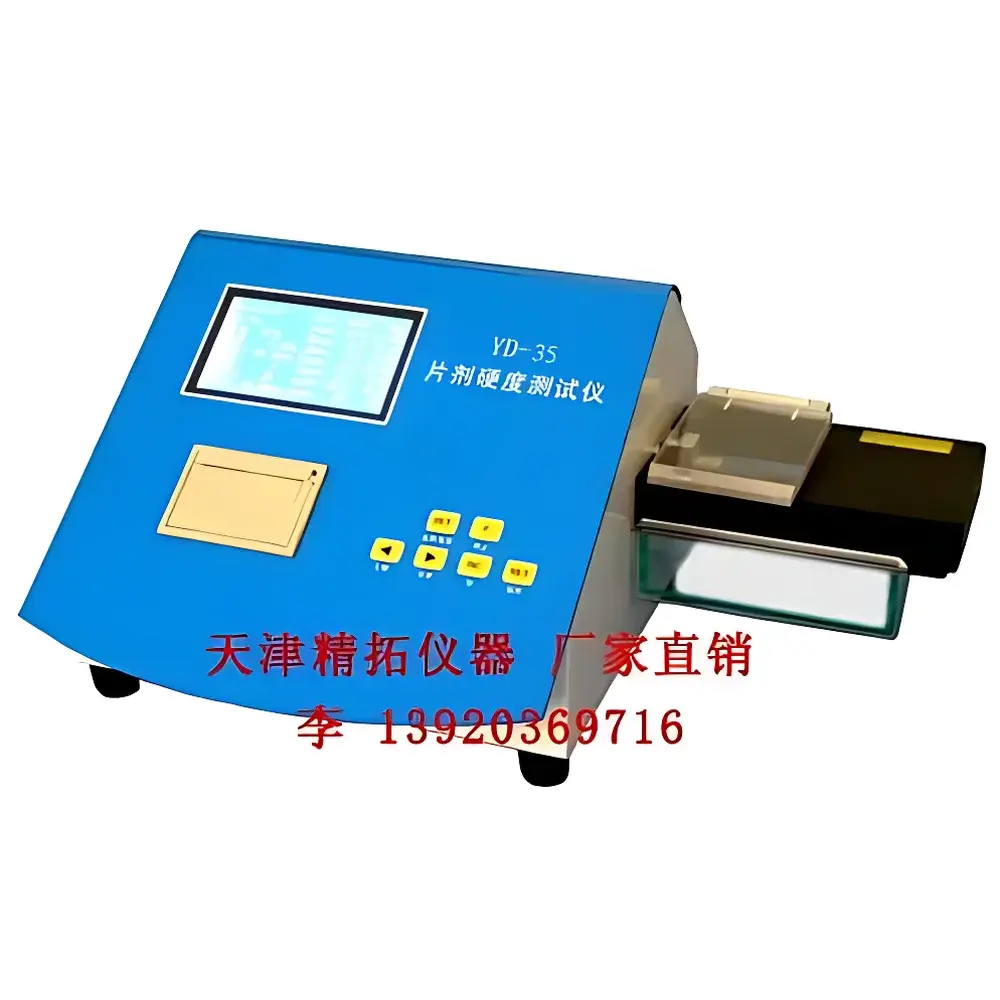
Jing Tuo YD-35 Intelligent Tablet Hardness Tester
| Brand | Jing Tuo Instrument |
|---|---|
| Origin | Tianjin, China |
| Manufacturer Type | Direct Manufacturer |
| Model | YD-35 |
| Hardness Range | 1–350 N |
| Resolution | 0.1 N |
| Accuracy | ±0.03 kg (equivalent to ±0.3 N) |
| Diameter Measurement Range | 2.0–30.0 mm |
| Diameter Accuracy | ±0.01 mm |
| Units | N / kg / Sc (hardness), mm / inch (diameter) |
| Measurement Modes | Manual single-tablet, automatic batch (up to 160 tablets) |
| Display | LCD, 4×8 Chinese or 8×16 English |
| Data Output | Statistical analysis, timestamped reporting, calibration logging, self-diagnosis, auto-save parameters |
Overview
The Jing Tuo YD-35 Intelligent Tablet Hardness Tester is a dedicated pharmaceutical mechanical testing instrument engineered for precise, repeatable quantification of tablet hardness and diameter—two critical physical attributes directly correlated with tablet integrity, disintegration behavior, and manufacturability. Operating on the principle of controlled axial compression, the device applies a calibrated, gradually increasing force perpendicular to the tablet’s flat face until fracture occurs; the peak load at failure is recorded as hardness. Simultaneously, integrated high-resolution optical or contact-based measurement systems capture tablet diameter with sub-hundred-micron accuracy. Designed in accordance with core principles of pharmacopeial testing (e.g., USP <1217>, Ph. Eur. 2.9.40), the YD-35 supports quality control laboratories in fulfilling regulatory expectations for mechanical property verification during formulation development, batch release, stability studies, and process validation.
Key Features
- Microprocessor-controlled actuation system ensures consistent loading rate and precise endpoint detection, minimizing operator-induced variability.
- High-stability load cell with 0.1 N resolution and verified accuracy of ±0.03 kg (±0.3 N) enables traceable, GLP-compliant hardness measurements across the full 1–350 N range.
- Dual-mode operation: manual single-tablet testing for R&D or troubleshooting, and automated sequential testing of up to 160 tablets per session—ideal for routine QC throughput.
- Configurable LCD interface supporting both Chinese and English display modes (4×8 Chinese characters or 8×16 ASCII), facilitating multilingual lab environments and international user training.
- Onboard real-time clock stamps all test records and calibration logs with date/time metadata, satisfying audit trail requirements under FDA 21 CFR Part 11 (when used with appropriate procedural controls).
- Integrated self-diagnostic routines monitor sensor drift, motor response, and mechanical alignment, issuing clear error codes to expedite maintenance and reduce downtime.
- All user-defined parameters—including unit preferences (N/kg/Sc for hardness; mm/inch for diameter), pass/fail thresholds, and report formatting—are retained in non-volatile memory without battery backup dependency.
Sample Compatibility & Compliance
The YD-35 accommodates standard convex, flat, and beveled tablets within a diameter range of 2.0–30.0 mm and thicknesses typical of commercial oral solid dosage forms (OSDFs). Its adjustable anvil geometry and low-inertia compression head minimize edge chipping and ensure reproducible fracture initiation. The instrument meets essential functional requirements outlined in ISO 8536-1 (infusion equipment), ASTM D638 (tensile properties of plastics—adapted for brittle solids), and aligns with the mechanical testing framework referenced in ICH Q5C (stability testing of biotechnological products) where tablet robustness is assessed. While not certified to ISO/IEC 17025, its design facilitates implementation within accredited labs adhering to GLP and GMP documentation practices.
Software & Data Management
Data acquisition, statistical processing (mean, SD, CV%, min/max), and report generation are performed entirely onboard. Each test record includes hardness value, diameter, test timestamp, operator ID (if entered), and calibration status. Reports can be printed via integrated thermal printer or exported via RS-232 serial interface to LIMS or Excel-compatible formats. Calibration certificates—generated during periodic verification using NIST-traceable reference weights and gauge blocks—are stored with full traceability. Audit trail functionality (time-stamped log of all parameter changes and calibration events) supports compliance with Annex 11 and data integrity principles per ALCOA+.
Applications
- Batch release testing per internal SOPs and pharmacopeial monographs (e.g., USP <1217>).
- Formulation optimization: correlating binder concentration, granulation method, and compression force with hardness profiles.
- Stability protocol execution: monitoring hardness drift over accelerated and long-term storage conditions.
- Equipment qualification: verifying consistency of tablet compression performance across shifts and machines.
- Educational use in pharmacy and pharmaceutics programs for hands-on understanding of tablet mechanical behavior.
FAQ
Does the YD-35 comply with USP <1217> requirements for tablet hardness testing?
Yes—the instrument implements the fundamental mechanical test methodology specified in USP <1217>, including controlled compression, peak-force detection, and dimensional verification. Final compliance depends on site-specific validation and operational qualification per your laboratory’s SOPs.
Can hardness data be exported to external databases or LIMS?
Yes—via RS-232 serial output, raw test data and summary reports can be transmitted to third-party software or enterprise systems for centralized review and trending.
What calibration standards are recommended for routine verification?
NIST-traceable deadweight standards (e.g., 10 N, 50 N, 200 N) and certified gauge blocks (for diameter verification) are recommended. Calibration frequency should follow risk-based assessment per your quality system.
Is the YD-35 suitable for coated or film-coated tablets?
Yes—its low-speed, controlled-force profile minimizes surface abrasion and preserves coating integrity during measurement, provided tablet geometry remains within the supported diameter and aspect ratio limits.
How is measurement repeatability ensured across operators?
Through standardized positioning jigs, fixed loading rates, and elimination of manual force application—replacing subjective “feel” with deterministic digital control and automated endpoint detection.





