
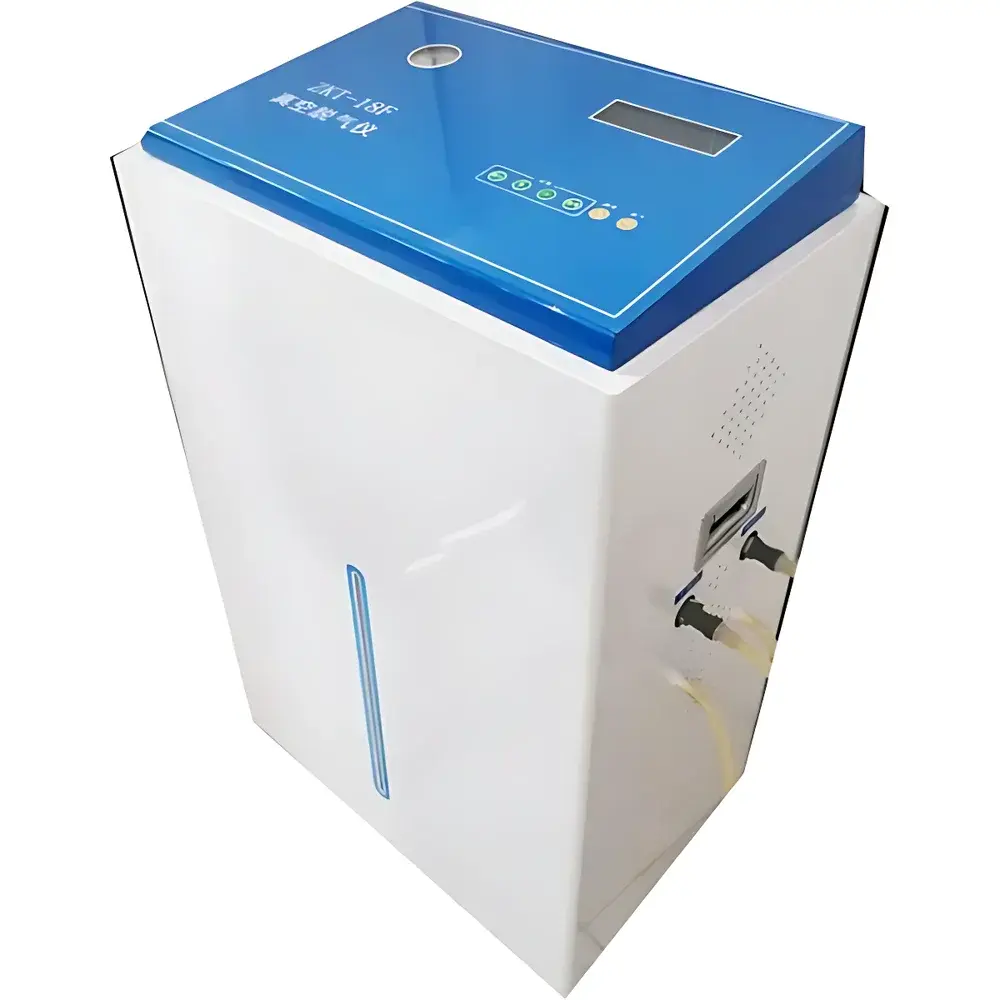
Jing Tuo ZKT-18F Vacuum Degassing Unit for Pharmaceutical Solvent Preparation
| Brand | Jing Tuo Instrument |
|---|---|
| Origin | Tianjin, China |
| Manufacturer Type | Direct Manufacturer |
| Model | ZKT-18F |
| Temperature Control Range | 37–45 °C |
| Temperature Resolution | 0.1 °C |
| Temperature Accuracy | ±0.5 °C |
| Vacuum Control Range | 0.02–0.05 MPa |
| Vacuum Resolution | 0.01 MPa |
| Sample Volume Capacity | 7 L or 21 L (selectable internal reservoir configuration) |
| Heating Power | 1500 W |
| Integrated Vacuum Pump | Yes |
| UV Sterilization Module | Included |
| Compliance | Meets requirements of Chinese Pharmacopoeia 2020 Edition (General Chapter <0931> “Dissolution Testing” and <0632> “Degassing of Solvents”) |
Overview
The Jing Tuo ZKT-18F Vacuum Degassing Unit is an engineered solution designed specifically for the preparation of degassed dissolution media in pharmaceutical quality control and R&D laboratories. It operates on a validated tri-modal principle—simultaneous heating, recirculation, and vacuum application—to remove dissolved gases (primarily O2 and CO2) from purified water, distilled water, and deionized water used as solvents in USP Apparatus I (basket) and II (paddle) dissolution testing. Unlike traditional boiling methods—which risk thermal degradation of sensitive excipients, introduce variability due to evaporation loss, and lack reproducible endpoint control—the ZKT-18F delivers consistent, traceable, and operator-independent degassing under defined thermodynamic conditions. Its design aligns with pharmacopeial expectations for solvent conditioning, particularly those outlined in the Chinese Pharmacopoeia 2020 Edition (ChP), General Chapters <0632> (Degassing of Solvents) and <0931> (Dissolution Testing), and supports alignment with broader international practices referenced in USP <711>, EP 2.9.3, and JP 17.
Key Features
- Integrated high-efficiency vacuum pump housed within the instrument chassis—eliminates external hose routing, reduces footprint, and enhances system integrity and noise containment.
- Precise dual-parameter control: independent regulation of bath temperature (37–45 °C, ±0.5 °C accuracy) and chamber vacuum level (0.02–0.05 MPa absolute, 0.01 MPa resolution), enabling method-specific optimization per monograph requirements.
- Recirculating fluid path with optimized flow dynamics ensures uniform temperature distribution and maximizes gas nucleation efficiency during vacuum exposure.
- Large-backlit LCD interface displays real-time temperature, vacuum pressure, operational status, and elapsed cycle time—designed for glove-compatible interaction in QC environments.
- Onboard microcontroller enables full automation: one-touch initiation of fill, heat, stir, and degas sequences; automatic termination upon reaching user-defined setpoints or timeout thresholds.
- Built-in UV-C sterilization module (254 nm wavelength) irradiates the internal reservoir and circulation loop between cycles, minimizing microbial load and supporting GLP-compliant solvent handling protocols.
- Self-diagnostic firmware monitors heater continuity, vacuum seal integrity, temperature sensor drift, and pump performance—alerts operators via on-screen codes and halts operation if critical faults are detected.
- Non-volatile memory retains last-used parameters (temperature, vacuum target, volume mode), reducing reconfiguration time across consecutive batches.
Sample Compatibility & Compliance
The ZKT-18F is validated for use with aqueous dissolution media only—including purified water, water for injection (WFI), distilled water, and deionized water—within the specified volume ranges (7 L standard or 21 L extended reservoir option). It is not intended for organic solvents, viscous formulations, or suspensions. The unit’s control architecture supports audit-ready operation: all parameter settings, runtime logs, and fault events are timestamped and stored locally. While the device itself does not provide electronic signatures or 21 CFR Part 11-compliant audit trails, its deterministic behavior, calibration traceability (via built-in offset adjustment), and stable operating envelope facilitate integration into validated dissolution workflows under GMP and GLP frameworks. Documentation packages—including IQ/OQ templates, calibration certificates, and ChP-aligned validation protocols—are available upon request for regulated site deployment.
Software & Data Management
The ZKT-18F operates via embedded firmware without external PC dependency. All operational data—including start/stop timestamps, setpoint values, actual temperature/vacuum profiles, and error logs—are retained in internal memory for up to 1,000 cycles. Data export is supported via USB port (CSV format) for offline review in LIMS or statistical process control platforms. Optional RS-485 Modbus RTU interface enables integration with laboratory building management systems (BMS) or centralized dissolution suite controllers for synchronized media preparation scheduling. Calibration constants (temperature sensor offset, pressure transducer zero/span) are adjustable through protected service menus and require administrator-level access—ensuring data integrity and compliance with internal QA procedures.
Applications
- Preparation of degassed dissolution media for USP Apparatus I/II dissolution testing in pharmaceutical QC labs.
- Standardized solvent conditioning prior to HPLC mobile phase preparation where dissolved oxygen may affect column stability or detector baseline noise.
- Supporting accelerated stability studies requiring repeated, identical media batches over extended timelines.
- Process development labs optimizing dissolution method robustness across temperature and vacuum parameter space.
- Contract testing organizations (CTOs) maintaining multiple dissolution suites requiring scalable, reproducible media preparation infrastructure.
FAQ
Does the ZKT-18F comply with USP <711> or EP 2.9.3 requirements for solvent degassing?
It meets the functional intent of these chapters—providing controlled, documented, and repeatable removal of dissolved gases—and is aligned with ChP 2020 <0632>. Formal USP/EP compliance is determined at the system level, including how the unit is qualified and operated within a validated dissolution protocol.
Can the unit be calibrated independently by the end user?
Yes—temperature and vacuum sensors include user-accessible offset calibration functions, with procedures documented in the technical manual. External verification using NIST-traceable references is recommended annually.
Is the UV sterilization module validated for microbial reduction?
The 254 nm UV-C source is rated for >3-log reduction of common waterborne bacteria (e.g., E. coli, Pseudomonas aeruginosa) under static exposure conditions per ISO 15714; dynamic loop exposure efficacy depends on flow rate and residence time, which are optimized in the ZKT-18F design.
What maintenance is required for the integrated vacuum pump?
The oil-free diaphragm pump requires no lubrication; periodic inspection of inlet filter and replacement every 12 months (or after 2,000 operating hours) is advised. Full service kits and OEM spare parts are available directly from Jing Tuo.
Can the ZKT-18F be connected to a networked lab information system?
Via optional RS-485 Modbus RTU or USB-to-serial gateway, it supports read-only data polling for integration into SCADA, MES, or custom LIMS dashboards—no proprietary software or drivers required.






