
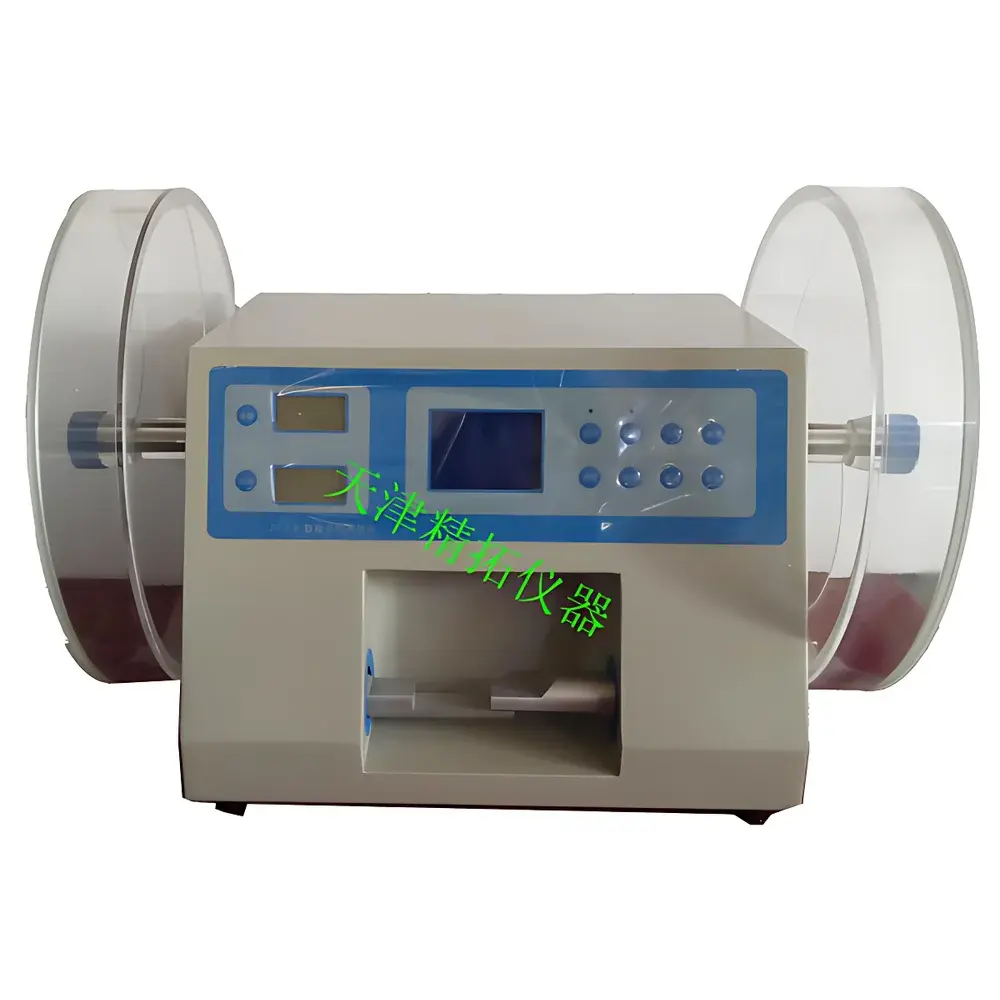
Jing Tuo ZPJ-2 Dual-Function Tablet Tester (Hardness & Friability)
| Brand | Jing Tuo Instrument |
|---|---|
| Origin | Tianjin, China |
| Manufacturer Type | Direct Manufacturer |
| Country of Origin | China |
| Model | ZPJ-2 |
| Pricing | Available Upon Request |
| Drum Quantity | 2 |
| Drum Internal Diameter | 286 mm |
| Drum Depth | 39 mm |
| Drop Height | 156 mm |
| Drum Rotation Speed | (25 ± 1) rpm |
| Total Rotations | (100 ± 1) cycles |
| Hardness Measurement Range | 2–199 N (±1 N accuracy) |
| Tablet Diameter Compatibility | 3–40 mm |
| Power Supply | 220 V / 50 Hz / 600 W |
Overview
The Jing Tuo ZPJ-2 Dual-Function Tablet Tester is an integrated, benchtop pharmaceutical quality control instrument engineered for concurrent or sequential assessment of tablet hardness and friability—two critical physical attributes defined in pharmacopoeial standards including USP <1217>, EP 2.9.8, and ChP 0921. Unlike modular or single-function testers, the ZPJ-2 implements a dual-chamber mechanical architecture: one pair of standardized friability drums operates under controlled rotational kinematics, while a precision-driven hardness testing station employs a calibrated load cell and motorized compression actuator. The system adheres to the fundamental principles of mechanical deformation quantification—hardness measurement follows quasi-static axial compression per Hertzian contact theory, while friability evaluation conforms to the tumbling attrition method specified in regulatory guidelines, where mass loss after controlled rotation is expressed as percentage weight change. Designed for routine QC laboratories operating under GLP and GMP frameworks, the ZPJ-2 delivers repeatable, operator-independent results without requiring manual timing, manual force application, or post-test manual calculations.
Key Features
- Integrated dual-mode operation: Simultaneous hardware pathways for hardness and friability testing eliminate cross-contamination risk and reduce instrument footprint.
- High-accuracy load cell with digital readout: Full-scale range 2–199 N, resolution ≤ 0.1 N, linearity error < ±0.5% FS, compliant with ISO 376 requirements for force transducers used in pharmaceutical testing.
- Regulatory-grade friability drum assembly: Two identical stainless-steel drums (ID 286 mm × depth 39 mm), precisely machined to meet USP-specified geometry; drop height fixed at 156 mm to ensure consistent impact energy per revolution.
- Motor-controlled rotational system: Closed-loop speed regulation maintains (25 ± 1) rpm across voltage fluctuations; programmable cycle count (default 100 ± 1 rotations) with automatic termination and audible alert.
- Automated hardness test sequence: Motor-driven descent, real-time force monitoring, peak detection, auto-hold, digital lock-in of maximum load, and automatic return-to-start position—all executed without user intervention.
- Embedded self-diagnostic firmware: Continuous validation of sensor zero-point drift, actuator end-stop integrity, and drum rotation encoder feedback; error codes displayed with contextual troubleshooting prompts.
Sample Compatibility & Compliance
The ZPJ-2 accommodates tablets ranging from 3 mm to 40 mm in diameter—including round, oval, and capsule-shaped dosage forms—without fixture modification. Its hardness platen and drum aperture geometry are validated for standard compressed tablets, film-coated tablets, and sugar-coated tablets per ICH Q5C stability guidance. All mechanical components contacting samples are constructed from electropolished 316L stainless steel, compliant with ISO 15378:2017 for primary packaging materials and equipment surfaces. The instrument supports audit-ready operation: timestamped test records include operator ID (via optional RFID login), sample ID, test mode, environmental temperature/humidity (when interfaced with external sensors), and raw force/time or mass-loss data. Data output conforms to ALCOA+ principles and facilitates 21 CFR Part 11-compliant electronic record generation when paired with validated LIMS or ELN software.
Software & Data Management
The ZPJ-2 operates via an embedded ARM-based controller with a 5.7-inch TFT-LCD touchscreen interface supporting multilingual menus (English, Spanish, Chinese). Test parameters—including target hardness threshold, friability rotation count, dwell time, and pass/fail criteria—are configurable and stored in non-volatile memory with version-controlled backup. Raw data (force vs. time curves, pre-/post-friability weights, calculated % loss) export directly to CSV or PDF via USB 2.0 port. Optional Ethernet or RS-232 connectivity enables integration into centralized QC data systems. Firmware updates are performed via signed binary packages to prevent unauthorized modification—a requirement aligned with Annex 11 and EU GMP Chapter 4 computerized system validation expectations.
Applications
- Routine release testing of solid oral dosage forms in contract manufacturing organizations (CMOs) and API formulation labs.
- Stability study endpoint analysis per ICH Q1A(R2), tracking hardness and friability changes across accelerated and long-term storage conditions.
- Formulation development support: Correlating binder concentration, granulation moisture, and compression force with mechanical robustness metrics.
- Supplier qualification of excipients—e.g., evaluating microcrystalline cellulose grades for compactibility and attrition resistance.
- Root cause investigation of coating defects or capping/lamination failures using hardness profile mapping across tablet batches.
FAQ
Does the ZPJ-2 comply with USP general chapter <1217> for tablet hardness testing?
Yes—the instrument’s loading rate, platen geometry, and force calibration protocol align with USP <1217> requirements for single-point hardness measurement.
Can friability results be exported in a format compatible with statistical process control (SPC) software?
Yes—CSV exports contain all raw and calculated values (initial mass, final mass, % loss, date/time stamp) with column headers optimized for import into Minitab, JMP, or Python pandas workflows.
Is calibration traceable to national metrology institutes?
Force transducer calibration certificates are provided with NIST-traceable documentation; annual recalibration services include uncertainty budgets per ISO/IEC 17025.
What maintenance intervals are recommended for sustained regulatory compliance?
Daily visual inspection of drum welds and platen surface integrity; monthly verification of rotation speed and load cell zero/balance; annual full performance qualification (PQ) per IQ/OQ/PQ protocols supplied with the instrument.



