
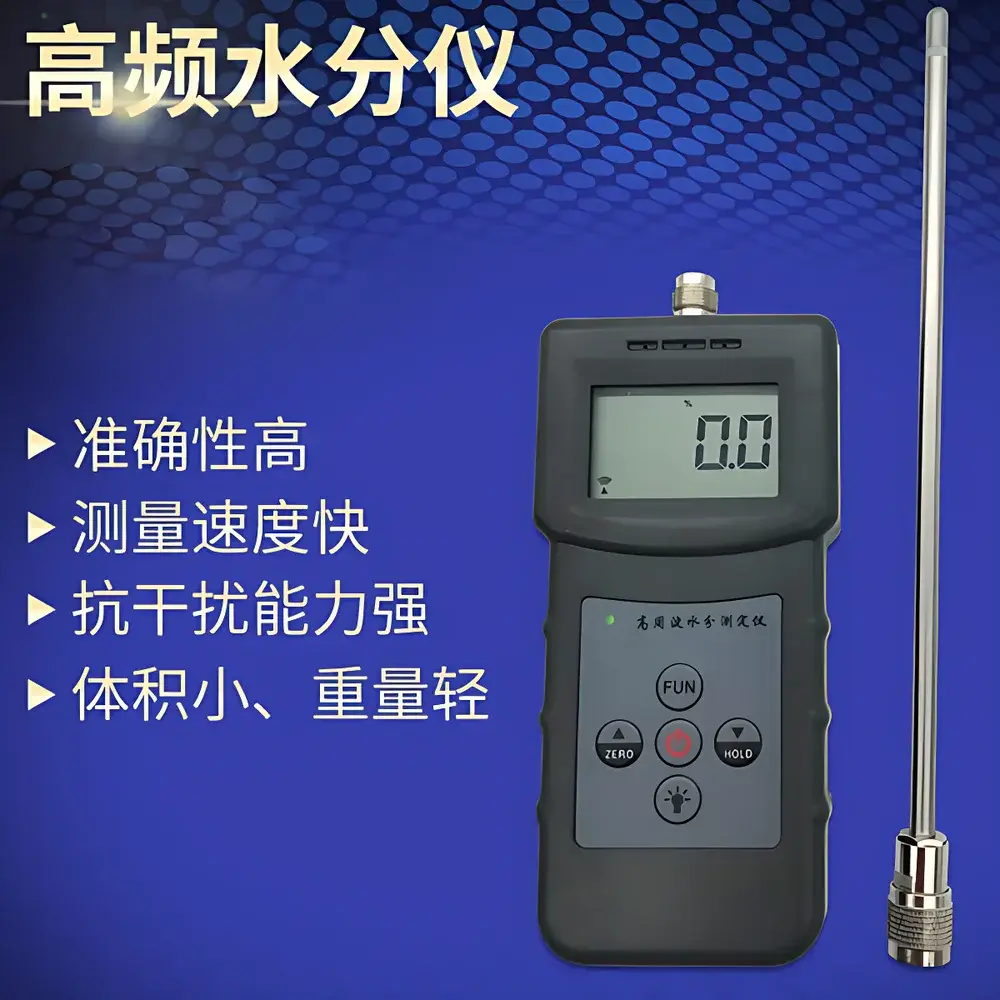
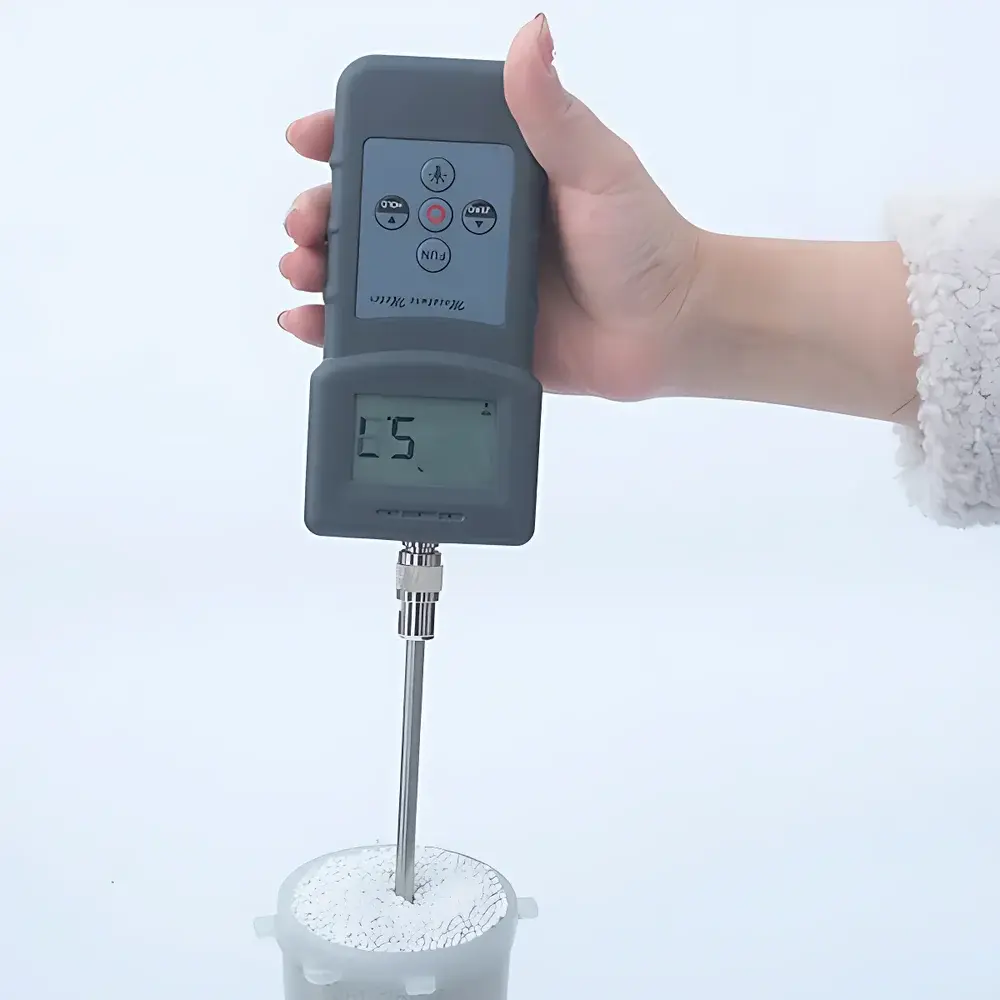
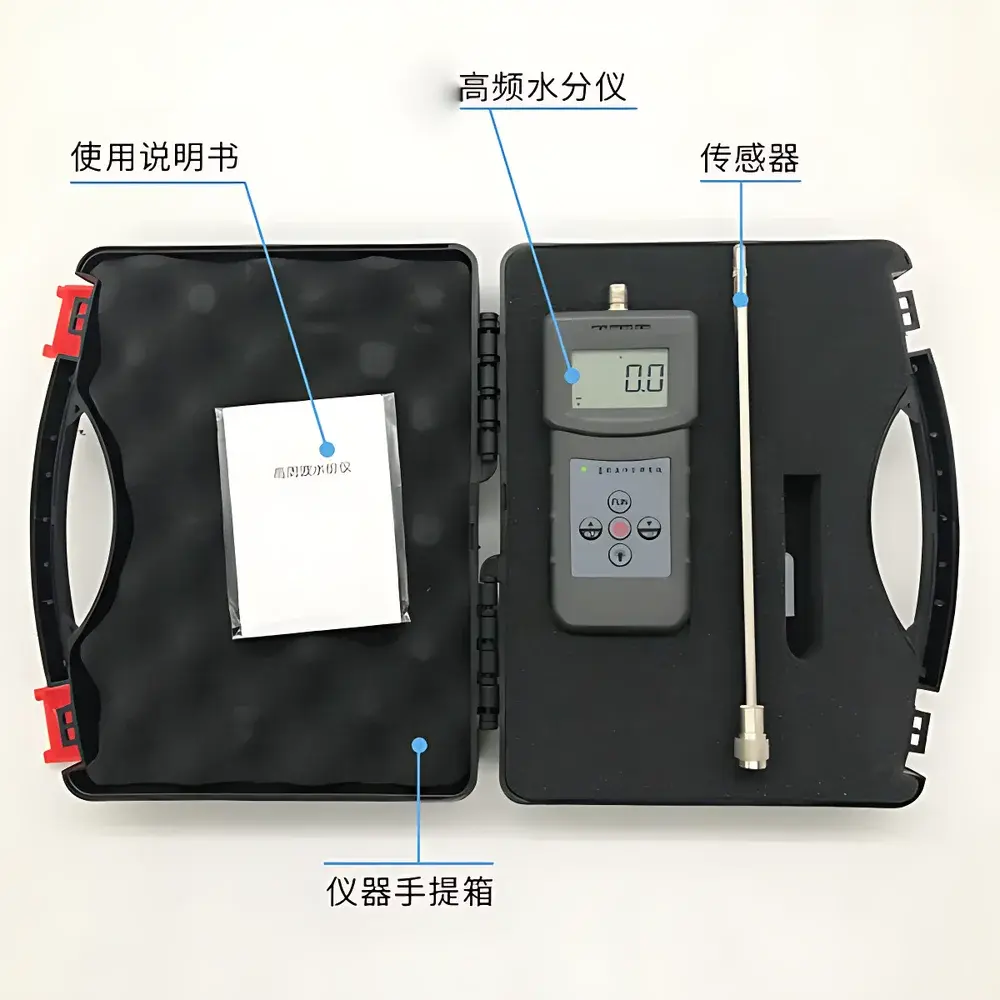
Jingcheng Huatai HT-350 High-Frequency Moisture Analyzer
| Brand | Jingcheng Huatai |
|---|---|
| Origin | Beijing, China |
| Model | HT-350 |
| Measurement Principle | High-frequency electromagnetic wave (radio frequency, 1–10 MHz) |
| Moisture Range | 0–80% w/w |
| Accuracy | ±(0.5% of reading + 1%) |
| Resolution | 0.1% |
| Response Time | 1 second |
| Operating Temperature | −10 °C to 50 °C |
| Operating Humidity | 35–85% RH |
| Display | 4-digit LCD with backlight |
| Power Supply | 4 × AAA batteries |
| Dimensions (main unit) | 140 mm × 60 mm × 24 mm |
| Sensor Probe Length | Standard 235 mm (custom lengths available) |
| Net Weight | ~120 g |
| Compliance | Designed for industrial QC environments |
Overview
The Jingcheng Huatai HT-350 High-Frequency Moisture Analyzer is a portable, non-destructive moisture measurement instrument engineered for rapid, in-situ quantification of water content in bulk solid materials. It operates on the principle of high-frequency electromagnetic wave interaction—typically in the 1–10 MHz band—where variations in dielectric permittivity and conductivity correlate directly with moisture concentration. Unlike loss-on-drying (LOD) methods, this technique requires no sample preparation, heating, or consumables, enabling real-time assessment without altering sample integrity. The integrated sensor and main unit form a compact, handheld architecture optimized for field use across chemical manufacturing, agrochemical production, pharmaceutical excipient handling, and mineral processing facilities.
Key Features
- Non-invasive RF-based sensing: Penetrates up to 50 mm depth depending on material density and dielectric properties, delivering representative volumetric moisture data without surface damage or sampling bias.
- Real-time digital readout: 4-digit LCD with adjustable backlight ensures legibility under low-light warehouse, plant floor, or outdoor conditions.
- Temperature-compensated measurement algorithm: Internal thermistor corrects for ambient thermal drift, maintaining accuracy across −10 °C to 50 °C operating range.
- Low-power design: Utilizes ultra-low-quiescent-current CMOS circuitry and energy-efficient LCD driver, achieving >100 hours of continuous operation on four AAA alkaline cells.
- On-device data retention: Includes MAX/MIN hold function and audible threshold alert for user-defined moisture limits (e.g., ≤2.5% for polymer granules).
- Ruggedized mechanical construction: IP54-rated enclosure resists dust ingress and incidental splashing; sensor probe features abrasion-resistant PTFE coating for repeated insertion into abrasive powders and granules.
Sample Compatibility & Compliance
The HT-350 is validated for direct-contact measurement of heterogeneous, non-conductive, and moderately conductive solids—including but not limited to: inorganic salts, urea-based fertilizers, kaolin and bentonite clays, PVC and polyolefin pellets, dried herbal extracts, sodium silicate solutions (as pastes), metal soaps, and detergent powders. It is not suitable for highly conductive liquids, metallic powders, or samples containing ferromagnetic additives. While not certified to ISO/IEC 17025 or ASTM D4944 (for soil), its measurement repeatability (≤±0.3% RSD at fixed moisture level) supports internal method validation per ICH Q2(R2) guidelines. Instrument firmware logs timestamped measurements locally and supports manual export via optional USB adapter for audit-ready recordkeeping aligned with GLP and GMP documentation requirements.
Software & Data Management
The HT-350 operates as a standalone field instrument with no embedded Bluetooth or wireless stack. All measurement data are retained in volatile memory during active use and cleared upon power-down—consistent with regulatory expectations for non-critical QC tools where traceability is maintained manually. For laboratories requiring electronic records, optional PC interface cables enable serial output (RS-232 TTL level) compatible with third-party data acquisition platforms such as LabVIEW, MATLAB, or custom CSV loggers. Exported timestamps, moisture values, and unit identifiers conform to ISO 8601 date formatting and support integration into LIMS systems compliant with FDA 21 CFR Part 11 when paired with validated software layers and user access controls.
Applications
- Batch release testing of chemical intermediates prior to packaging—verifying compliance with moisture specifications (e.g., <0.5% for hygroscopic catalysts).
- In-process monitoring of fluid-bed dryer exit streams in fertilizer granulation lines.
- Field verification of desiccant efficacy in sealed transport containers for moisture-sensitive APIs.
- Quality triage of incoming raw materials—e.g., confirming clay moisture ≤12% before ceramic slip formulation.
- Validation of drying cycle endpoints in pilot-scale solvent recovery units handling acetone-washed resins.
- Environmental screening of landfill cover soils to assess compaction readiness per ASTM D1557 protocols.
FAQ
Does the HT-350 require calibration with reference standards?
Yes. Initial factory calibration uses NIST-traceable moisture standards (e.g., potassium sulfate saturated solution at 25 °C, nominal 97.3% RH). Users must perform periodic verification using material-specific check standards—recommended every 30 days or after 200 measurements, whichever occurs first.
Can it measure moisture in conductive slurries or pastes?
No. High electrical conductivity attenuates RF signal penetration and induces phase shift errors. The instrument is rated only for solids and semi-solids with bulk resistivity >10⁴ Ω·m.
Is sensor probe length customizable?
Yes. Standard probe is 235 mm, but options include 150 mm (for shallow bins) and 300 mm (for deep silos); all share identical electronics and calibration curves.
What environmental conditions affect measurement stability?
Extreme ambient humidity (>90% RH) may cause condensation on the probe tip, leading to transient overestimation. Operation below −10 °C risks LCD response lag and battery voltage sag—use is discouraged outside the specified thermal envelope.
How does temperature compensation work?
An onboard thermistor measures probe base temperature and applies a linear correction coefficient derived from empirical dielectric vs. temperature models for common industrial matrices (e.g., urea, limestone, polyethylene).
Related Products





