
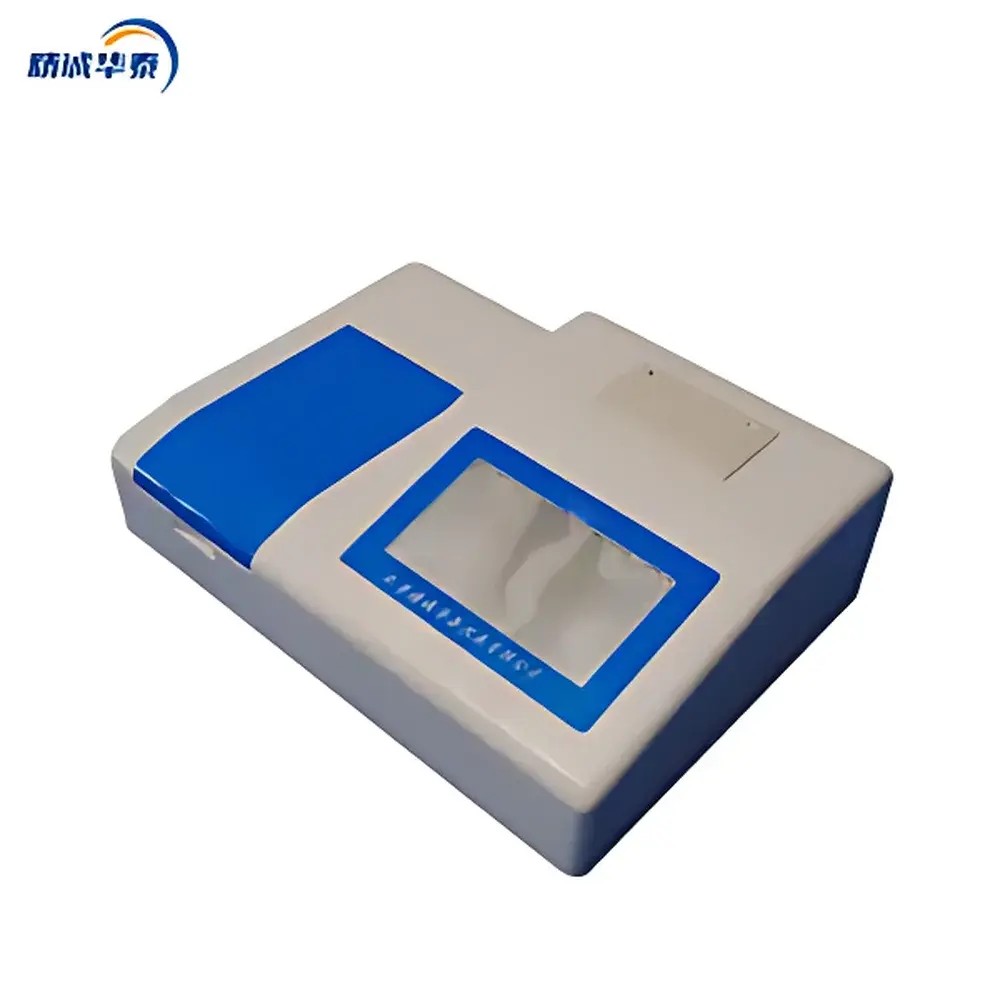
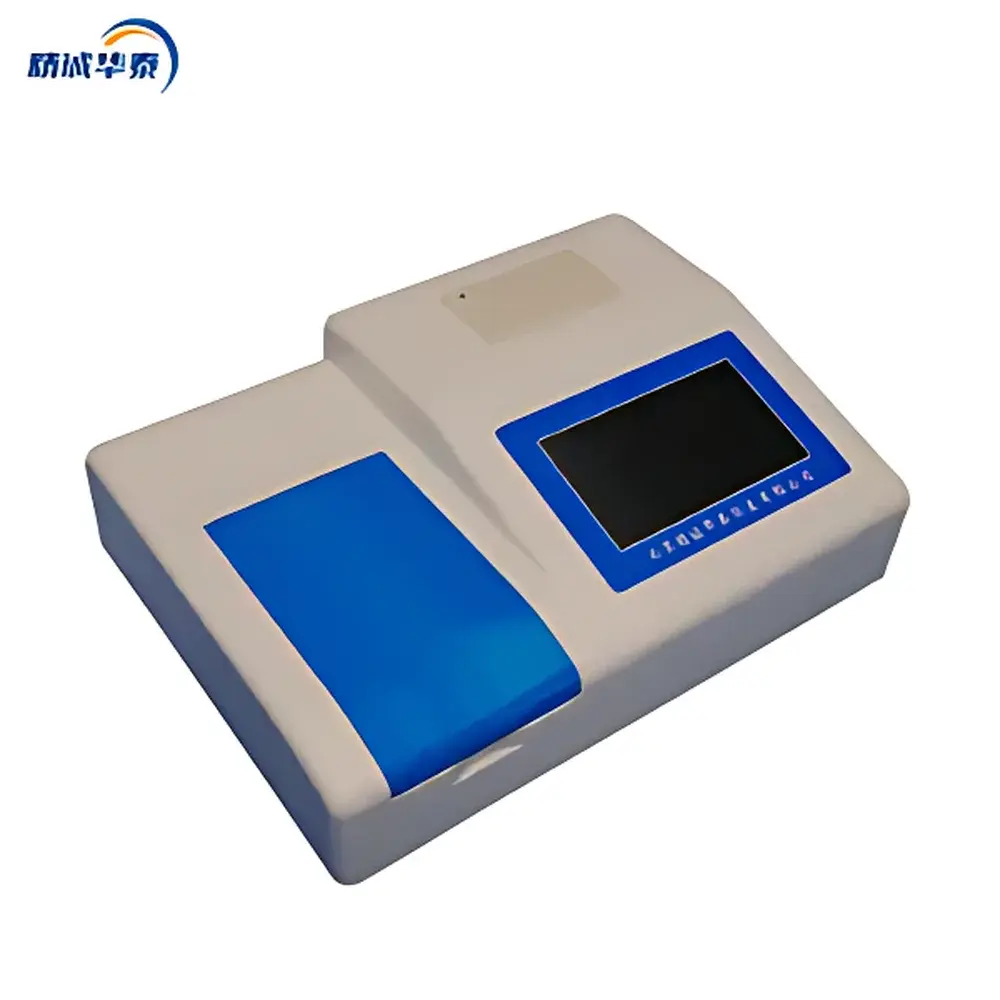
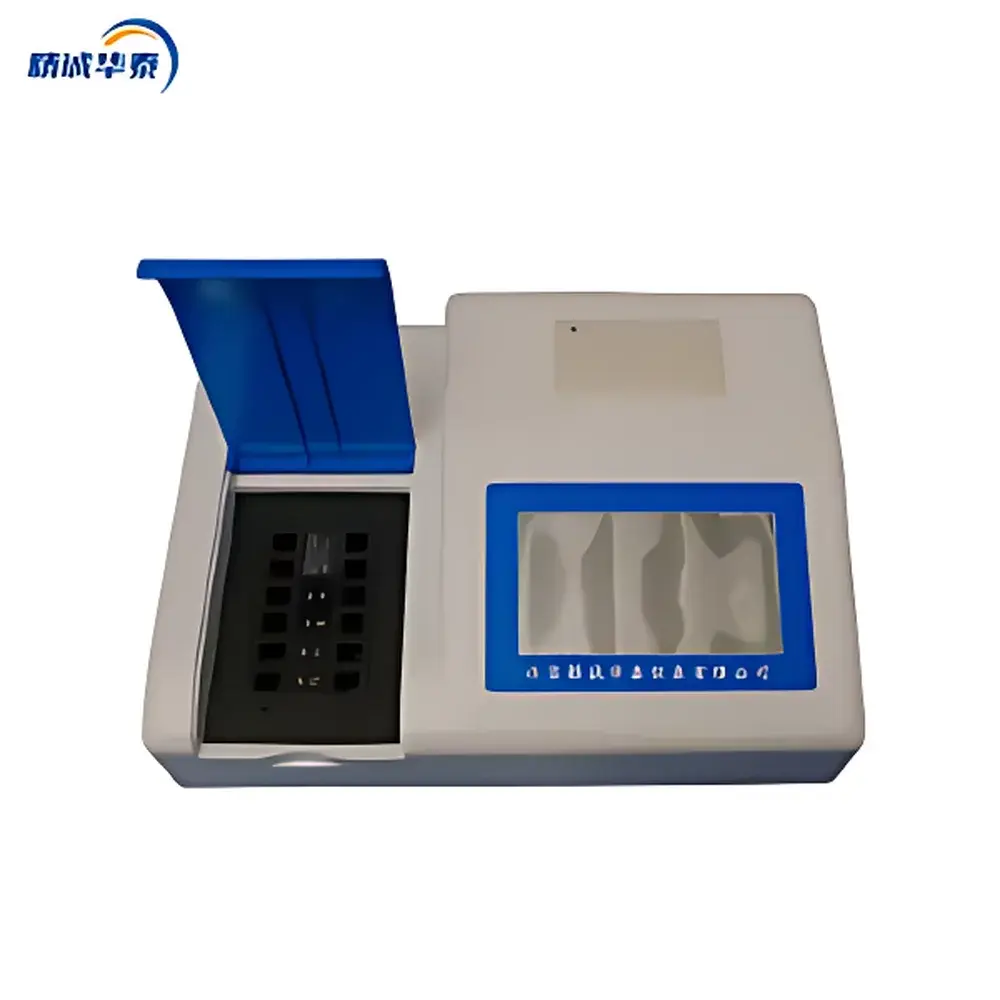
Jingcheng Huatai HT-Q12 Food Formaldehyde Detector
| Brand | Jingcheng Huatai |
|---|---|
| Origin | Beijing, China |
| Manufacturer Type | Authorized Distributor |
| Country of Origin | China |
| Model | HT-Q12 |
| Price | USD 630 (approx. based on ¥4500 @ 7.14 exchange) |
| Detection Principle | Colorimetric Spectrophotometry (412 nm) |
| Optical System | Dual-beam LED-based Photometer |
| Detection Channels | 12 independent cuvette positions |
| Display | 7-inch capacitive touch LCD with Chinese UI |
| Data Interface | USB 2.0 |
| Power Supply | DC 12 V with rechargeable 2 A Li-ion battery pack |
| Wavelength Accuracy | ±1.5 nm |
| Absorbance Range | 0–3.0 Abs |
| Absorbance Repeatability | ≤0.005 Abs |
| Baseline Drift | ≤0.005 Abs / 3 min |
| Transmittance Accuracy | ±1.5% |
| Transmittance Repeatability | ≤0.005% |
| Sample Identification | Built-in database of >100 food matrix names (editable) |
| Calibration | User-accessible recalibration, factory reset, and zero-point auto-adjustment |
| Security | Password-protected operator access control |
| Thermal Management | Passive heat dissipation |
| Compliance | Designed per GB/T 5009.49–2003 (Chinese Standard for Formaldehyde in Foods), aligned with AOAC Official Method 2005.09 principles for spectrophotometric formaldehyde quantification |
Overview
The Jingcheng Huatai HT-Q12 Food Formaldehyde Detector is a dedicated benchtop spectrophotometric analyzer engineered for rapid, on-site quantification of formaldehyde residues in food matrices. It operates on the principle of acetylacetone-based colorimetric reaction (Hantzsch condensation), where formaldehyde reacts with acetylacetone and ammonium acetate under controlled heating to form a yellow chromophore (3,5-diacetyl-1,4-dihydrolutidine) with peak absorbance at 412 nm. The instrument employs a dual-beam optical architecture using high-stability, narrow-bandwidth (FWHM < 5 nm) imported LEDs as light sources, enabling precise transmittance/absorbance measurement across a dynamic range of 0–3.0 Abs. Its 12-channel independent detection system allows concurrent analysis of up to twelve samples without cross-contamination or optical crosstalk—critical for high-throughput screening in food safety laboratories, regulatory inspection units, and production QA/QC environments.
Key Features
- Twelve independently controlled sample channels with individual photometric readout and programmable incubation timing per position.
- 32-bit embedded microcontroller ensuring deterministic real-time data acquisition, thermal drift compensation, and low-latency response during kinetic assays.
- 7-inch capacitive touchscreen interface with localized Chinese firmware; supports intuitive navigation, method selection, and result visualization without external peripherals.
- Integrated thermal-stable LED light source array (412 nm ±1.5 nm) with per-channel intensity modulation—unused channels may be deactivated to reduce power consumption and thermal load.
- USB 2.0 host/device interface enabling bidirectional data transfer: instrument-to-PC export of raw absorbance values, calibration logs, and QC reports; PC-to-instrument firmware updates and method uploads.
- Onboard self-diagnostic suite including automatic dark-current correction, zero-point validation, repeatability verification (CV ≤5% at mid-range concentration), and baseline stability monitoring over 3-minute intervals.
- Built-in security framework with role-based access control: configurable operator accounts, password enforcement, and audit trail logging for GLP-compliant operation.
Sample Compatibility & Compliance
The HT-Q12 is validated for use with liquid extracts prepared from common food categories including aquatic products (e.g., squid, shrimp), tofu, rice noodles, dried mushrooms, and starch-based processed foods—following standardized extraction protocols per GB/T 5009.49–2003. Each channel accommodates standard 10 mm pathlength cuvettes (glass or disposable plastic). Instrument design conforms to electromagnetic compatibility requirements outlined in GB/T 18268.1–2010 (IEC 61326-1) and electrical safety standards per GB 4793.1–2007 (IEC 61010-1). While not FDA 21 CFR Part 11-certified out-of-box, its data export functionality supports traceable CSV/Excel reporting compatible with laboratory information management systems (LIMS) used in ISO/IEC 17025-accredited food testing facilities.
Software & Data Management
Data handling is implemented via embedded firmware with non-volatile memory storing ≥5,000 test records, including timestamp, operator ID, sample name (selected from editable 100+ entry database), raw absorbance, calculated concentration (mg/kg), and pass/fail flag against user-defined thresholds. Results are exportable in comma-separated format (.csv) via USB mass storage mode. Optional PC software (Windows 7–11 compatible) provides advanced post-processing: calibration curve fitting (linear, quadratic, or 4-parameter logistic), statistical summary (mean, SD, CV%), trend analysis across batches, and customizable report generation compliant with internal QA documentation requirements.
Applications
- Routine surveillance testing in municipal food and drug administration (FDA-equivalent) field laboratories.
- In-process quality assurance at seafood processing plants, bean curd manufacturers, and noodle production lines.
- Third-party certification labs performing contract testing for HACCP and ISO 22000 compliance audits.
- University food science departments conducting method validation studies or student training in analytical food chemistry.
- Market supervision agencies executing random sampling programs targeting informal food vendors and wet markets.
FAQ
What extraction method is recommended prior to analysis with the HT-Q12?
Standard aqueous extraction with phosphate buffer (pH 6.5) followed by distillation or direct derivatization is advised per GB/T 5009.49–2003. Validation data confirms recovery rates of 92–105% for spiked samples across representative food types.
Can the instrument be calibrated using NIST-traceable formaldehyde standards?
Yes—calibration solutions prepared from certified reference materials (e.g., AccuStandard F-101-M or Sigma-Aldrich 372536) are fully supported. The system accepts multi-point calibration curves with up to six concentration levels.
Is remote firmware update capability available?
Firmware upgrades require local USB connection and authenticated operator credentials. Over-the-air (OTA) updates are not implemented due to regulatory constraints on unverified code execution in safety-critical instrumentation.
Does the HT-Q12 support quantitative analysis of other aldehydes besides formaldehyde?
No—the assay chemistry and optical filter set are specifically optimized for formaldehyde. Cross-reactivity with acetaldehyde or furfural is negligible (<2%) under recommended reaction conditions.
What is the expected service life of the LED light source?
Rated operational lifetime exceeds 50,000 hours at nominal drive current. No periodic lamp replacement is required during normal usage over a 7–10 year service interval.







