
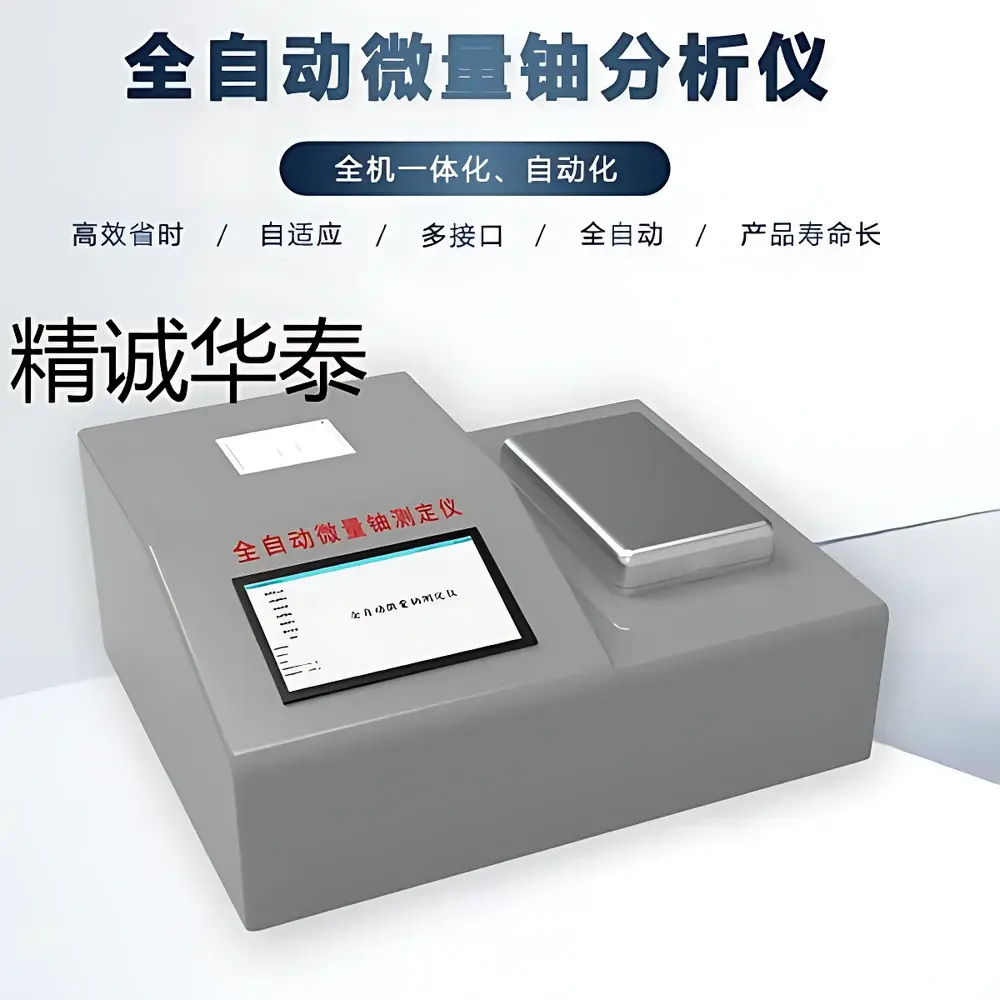
Jingcheng Huatai HT-WY Laser-Induced Fluorescence Uranium Trace Analyzer
| Brand | Jingcheng Huatai |
|---|---|
| Origin | Beijing, China |
| Manufacturer Type | Authorized Distributor |
| Country of Origin | China |
| Model | HT-WY |
| Pricing | Upon Request |
| Detection Limit | ≤0.01 ng/mL (3σ definition) |
| Uranium Measurement Range | 0–20 ng/mL (extendable to 100 ng/mL via dilution) |
| Linearity Coefficient | ≥0.9995 |
| Precision (RSD) | ≤5% |
| Stability (8-h RSD at 2 ng/mL) | ≤7% after 1-h warm-up |
| Data Storage Capacity | 4,000 data points |
| Interface | USB 2.0, 100Base-T4 Ethernet |
| Printer | Integrated thermal printer (57 mm × 40 mm paper) |
| Power Supply | 220 V ±10%, 50 Hz |
| Net Weight | 15 kg |
Overview
The Jingcheng Huatai HT-WY Laser-Induced Fluorescence Uranium Trace Analyzer is a benchtop analytical instrument engineered for quantitative determination of uranium in aqueous environmental, nuclear fuel cycle, and geological samples. It operates on the principle of laser-induced fluorescence (LIF), where uranium(VI) ions—complexed with a proprietary fluorogenic enhancer—are selectively excited by a stable pulsed ultraviolet light source (peak emission ~337 nm), and the resulting characteristic fluorescence emission (centered near 500 nm) is detected with high signal-to-noise ratio. This method delivers exceptional selectivity for uranium in the presence of common interferents (e.g., thorium, rare earth elements, iron), eliminating the need for extensive chemical separation prior to analysis. Designed for compliance with ISO/IEC 17025 laboratory quality requirements, the HT-WY supports trace-level uranium quantification in regulatory monitoring programs—including those aligned with IAEA Safety Standards Series No. RS-G-1.7 and EPA Method 908.0—and is routinely deployed in nuclear facility effluent surveillance, groundwater assessment, and uranium exploration geochemistry.
Key Features
- Integrated solid-state UV excitation source with ≥5-year operational lifetime and stable pulse output; no lamp alignment or periodic replacement required.
- Onboard microprocessor-controlled sample agitation system eliminates external shakers, ensuring reproducible homogenization prior to fluorescence measurement.
- Auto-ranging detection algorithm dynamically selects optimal gain and integration time based on sample uranium concentration, maintaining linearity across 0–20 ng/mL without manual range switching.
- 7-inch capacitive touchscreen interface with bilingual (English/Chinese) firmware navigation; all calibration, measurement, and data export workflows guided by contextual prompts.
- Dual quantification modes: standard addition and calibration curve methods, both supported by real-time linear regression (y = mx + b) calculation and statistical validation (r² ≥ 0.9995).
- Embedded thermal printer (57 mm roll) provides immediate hardcopy output of results, including sample ID, date/time stamp, concentration, RSD, and calibration parameters.
- Comprehensive connectivity: USB 2.0 host port for flash drive data export; 100Base-T4 Ethernet interface enables direct integration into LAN-based LIMS or centralized data acquisition systems.
Sample Compatibility & Compliance
The HT-WY accepts liquid samples directly—such as filtered groundwater, acid-digested soil leachates, or spent nuclear fuel process streams—provided uranium is present as soluble U(VI) species. Solid matrices require minimal pretreatment: digestion with HNO₃/HF (or HNO₃/H₂O₂ for organic-rich samples), followed by pH adjustment to 2.5–3.5 and complexation with supplied uranium fluorescence enhancer. The analyzer meets performance criteria referenced in ASTM D5056-22 (Standard Test Method for Uranium in Water by Laser Fluorimetry) and supports audit-ready operation under GLP and GMP frameworks. All measurement records include embedded metadata (operator ID, instrument serial number, calibration timestamp, detector HV setting), satisfying FDA 21 CFR Part 11 requirements for electronic record integrity when paired with validated networked software.
Software & Data Management
Data acquisition, processing, and archiving are managed by the onboard ARM Cortex-M7 microcontroller running a deterministic real-time OS. Each measurement session generates a structured ASCII log file containing raw photon counts, background-subtracted net fluorescence intensity, calculated concentration, RSD, and regression statistics. Up to 4,000 complete assay records—including full calibration history—are retained in non-volatile memory. Export options include CSV via USB mass storage mode or TCP/IP socket transmission to designated server IP addresses. Optional PC-based desktop software (HT-WY Data Manager v3.x) provides advanced features: multi-instrument fleet monitoring, automated report generation compliant with ISO 14001 environmental audit templates, and trend analysis of long-term QA/QC control sample performance.
Applications
- Environmental monitoring of uranium contamination in drinking water sources and aquifer systems per WHO guideline values (30 µg/L) and national regulatory thresholds.
- Routine analysis of uranium concentration in nuclear fuel fabrication plant coolant loops, reprocessing facility effluents, and radioactive waste treatment streams.
- Geochemical prospecting support: rapid field-laboratory screening of rock leachates and drill core solutions during uranium deposit evaluation.
- Research applications in actinide speciation studies, uranium sorption/desorption kinetics, and development of novel extraction ligands—where sub-ng/mL sensitivity and low matrix interference are critical.
- Verification of uranium removal efficiency in ion exchange, reverse osmosis, and adsorption-based remediation technologies.
FAQ
What sample volume is required for analysis?
A minimum of 2.0 mL of clarified liquid sample is recommended; smaller volumes (≥0.5 mL) may be used with reduced precision due to pipetting uncertainty.
Is acid digestion mandatory for solid samples?
Yes—complete dissolution of uranium-bearing mineral phases (e.g., uraninite, coffinite) requires oxidative acid digestion; microwave-assisted HNO₃/HF protocols are validated for this instrument.
Can the HT-WY distinguish between U(IV) and U(VI)?
No—the method detects only fluorescent U(VI)-enhancer complexes; U(IV) must first be quantitatively oxidized to U(VI) using KMnO₄ or Ce(IV) prior to analysis.
How often does the UV source require recalibration?
The pulsed UV source is factory-calibrated and requires no user recalibration; annual verification of pulse energy stability using the built-in photodiode monitor is recommended.
Is the thermal printer compatible with standard label stock?
The integrated printer accepts only 57 mm wide thermal paper rolls (40 mm core diameter); adhesive-backed labels are not supported due to thermal head clearance constraints.







