
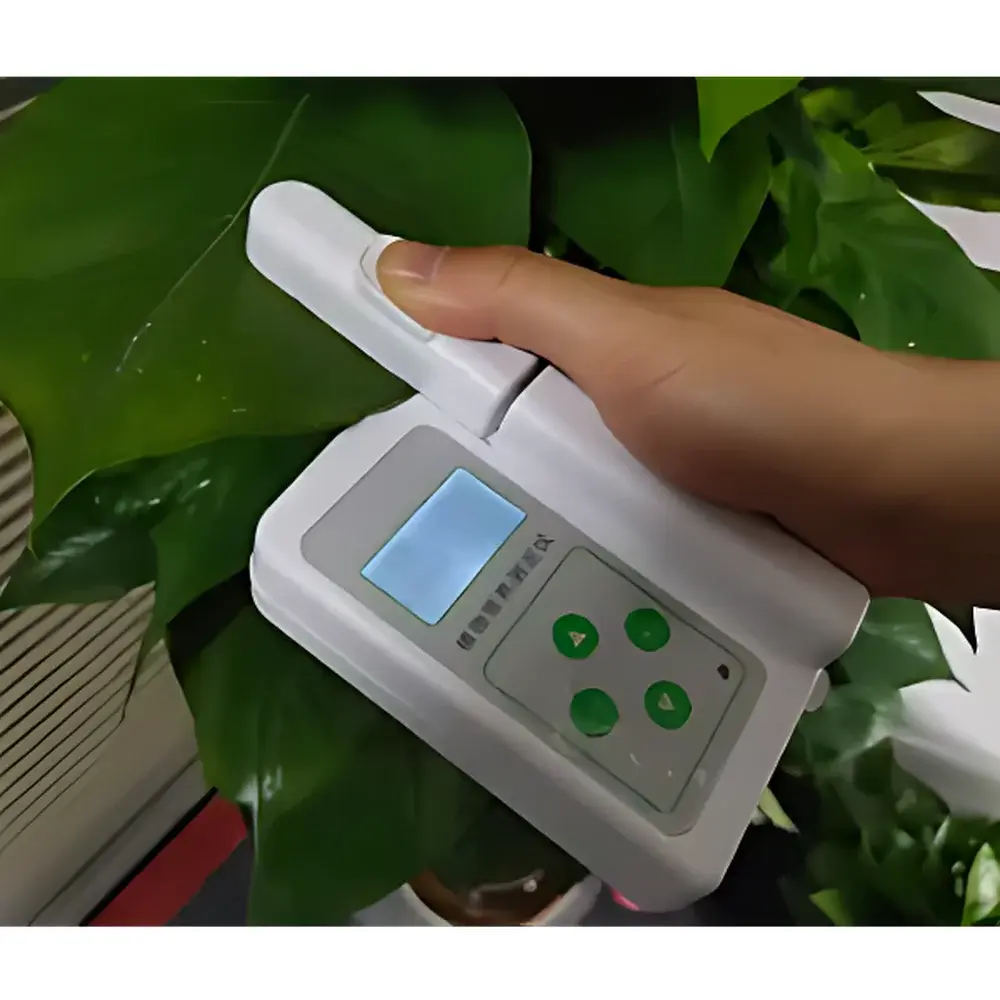
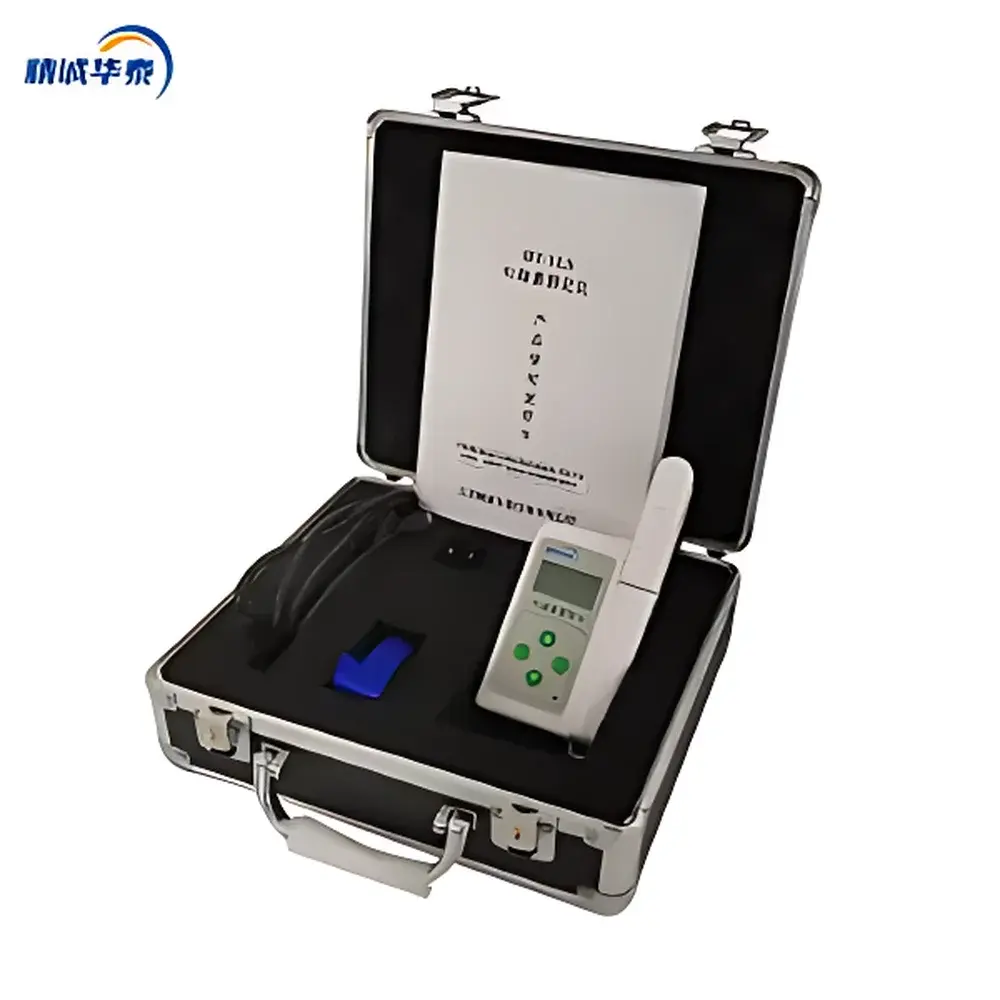
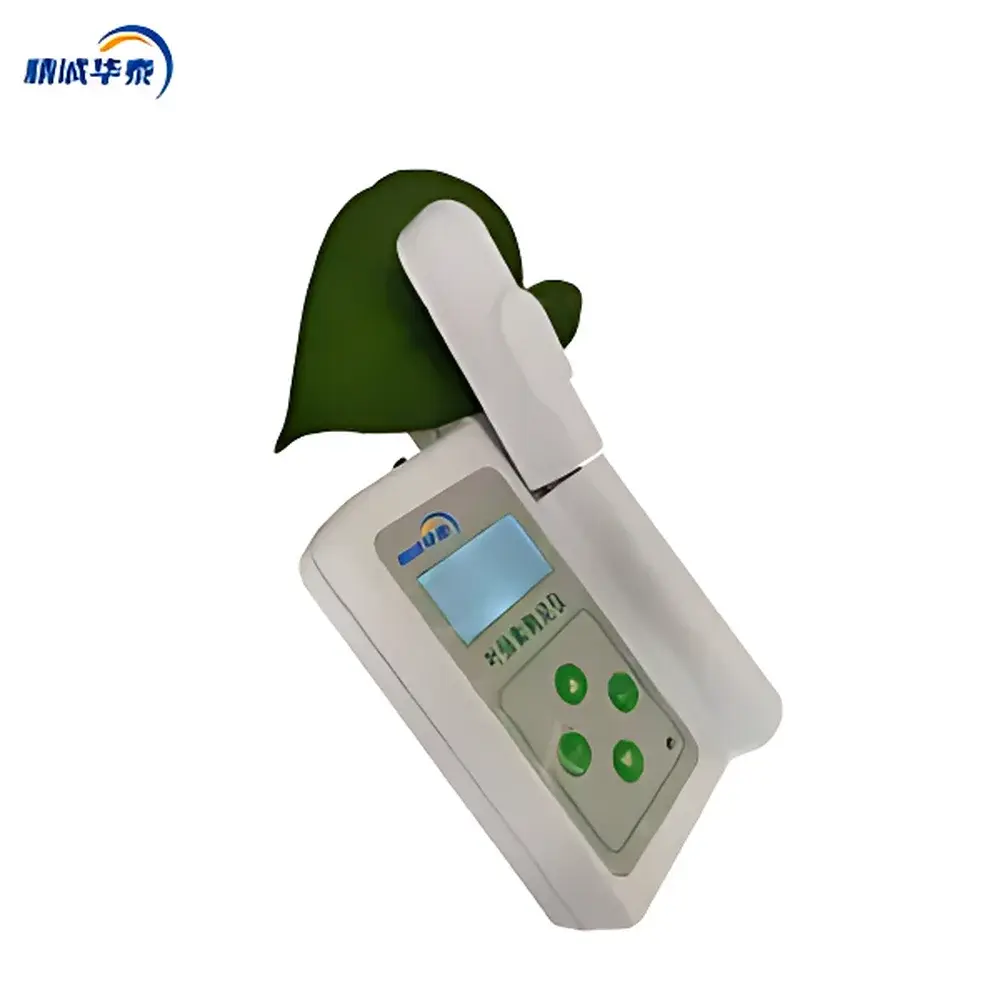
Jingcheng Huatai HT-YL4 Portable Chlorophyll & Plant Nutrient Analyzer
| Brand | Jingcheng Huatai |
|---|---|
| Origin | Beijing, China |
| Manufacturer Type | Authorized Distributor |
| Regional Classification | Domestic (China) |
| Model | HT-YL4 |
| Price | USD 780 (FOB) |
| Measurement Principle | Dual-wavelength optical absorption (650 nm & 940 nm) for SPAD-based chlorophyll estimation |
| Display | Backlit Chinese LCD (2.8″, 320×240) |
| Dimensions | 165 × 78 × 42 mm |
| Weight | 200 g |
| Power | Rechargeable 4.2 V Li-ion battery (2000 mAh) |
| Operating Temp. | –10 °C to +50 °C |
| Storage Humidity | ≤85% RH |
| Data Storage | 32 KB internal memory |
| Interface | USB 2.0 for PC data export |
| Measurement Area | 2 mm × 2 mm |
| Response Time | <3 s per reading |
Overview
The Jingcheng Huatai HT-YL4 Portable Chlorophyll & Plant Nutrient Analyzer is an integrated field-deployable instrument engineered for rapid, non-destructive assessment of key physiological parameters in living plant leaves. It operates on the established principle of dual-wavelength optical absorption—specifically at 650 nm (chlorophyll absorption peak) and 940 nm (reference wavelength minimally affected by chlorophyll)—to compute the Soil-Plant Analysis Development (SPAD) index, a widely accepted proxy for relative chlorophyll content. In addition to SPAD, the HT-YL4 simultaneously estimates leaf nitrogen concentration (mg/g dry weight equivalent), leaf surface temperature (°C), and leaf surface relative humidity (%RH) using calibrated solid-state sensors. This multi-parameter capability supports precision agriculture workflows, enabling real-time evaluation of nitrogen status, water-use efficiency, and photosynthetic potential without tissue extraction or laboratory processing. Designed for use in greenhouse trials, field phenotyping, agronomic extension services, and undergraduate plant physiology labs, the device delivers field-ready performance with laboratory-grade repeatability under variable ambient conditions.
Key Features
- Simultaneous measurement of four core plant physiological metrics: SPAD (0.0–99.9), nitrogen content (0.0–99.9 mg/g), leaf surface temperature (–10.0–99.9 °C), and leaf surface humidity (0.0–99.9 %RH)
- High-stability LED optical source with dual-band emission (650 nm / 940 nm) and automatic drift compensation via built-in calibration routine
- Compact ergonomic housing (165 × 78 × 42 mm) with single-hand operation design and IP54-rated enclosure for dust and splash resistance
- Backlit 2.8-inch Chinese-language LCD (320 × 240 resolution) supporting concurrent display of all measured parameters and status indicators
- On-device data logging with 32 KB internal memory—capable of storing >10,000 timestamped readings with full parameter sets
- USB 2.0 interface for direct connection to Windows-based PCs; compatible with included HT-DataView software for post-acquisition analysis
- Rechargeable 4.2 V Li-ion battery (2000 mAh) providing ≥8 hours of continuous operation under typical field usage
Sample Compatibility & Compliance
The HT-YL4 is validated for use on intact, fully expanded leaves of dicotyledonous and monocotyledonous species—including but not limited to maize, wheat, rice, soybean, tomato, lettuce, and Arabidopsis thaliana. Measurements require a minimum leaf thickness of 0.15 mm and are optimized for leaf lamina regions free of major veins, epidermal wax accumulation, or surface moisture films. While the SPAD algorithm follows the empirical calibration framework defined in Minolta’s original SPAD-502 methodology (and referenced in ISO 10212:2019 Annex B), the HT-YL4 does not claim formal ISO/IEC 17025 accreditation. It complies with China’s JJF 1402–2013 verification regulation for portable chlorophyll meters and meets CE EMC Directive 2014/30/EU for electromagnetic compatibility. The device is intended for research, educational, and advisory applications—not for regulatory submission under FDA 21 CFR Part 11 or EU Annex 11 without supplementary validation by the end user.
Software & Data Management
The HT-YL4 interfaces exclusively with the proprietary HT-DataView desktop application (Windows 10/11, 64-bit), which provides full traceability of measurement metadata including date/time stamp, GPS coordinates (if connected via external Bluetooth module), operator ID, and instrument serial number. Within HT-DataView, users can generate time-series plots for any parameter, overlay multiple datasets, calculate descriptive statistics (mean, min, max, SD), and export CSV or PDF reports compliant with GLP documentation standards. All curve plots support interactive data point interrogation: hovering over a coordinate displays exact acquisition timestamp and raw sensor values. Audit trails are preserved locally in encrypted binary logs; no cloud upload or remote telemetry is enabled by default. Data integrity is maintained through cyclic redundancy check (CRC-16) validation during USB transfer.
Applications
- Nitrogen use efficiency (NUE) monitoring across crop growth stages to optimize top-dressing schedules and reduce fertilizer input
- Early detection of abiotic stress—including drought, heat, and cold—via divergence in SPAD–temperature–humidity correlation patterns
- Phenotypic screening of germplasm collections for chlorophyll retention traits under controlled-environment or field trials
- Validation of canopy reflectance models (e.g., NDVI, PRI) using ground-truth SPAD and microclimate measurements
- Undergraduate teaching modules on plant-water relations, nutrient physiology, and optical sensing fundamentals
- Extension service support for smallholder farmers conducting on-farm nutrient diagnostics
FAQ
What is the physical measurement basis for SPAD estimation on the HT-YL4?
The device uses transmittance-based dual-wavelength photometry at 650 nm (chlorophyll-a absorption band) and 940 nm (near-infrared reference). SPAD is calculated as log₁₀(I₉₄₀/I₆₅₀) × k, where k is a factory-determined scaling factor derived from empirical regression against destructive Kjeldahl nitrogen assays.
Can the HT-YL4 be used on conifer needles or mosses?
No. The 2 mm × 2 mm aperture and optical path geometry are optimized for broadleaf morphology. Needle-like or highly heterogeneous surfaces yield unreliable SPAD due to scattering artifacts and incomplete light capture.
Does the instrument require daily recalibration?
A one-point zero calibration using the supplied opaque cap is recommended before each field session. Full two-point calibration (zero + reference tile) is required only after firmware updates or if measurement drift exceeds ±2.0 SPAD over 10 consecutive readings.
Is the leaf temperature sensor measuring bulk leaf temperature or epidermal surface temperature?
It measures epidermal surface temperature via a contactless infrared thermopile aligned coaxially with the optical path; accuracy assumes emissivity ε ≈ 0.96, typical for hydrated green foliage.
How is nitrogen content estimated without chemical analysis?
Nitrogen concentration is derived from a multivariate regression model trained on SPAD, leaf temperature, and humidity data against destructively analyzed total N (Kjeldahl method) across 12 common crop species. The model is embedded in firmware and not user-modifiable.





