
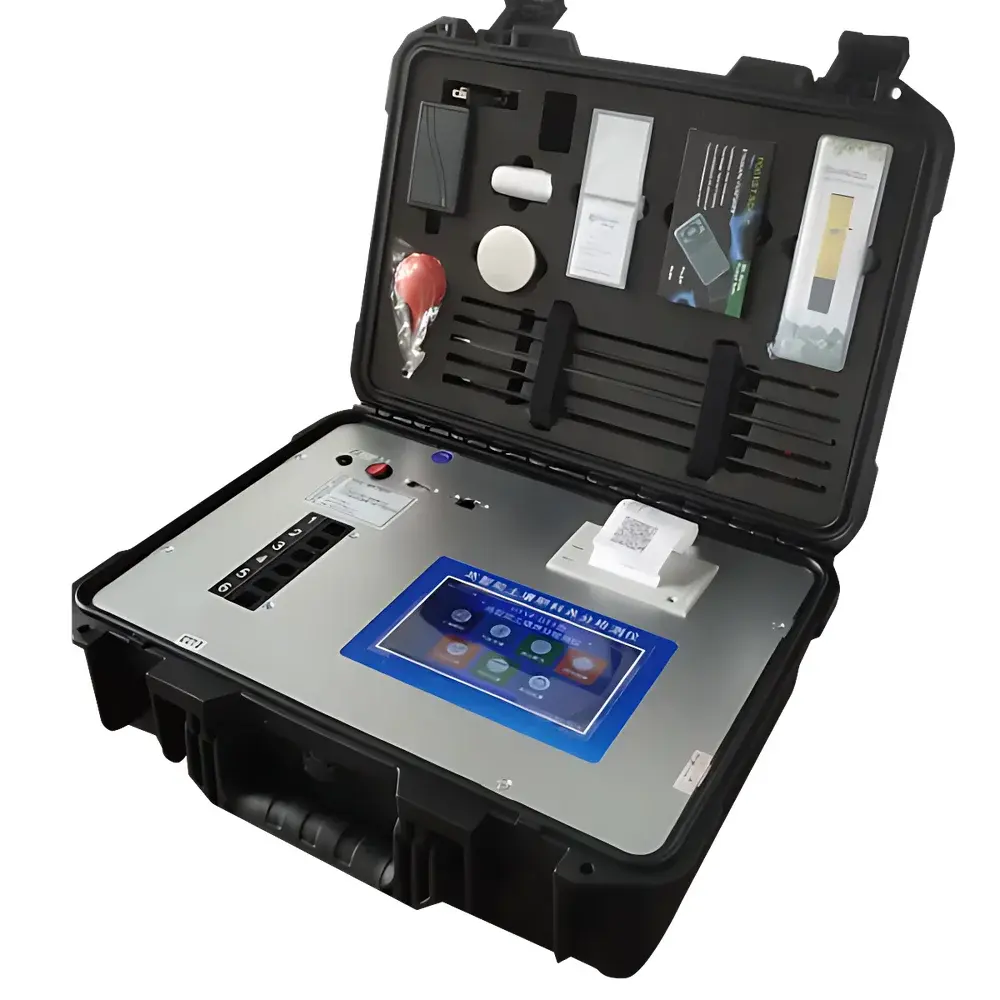
Jingcheng Huatai HTYF-DT1-A Soil Nutrient Analyzer
| Brand | Jingcheng Huatai |
|---|---|
| Origin | Beijing, China |
| Model | HTYF-DT1-A |
| Operating System | Android 8.1 |
| Display | 7-inch capacitive touchscreen |
| Detection Channels | 6 |
| Wavelength Range | 420–680 nm (±2 nm per band) |
| Optical Path | 1 cm cuvette |
| Repeatability Error | ≤0.02% (K₂Cr₂O₇ solution) |
| Stability | Drift ≤0.3% in 60 min (transmittance), ≤0.001 absorbance unit in 60 min |
| Linearity Error | ≤0.1% (CuSO₄) |
| Sensor Output | Simultaneous in-situ measurement of 33 parameters including pH, EC, moisture, temperature, CEC, and elemental concentrations (N, P, K, Ca, Mg, S, Fe, Mn, B, Zn, Cu, Cl, Si, Mo, Se, Pb, As, Cd, Cr, Hg, Ni, Al, Ti, F) |
| Power Supply | AC 220 V ±10% / DC 12 V (internal Li-ion battery) |
| Power Consumption | ≤10 W |
| Data Storage | 4 GB internal memory |
| Connectivity | USB, Ethernet, 4G LTE, Wi-Fi |
| Compliance | Designed to support ISO 11260, ISO 14253-1, ASTM D5088, and GLP-aligned data integrity workflows |
Overview
The Jingcheng Huatai HTYF-DT1-A Soil Nutrient Analyzer is a field-deployable, multi-parameter spectrophotometric and sensor-integrated analytical platform engineered for quantitative assessment of macro- and micronutrients, heavy metals, organic matter, and physicochemical soil properties. It operates on dual detection principles: (1) standardized colorimetric analysis using calibrated narrow-band LED sources (420 nm, 510 nm, 590 nm, 680 nm) and silicon photodiode detection for extract-based nutrient quantification (e.g., ammonium-N, available P, exchangeable K, organic carbon via Tyurin or extraction methods); and (2) real-time in-situ measurement via an integrated FDR (Frequency Domain Reflectometry) probe for concurrent determination of moisture, temperature, pH, electrical conductivity (EC), total dissolved solids (TDS), salinity, cation exchange capacity (CEC), and elemental ion activity profiles. The instrument conforms to the optical path geometry and repeatability requirements outlined in ISO 11260 (soil phosphorus determination) and ASTM D5088 (field screening of trace metals), while its embedded data handling architecture supports audit-ready documentation per GLP and ISO/IEC 17025 traceability frameworks.
Key Features
- Six independent optical channels with fixed-wavelength cold-light sources—each channel equipped with four precisely stabilized LEDs (420 nm, 510 nm, 590 nm, 680 nm) and thermally compensated silicon photodetectors ensuring ≥100,000-hour operational lifespan and <0.001 AU drift over 60 minutes.
- Integrated 7-inch capacitive touchscreen running Android 8.1 OS with quad-core CPU (≥1.8 GHz), 4 GB RAM, and 4 GB onboard storage—enabling local execution of calibration routines, video-guided sample preparation protocols, and offline data processing without cloud dependency.
- Standardized 1 cm optical path cuvette holder with mechanical zero-position locking and ambient light shielding—eliminating positional error and meeting ISO 14253-1 geometric tolerance requirements for photometric reproducibility.
- Built-in thermal printer supporting direct output of compliant reports: including sample ID, test date/time, analyst ID, wavelength used, absorbance values, concentration (mg/kg or %), pass/fail interpretation per threshold criteria, and QR-coded metadata for digital traceability.
- On-device soil fertility recommendation engine compliant with FAO’s Nutrient Expert framework—accepting measured N-P-K-organic matter inputs to compute crop-specific fertilizer prescriptions across 200+ species, with extensible crop library and yield-target parameterization.
- Dual-mode power architecture: mains-powered (AC 220 V ±10%) with automatic switchover to internal Li-ion battery (DC 12 V), enabling uninterrupted operation during field transitions; power draw remains ≤10 W under full spectral acquisition and sensor polling cycles.
Sample Compatibility & Compliance
The HTYF-DT1-A accommodates standard soil extraction protocols—including Olsen, Mehlich-3, Bray-1, KCl, and Tyurin methods—for aqueous extracts derived from air-dried, sieved (<2 mm) samples. Solid-phase direct sensing is performed via a stainless-steel FDR probe rated IP68, suitable for mineral, loam, and clay-textured soils across pH 3.5–9.0 and EC up to 12 dS/m. All colorimetric assays align with national standard methodologies (NY/T 1121 series, GB/T 22923–2008), and the system’s data logging structure includes mandatory fields for analyst signature, calibration timestamp, reagent lot number, and instrument serial ID—supporting regulatory readiness for USDA NRCS, EPA Region 3 soil screening programs, and ISO/IEC 17025-accredited laboratories conducting environmental soil testing.
Software & Data Management
Data acquisition, calibration management, and reporting are governed by a proprietary Android application designed for interoperability with LIMS environments. Each measurement event generates a structured JSON record containing raw absorbance, corrected concentration, sensor-derived physical parameters, GPS coordinates (via optional external module), and digital audit trail entries (user login, calibration verification, QC flag status). Wireless export supports encrypted HTTPS push to cloud repositories or local NAS via Wi-Fi/Ethernet/4G LTE. Internal database enforces role-based access control (RBAC), with optional biometric extension (fingerprint or facial recognition) to satisfy 21 CFR Part 11 electronic signature requirements where applicable. Automatic backup occurs at session close or every 15 minutes during continuous operation.
Applications
This analyzer serves as a primary tool in precision agriculture decision support systems, enabling rapid pre-planting nutrient mapping, mid-season deficiency diagnostics, post-harvest residual analysis, and fertilizer efficacy validation. It is routinely deployed by extension services for on-farm advisory work, by agrochemical manufacturers for product performance trials, by academic researchers studying nutrient cycling in controlled-environment mesocosms, and by environmental consultancies performing baseline soil characterization for brownfield redevelopment or landfill closure monitoring. Its dual-mode capability—extract-based chemistry + in-situ sensor fusion—provides orthogonal validation pathways essential for method verification under ISO 17025 Clause 7.2.2.
FAQ
Does the HTYF-DT1-A require external laboratory validation for regulatory submissions?
No—while it is not a certified reference method instrument, its adherence to ISO 11260, ASTM D5088, and NY/T 1121 protocols enables use as a screening-level device in Tier 1 assessments; confirmatory analysis by ICP-OES or AAS is recommended for regulatory reporting where statutory limits apply.
Can the built-in sensor probe be calibrated independently of the optical module?
Yes—each sensor parameter (pH, EC, moisture, temperature) features user-accessible two-point calibration routines with NIST-traceable standards; calibration coefficients are stored per probe ID and applied automatically during data reduction.
Is firmware update supported over-the-air?
Yes—updates are distributed via signed ZIP packages through the manufacturer’s secure portal; installation requires administrator credentials and triggers automatic rollback if integrity checks fail.
What is the minimum detectable concentration for cadmium in soil extract?
Based on method validation using APDC chelation and dithizone colorimetry at 590 nm, the practical quantitation limit is 0.2 mg/kg (dry weight) in 1:5 soil:water extracts, consistent with EPA Method 7062B performance criteria.
How does the instrument handle high-iron or high-organic-matter matrices that may interfere with colorimetric assays?
The software applies matrix-correction algorithms derived from empirical interference studies—users may select “high-Fe” or “high-OM” assay modes that adjust baseline compensation and wavelength weighting to minimize turbidity and complexation artifacts.







