
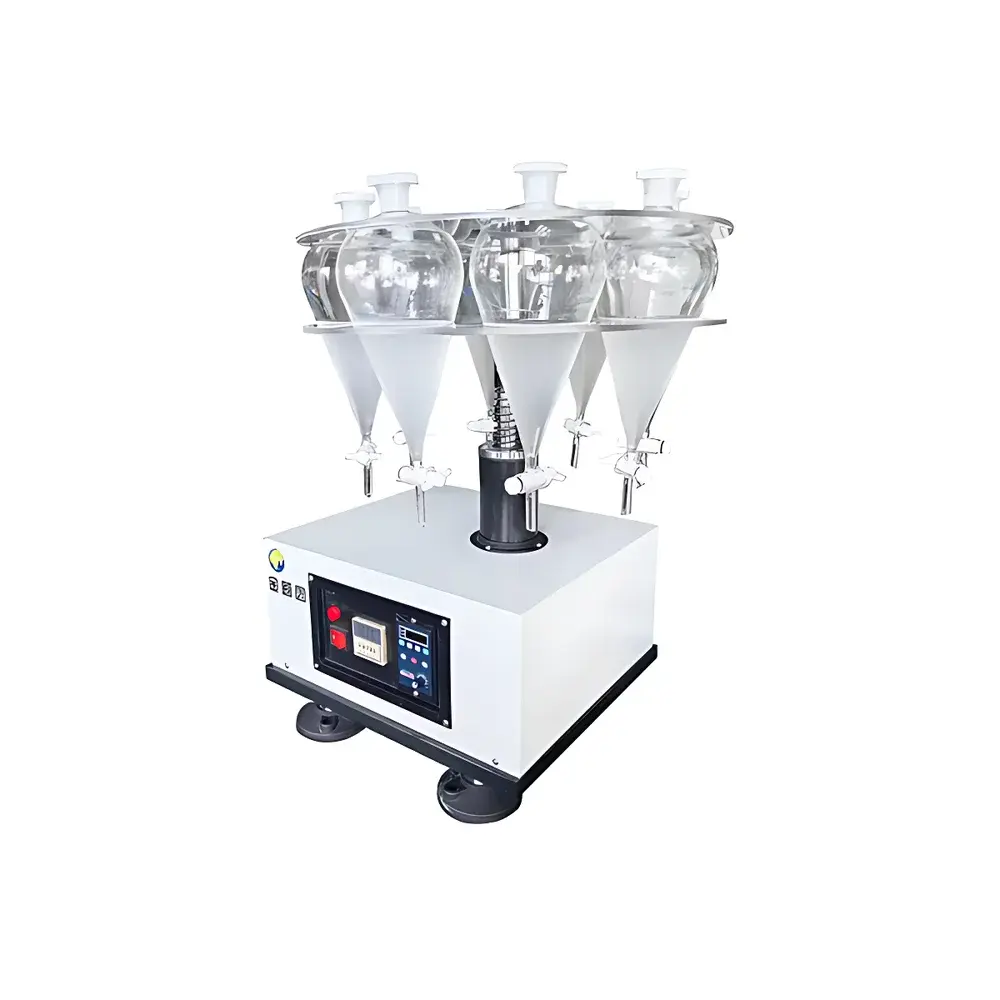
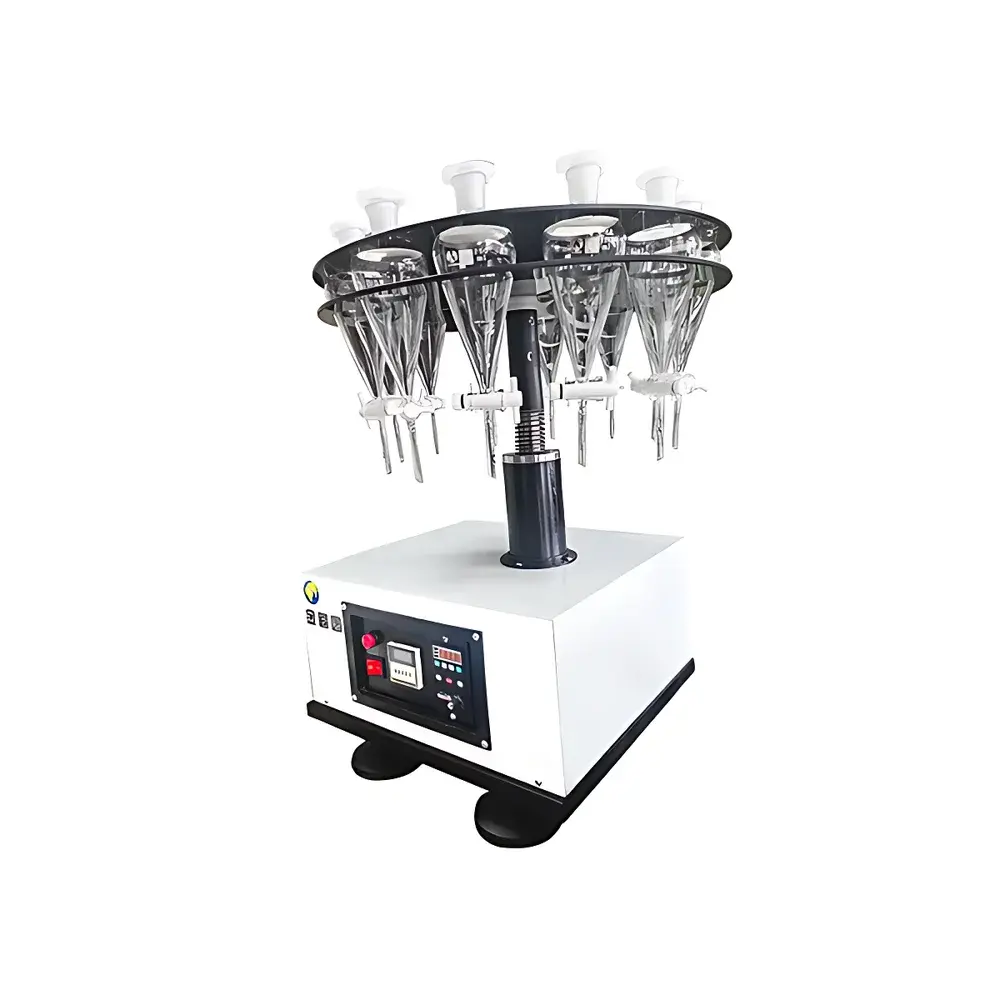
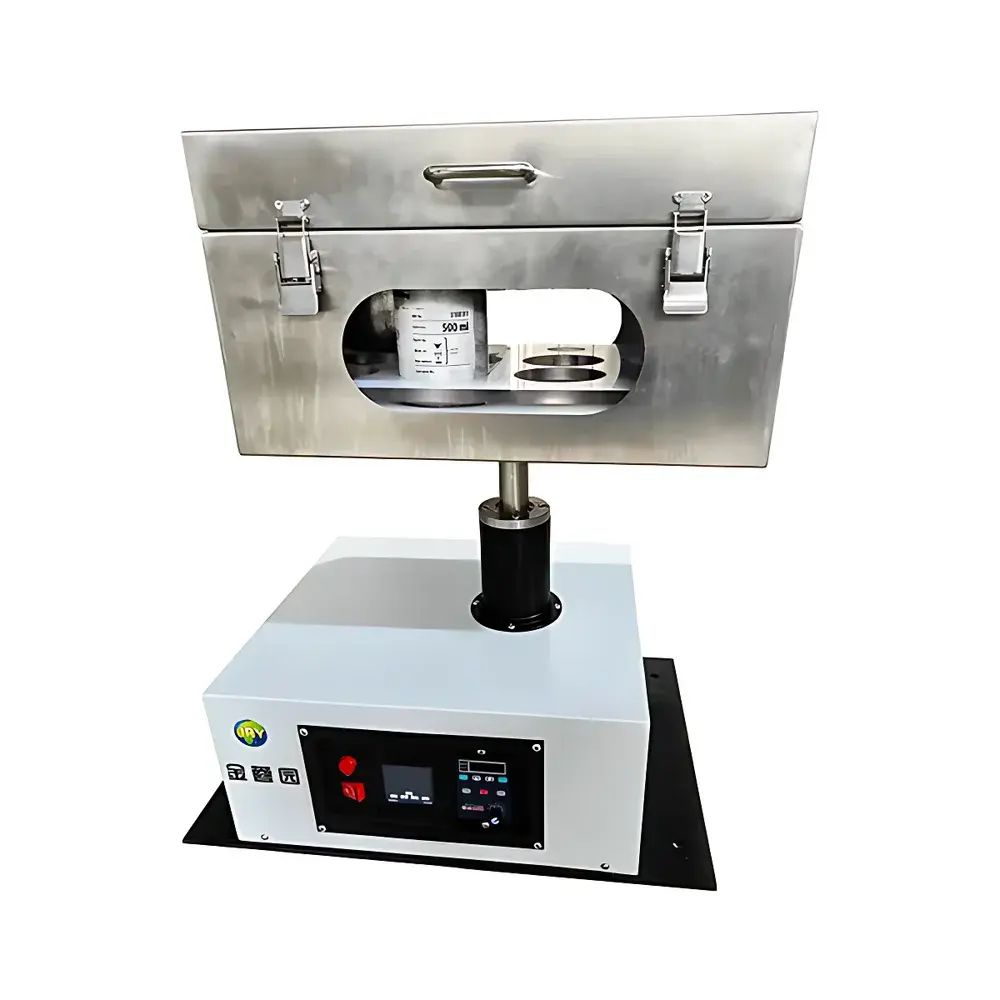
Jingrongyuan JRY-L10 Vertical Liquid-Liquid Extraction Shaker
| Brand | Jingrongyuan |
|---|---|
| Origin | Hunan, China |
| Manufacturer Type | Authorized Distributor |
| Country of Origin | China |
| Model | JRY-L10 |
| Extraction Time Range | 0–9999 min |
| Oscillation Mode | Vertical |
| Simultaneous Extraction Capacity | 10 separatory funnels |
| Oscillation Frequency | 0–350 rpm (infinitely adjustable) |
| Noise Level | <60 dB(A) |
| Oscillation Amplitude | 50 mm |
| Rated Voltage | 220 V, 50 Hz |
| Motor Power | 180 W |
| Net Weight | <30 kg |
| Construction Material | Cold-rolled steel with anti-corrosive epoxy powder coating |
| Compatible Funnel Sizes | 125 mL, 250 mL, 500 mL, 1000 mL |
Overview
The Jingrongyuan JRY-L10 Vertical Liquid-Liquid Extraction Shaker is an engineered solution for reproducible, high-throughput liquid-liquid extraction (LLE) in analytical and quality control laboratories. Based on controlled vertical reciprocating motion, the system induces consistent phase dispersion and interfacial contact between immiscible solvents—enabling efficient mass transfer of target analytes from aqueous to organic phases (or vice versa). Unlike orbital or rotary shakers, its vertical oscillation geometry minimizes emulsion formation while preserving funnel integrity during extended agitation cycles. Designed for routine compliance-driven workflows—including EPA Method 3510C, ASTM D7066, and ISO 11348-3 sample preparation—the JRY-L10 supports standardized LLE protocols required in environmental monitoring, food safety testing, pharmaceutical QC, and agrochemical residue analysis.
Key Features
- Vertical oscillation mechanism: Delivers uniform linear displacement (50 mm amplitude) at precisely adjustable frequencies (0–350 rpm), ensuring consistent kinetic energy input across all 10 mounted separatory funnels.
- Simultaneous 10-funnel capacity: Accommodates standard glass separatory funnels (125–1000 mL) on a rigid, corrosion-resistant steel platform with individual clamping fixtures—eliminating cross-contamination risk and enabling parallel processing.
- Programmable time control: Digital timer supports extraction durations from 1 minute to 9999 minutes (166.6 hours), facilitating both rapid screening and extended equilibrium-based extractions.
- Low-noise operation: Acoustic enclosure design and vibration-damped motor mounting maintain sound pressure levels below 60 dB(A) at 1 m distance—suitable for shared lab environments without acoustic isolation.
- In-situ phase separation capability: The sample rack rotates 360° manually post-extraction, allowing gravity-driven layer separation without funnel removal—reducing operator exposure and improving procedural repeatability.
- Robust industrial construction: All structural components are fabricated from cold-rolled steel and finished with electrostatically applied epoxy powder coating (film thickness ≥80 µm), providing resistance to organic solvents, acids, and alkaline reagents commonly used in LLE workflows.
Sample Compatibility & Compliance
The JRY-L10 accepts standard borosilicate glass separatory funnels conforming to ASTM E288–22 dimensional tolerances. Its mechanical design ensures secure retention of funnels with ground-glass stopcocks and PTFE sleeves, minimizing leakage under dynamic load. The device operates within ambient temperature ranges of 5–40 °C and relative humidity ≤80% non-condensing—meeting IEC 61010-1:2010 safety requirements for laboratory electrical equipment. While not certified for GLP/GMP production environments out-of-the-box, its programmable parameters, non-volatile timer memory, and stable mechanical output support audit-ready documentation when integrated into validated SOPs aligned with ISO/IEC 17025 or FDA 21 CFR Part 11-compliant data management systems.
Software & Data Management
The JRY-L10 operates via an embedded microcontroller with LED-based digital interface—no external PC or proprietary software required. All operational parameters (time, speed, and run status) are retained in non-volatile memory after power loss. For laboratories requiring electronic recordkeeping, optional RS-232 or USB-to-serial adapters enable integration with LIMS or ELN platforms via ASCII command protocol (e.g., “GET_TIME”, “SET_SPEED=220”). Timestamped run logs can be exported for traceability; however, built-in audit trail functionality requires third-party middleware compliant with ALCOA+ principles.
Applications
- Pre-concentration of trace-level pollutants (e.g., PAHs, PCBs, organochlorine pesticides) from wastewater per EPA Method 3510C.
- Extraction of fat-soluble vitamins (A, D, E, K) and lipid oxidation markers from food matrices prior to HPLC-UV or GC-MS analysis.
- Isolation of mycotoxins (aflatoxins, ochratoxin A) from cereal extracts using chloroform/methanol/water solvent systems.
- Recovery of metal chelates (e.g., dithizone complexes of Pb²⁺, Cd²⁺) in environmental soil leachates prior to AAS or ICP-OES quantification.
- Standardized sample cleanup in pesticide multiresidue methods (e.g., QuEChERS-acidified variants) where phase separation kinetics directly impact recovery accuracy.
FAQ
What types of separatory funnels are compatible with the JRY-L10?
Standard conical and pear-shaped glass separatory funnels (125 mL to 1000 mL) with ground-glass joints and PTFE stopcocks are fully supported. Plastic funnels are not recommended due to potential creep deformation under cyclic loading.
Can the JRY-L10 be used for acid digestion sample prep?
No. It is designed exclusively for liquid-liquid partitioning at ambient or mildly elevated temperatures. It does not provide heating, pressure containment, or corrosion resistance suitable for mineral acid digestion protocols.
Is calibration documentation provided with the unit?
Factory verification of timer accuracy (±0.5% over full range) and speed stability (±2 rpm at setpoint) is included in the delivery package. Full metrological calibration per ISO/IEC 17025 requires external accredited service.
Does the shaker meet CE or UL safety certification?
The JRY-L10 complies with IEC 61010-1:2010 for laboratory equipment safety. CE marking is not affixed; users must perform local conformity assessment per their national regulatory framework (e.g., UKCA, FCC, or NRCan requirements).
How is maintenance performed on the drive mechanism?
The brushless AC motor and eccentric cam assembly require no scheduled lubrication. Routine inspection includes checking clamp torque (recommended 1.8 N·m), verifying amplitude consistency with a dial indicator, and cleaning powder-coated surfaces with isopropanol-dampened lint-free cloth.



