
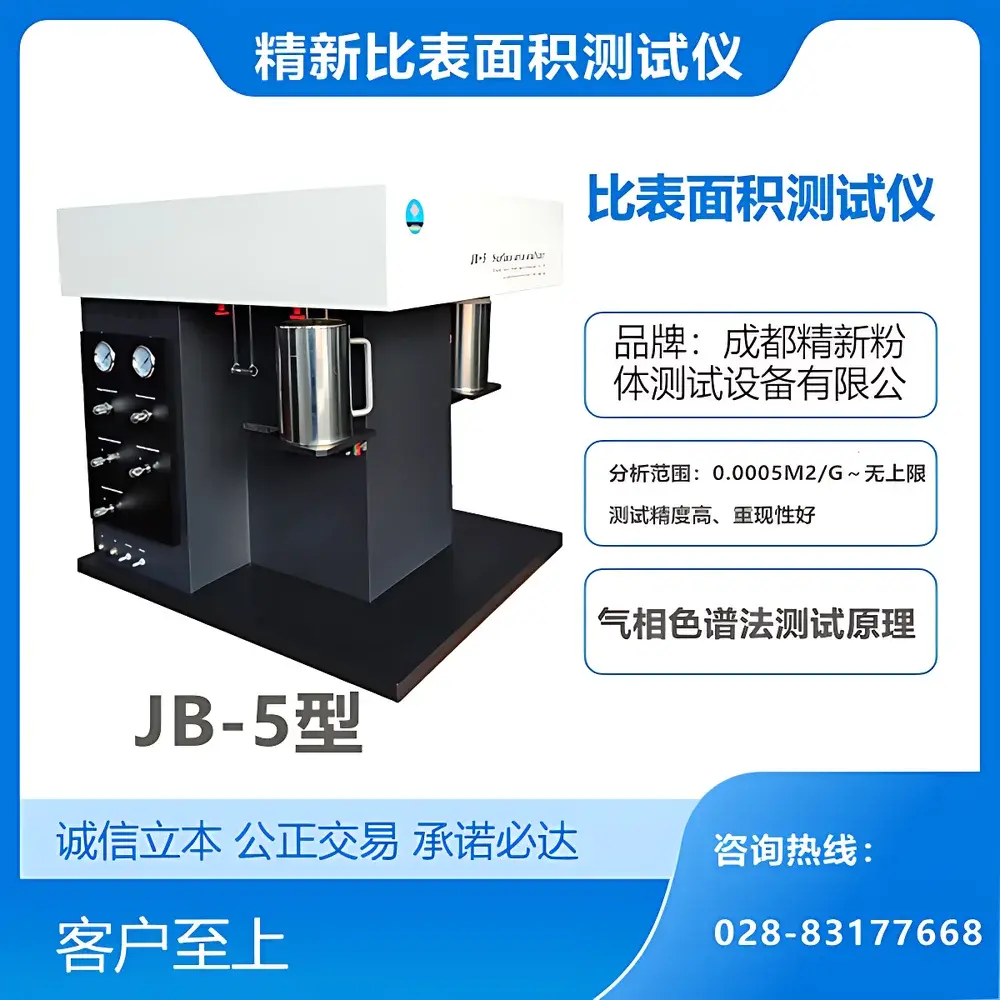
Jingxin JB-5 Dynamic Flow Specific Surface Area Analyzer
| Brand | Jingxin (Chengdu) |
|---|---|
| Origin | Sichuan, China |
| Manufacturer Type | Direct Manufacturer |
| Regional Classification | Domestic (China) |
| Model | JB-5 |
| Instrument Category | Specific Surface Area Analyzer |
| Measurement Principle | Dynamic Flow (Carrier Gas Chromatographic) Method |
| Number of Analysis Stations | 4 |
| Measurable Range | 0.0005 m²/g to unlimited |
| Repeatability | ≥99% |
| Calibration Standard | Certified Reference Materials per ISO 9277 & GB/T 19587–2004 |
| Detector Type | Low-Temperature High-Sensitivity Thermal Conductivity Detector (TCD) |
| Carrier Gas | Ultra-High-Purity Helium (≥99.999%) |
| Adsorptive Gas | Ultra-High-Purity Nitrogen (≥99.999%) |
| Sample Tube Material | Borosilicate Glass (GG-17 U-shaped) |
| Vacuum System | Integrated Dual-Stage Rotary Vane Pump |
| Dewar Capacity | 500 mL, Double-Wall Vacuum Insulated |
| Test Modes | Single-Point, Multi-Point BET, Comparative Analysis |
| Average Analysis Time per Sample | 5–7 min |
| Software Platform | Windows XP/7/10 Compatible Dedicated Acquisition & Analysis Suite |
| Power Supply | AC 220 V ±22 V, 50 Hz ±0.5 Hz |
| Dimensions (L×W×H) | 700 × 300 × 600 mm |
| Compliance | ISO 9277:2010, GB/T 19587–2004, ASTM D3037 (applicable sections) |
Overview
The Jingxin JB-5 Dynamic Flow Specific Surface Area Analyzer is an industrial-grade, multi-station surface area measurement system engineered for high-throughput quality control and R&D laboratories. It operates on the dynamic flow (carrier gas chromatographic) principle—specifically, low-temperature nitrogen adsorption under continuous helium carrier gas flow—enabling rapid, quantitative determination of specific surface area (SSA) for solid powders and granular materials. Unlike static volumetric or gravimetric methods, the JB-5 employs a real-time thermal conductivity detection (TCD) architecture to monitor nitrogen adsorption/desorption profiles as analyte gas passes over a temperature-stabilized sample bed. This method complies with internationally recognized standards including ISO 9277:2010 (“Gases — Determination of specific surface area of solids by krypton adsorption”) and its nitrogen-adapted implementation in GB/T 19587–2004 (“Determination of specific surface area of solids — Nitrogen adsorption method”). The instrument is optimized for routine analysis where speed, reproducibility, and operational robustness outweigh ultra-high-resolution pore distribution profiling.
Key Features
- Four independent analysis stations enable concurrent testing of up to four samples—ideal for batch QC in battery cathode material production, pharmaceutical excipient validation, or catalyst screening.
- Thermal conductivity detector (TCD) with cryogenically stabilized sensing element ensures long-term signal stability and immunity to carrier gas composition drift, eliminating recalibration between helium/nitrogen switching cycles.
- Precision mass-flow-controlled gas delivery system, featuring dual-stage pressure regulation and laminar flow optimization, guarantees consistent gas velocity across all stations—critical for inter-sample comparability and BET linearity.
- 500 mL vacuum-insulated Dewar flask with borosilicate glass inner liner maintains stable liquid nitrogen temperature (77 K) for >4 hours per fill, minimizing thermal fluctuation during extended unattended operation.
- U-shaped GG-17 borosilicate sample tubes provide uniform heating/cooling profiles and mechanical resilience under repeated thermal cycling and vacuum exposure.
- Dedicated Windows-based software supports full audit trail logging (user ID, timestamp, parameter set, raw TCD voltage vs. time), compliant with GLP documentation requirements and internally traceable to reference material certificates.
Sample Compatibility & Compliance
The JB-5 accommodates a broad spectrum of inorganic and organic particulates—including graphite anodes, LiCoO₂, Ni(OH)₂, LiMn₂O₄, Li₄Ti₅O₁₂, Li₂CO₃, micronized APIs, zeolitic catalysts, activated carbon, cement clinker, and ceramic precursors—without requiring degassing optimization per material class. Sample mass loading (typically 0.1–1.0 g) is empirically determined based on expected SSA and detector saturation limits. All measurements adhere to the theoretical foundation of the Brunauer–Emmett–Teller (BET) model for monolayer adsorption, with built-in validation checks for linear range (P/P₀ = 0.05–0.30) and C-constant plausibility. Instrument calibration is performed using NIST-traceable silica standard SRM 1900b or equivalent certified reference materials, ensuring measurement uncertainty ≤ ±1% (k = 2) under controlled ambient conditions (20–25 °C, RH < 60%). Full compliance documentation—including factory calibration reports, installation qualification (IQ), and operational qualification (OQ) templates—is supplied with each unit.
Software & Data Management
The proprietary acquisition and analysis suite provides real-time visualization of TCD response curves, automated baseline correction, and iterative BET slope calculation with manual override capability. Each analysis session generates a structured XML data file containing raw sensor output, processed isotherm points, BET constants, SSA result, and metadata (operator, date/time, station ID, gas lot numbers). Export options include CSV (for LIMS integration), PDF (formatted test report with header/footer branding), and image snapshots (PNG) of isotherms and linear fits. Audit trail records are immutable and timestamped to the millisecond, satisfying internal QA requirements and supporting FDA 21 CFR Part 11 readiness when deployed with validated Windows domain authentication and electronic signature workflows.
Applications
The JB-5 serves as a primary metrology tool in industries where surface area directly correlates with functional performance: lithium-ion battery cathode/anode material release testing; pharmaceutical powder flow and dissolution rate prediction; heterogeneous catalyst activity benchmarking; cement hydration kinetics modeling; and ceramic green-body sintering behavior assessment. Its 5–7 minute per-sample throughput makes it particularly suitable for production-line sampling plans requiring ≥20 tests/day, while its wide dynamic range (0.0005–∞ m²/g) eliminates re-range adjustments typical of single-point instruments. Users routinely deploy it for incoming raw material verification, in-process blend uniformity checks, and final product release against internal specifications aligned with ISO 9277–based acceptance criteria.
FAQ
What gases are required for operation, and what purity levels are mandatory?
Ultra-high-purity helium (≥99.999%) is used as the carrier gas; ultra-high-purity nitrogen (≥99.999%) serves as the adsorptive gas. Lower purities introduce hydrocarbon or oxygen interference, compromising TCD baseline stability and BET linearity.
Can the JB-5 perform pore size distribution analysis?
No. The JB-5 is designed exclusively for specific surface area quantification via dynamic flow BET. It does not support t-plot, BJH, or DFT-based pore size modeling, which require full isotherm acquisition at multiple relative pressures.
Is vacuum pretreatment integrated into the instrument?
Yes—each station includes programmable vacuum degassing (up to 10⁻² mbar) with adjustable temperature ramping (room temperature to 300 °C) and hold duration, synchronized with autosampler sequencing.
How is instrument performance verified between calibrations?
Daily system suitability is confirmed using a control sample of certified silica (e.g., SRM 1900b); deviation >±1.5% from historical mean triggers full recalibration and root-cause review.
Does the software support networked deployment or LIMS connectivity?
Yes—the application exposes RESTful API endpoints for scheduled data push to enterprise LIMS and supports configurable database write-back (ODBC/JDBC) for centralized result aggregation and trend analysis.



