
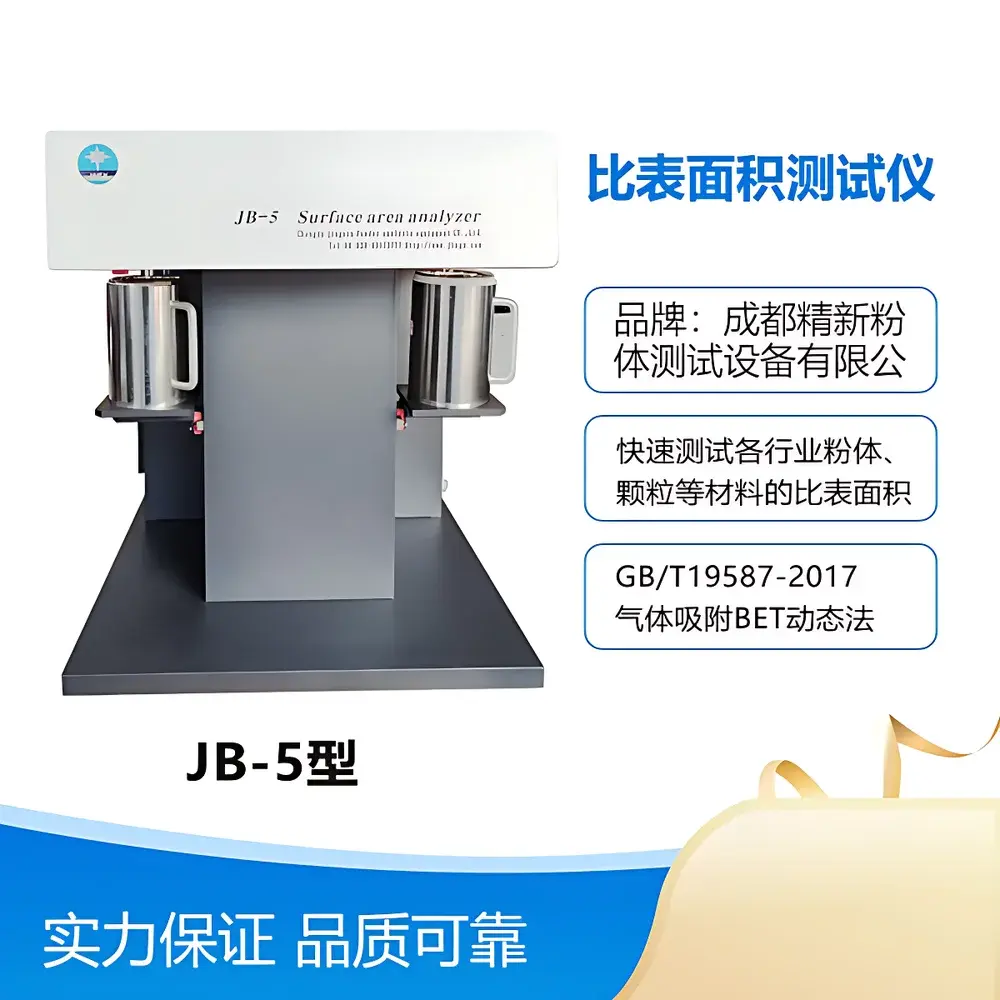
Jingxin JB-5 Multi-Station Dynamic Nitrogen Adsorption Specific Surface Area Analyzer
| Brand | Chengdu Jingxin (CDJX) |
|---|---|
| Origin | Sichuan, China |
| Manufacturer Type | Direct Manufacturer |
| Instrument Category | Domestic |
| Model | JB-5 |
| Price Range | USD 7,000–10,000 (FOB) |
| Instrument Type | Specific Surface Area Analyzer |
| Measurement Principle | Dynamic Flow Method (Low-Temperature Nitrogen Adsorption with Helium Carrier Gas) |
| Number of Analysis Stations | 4 |
| Measurable Surface Area Range | 0.0005 m²/g to unlimited |
| Repeatability | ≥99% |
| Calibration Standard | Certified Reference Materials per ISO 9277 & GB/T 19587–2004 |
| Detector Type | Low-Temperature High-Sensitivity Thermal Conductivity Detector (TCD) |
| Carrier Gas | Ultra-High-Purity Helium (≥99.999%) |
| Adsorptive Gas | Ultra-High-Purity Nitrogen (≥99.999%) |
| Sample Tube Material | GG-grade Borosilicate Glass U-Tube |
| Data Acquisition | Real-time Windows-based Software (XP/7/10 Compatible) |
| Power Supply | AC 220 V ±10%, 50 Hz ±0.5 Hz |
| Dimensions (L×W×H) | 700 × 300 × 600 mm |
| Weight | ~45 kg |
Overview
The Jingxin JB-5 Multi-Station Dynamic Nitrogen Adsorption Specific Surface Area Analyzer is an engineered solution for high-throughput surface area characterization of solid particulates and powders in industrial QC laboratories and R&D facilities. Based on the dynamic flow (or continuous-flow) nitrogen adsorption principle—standardized in ISO 9277:2010 and GB/T 19587–2004—the instrument quantifies specific surface area by measuring the amount of nitrogen gas adsorbed onto a solid sample surface at liquid nitrogen temperature (77 K), using helium as a carrier gas and nitrogen as the adsorptive probe. Unlike static volumetric methods, the dynamic approach employs real-time thermal conductivity detection (TCD) to monitor concentration changes in the effluent stream, enabling rapid, stable, and reproducible measurements without requiring high-vacuum manifolds or complex pressure transducers. The JB-5 is optimized for routine analysis across diverse material classes where batch consistency, inter-lot comparability, and regulatory traceability are essential.
Key Features
- Four independent analysis stations operating in parallel—each with dedicated TCD, flow control, and thermal management—enabling concurrent testing of up to four samples without cross-contamination or signal interference.
- High-stability dual-gas delivery system featuring precision mass flow controllers and ultra-high-purity helium (≥99.999%) and nitrogen (≥99.999%), ensuring consistent carrier-to-adsorptive gas ratios and minimizing baseline drift.
- GG-grade borosilicate U-tube sample holders rated for repeated thermal cycling between ambient and cryogenic conditions; resistant to chemical corrosion from catalysts, battery cathode materials, and pharmaceutical excipients.
- Large-capacity 500 mL vacuum-insulated Dewar flask with double-wall glass construction, providing ≥4-hour thermal stability at 77 K—critical for uninterrupted multi-sample runs.
- Low-noise, low-drift thermal conductivity detector housed in thermally stabilized enclosure; operational lifetime extended via controlled cooling and immunity to gas composition shifts.
- Integrated software platform supporting single-point, multipoint BET, and comparative surface area calculations—with built-in calibration routines using certified reference standards (e.g., NIST SRM 1990a).
Sample Compatibility & Compliance
The JB-5 accommodates powdered, granular, and pelletized solids with particle sizes ranging from submicron to several millimeters. Common applications include lithium-ion battery cathode materials (LiCoO₂, LiMn₂O₄, Li₄Ti₅O₁₂), graphite anodes, pharmaceutical APIs and excipients, heterogeneous catalysts (Pt/C, Ni/Al₂O₃), cement clinkers, ceramic precursors, activated carbons, and metal oxides. All measurement protocols align with ISO 9277:2010 (Gas adsorption — Determination of specific surface area using the BET method) and GB/T 19587–2004 (Determination of specific surface area of solids by gas adsorption). While not inherently 21 CFR Part 11 compliant out-of-the-box, audit trails, user access logs, and electronic signature support can be implemented via optional software modules meeting GLP/GMP documentation requirements.
Software & Data Management
The proprietary Windows-native acquisition and analysis suite (compatible with Windows XP, 7, and 10) provides real-time chromatogram visualization, automatic peak integration, and on-the-fly BET linear regression. Raw data—including time-resolved TCD voltage, flow rates, temperature logs, and calibration coefficients—are stored in structured binary format with metadata tagging (operator ID, sample ID, date/time stamp, instrument serial number). Export options include CSV, PDF reports, and XML for LIMS integration. Data integrity safeguards include write-protected archives, version-controlled calibration files, and configurable auto-backup intervals. Optional add-ons enable electronic signatures, role-based permissions, and change-control logging aligned with ALCOA+ principles.
Applications
- Quality control of battery electrode materials: monitoring surface area shifts during synthesis, calcination, or coating processes to correlate with electrochemical performance.
- Routine screening of catalyst supports and active phases to ensure batch-to-batch consistency in petrochemical and fine chemical manufacturing.
- Pharmaceutical solid-state characterization: evaluating surface area changes induced by milling, drying, or amorphous content—key inputs for dissolution rate modeling.
- Ceramic and refractory raw material qualification: verifying specific surface area of alumina, silica, and zirconia powders prior to sintering.
- Environmental sorbent validation: quantifying surface area of activated carbon, zeolites, and MOFs used in VOC capture or heavy metal remediation.
FAQ
What is the minimum detectable surface area for the JB-5?
The instrument achieves reliable detection down to 0.0005 m²/g, validated using low-surface-area reference materials such as fused quartz and dense sintered alumina.
Can the JB-5 perform full BET isotherms or only single-point analysis?
It supports both single-point estimation and multi-point BET analysis (typically 3–5 relative pressure points), with automated P/P₀ stepping via programmable flow modulation.
Is helium consumption high during operation?
Helium usage is optimized at ~30–50 mL/min per station under standard test conditions; total consumption for a 4-station run over 8 hours remains below 15 L.
How is instrument calibration maintained?
Calibration is performed using NIST-traceable standard reference materials (e.g., SRM 1990a) before each analytical session or daily—depending on lab SOP—and recorded with full audit trail.
Does the JB-5 require liquid nitrogen refilling during extended operation?
Yes—continuous operation beyond 4 hours typically requires manual LN₂ replenishment; however, the 500 mL Dewar volume enables unattended testing of 8–12 samples per fill under typical throughput conditions.



