
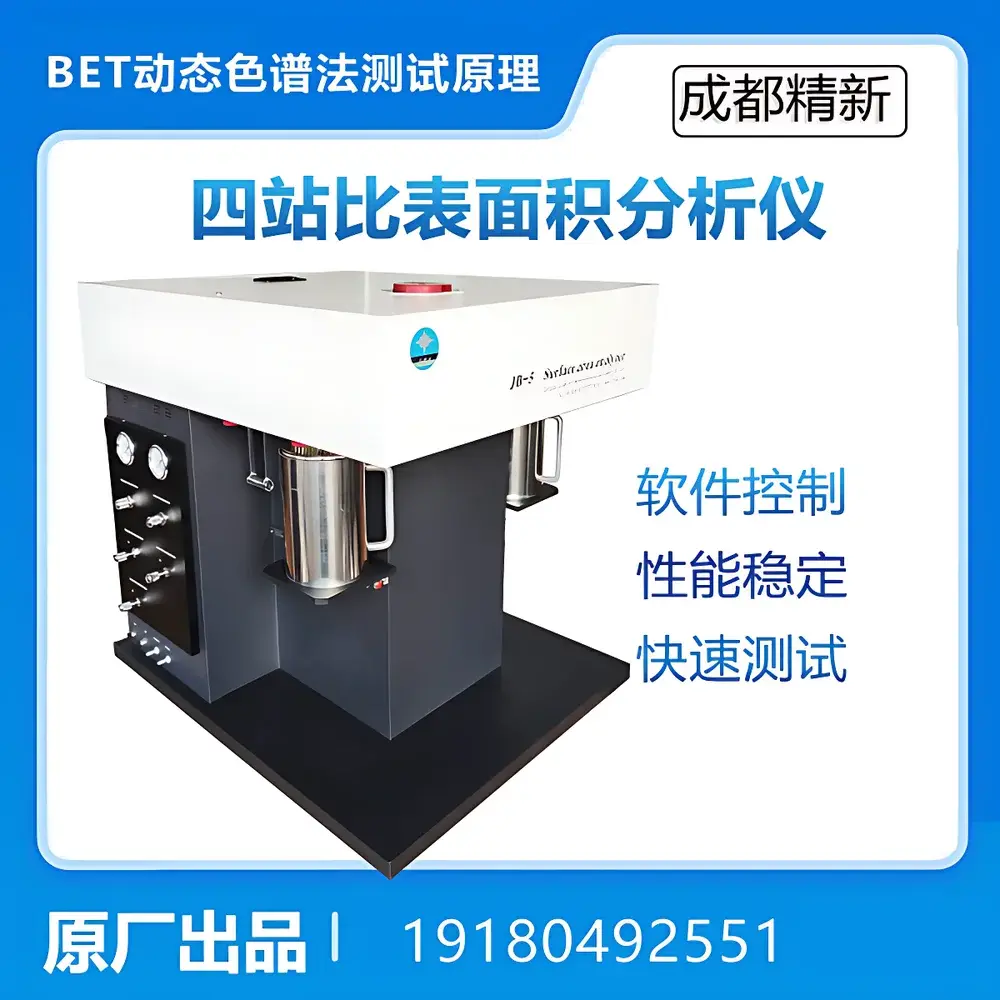
Jingxin JB5 Quad-Station Dynamic Nitrogen Adsorption Specific Surface Area Analyzer
| Brand | Jingxin (Chengdu Jingxin Instrument Co., Ltd.) |
|---|---|
| Origin | Sichuan, China |
| Manufacturer Type | Direct Manufacturer |
| Instrument Category | Domestic |
| Model | JB5 |
| Price Range | USD 7,000–10,000 (FOB) |
| Instrument Type | Specific Surface Area Analyzer |
| Measurement Principle | Dynamic Flow Method (Gas Chromatography-Based Nitrogen Adsorption) |
| Number of Analysis Stations | 4 |
| Specific Surface Area Range | 0.0005 m²/g to unlimited |
| Repeatability | ≥99% |
| Calibration Standard | Certified Reference Materials per ISO 9277 & GB/T 19587–2004 |
| Carrier Gas | Ultra-High-Purity Helium (≥99.999%) |
| Adsorptive Gas | Ultra-High-Purity Nitrogen (≥99.999%) |
| Sample Tube Material | High-Temperature-Resistant GG Glass U-Tube |
| Detection Method | Thermal Conductivity Detection (TCD) with Low-Temperature Stabilized Sensor |
| Flow Control | Precision Mass Flow Regulator |
| Dewar Capacity | 500 mL Vacuum Double-Wall Glass Dewar |
| Test Modes | Single-Point, Multi-Point BET, Comparative Analysis |
| Average Analysis Time per Sample | 5–7 min |
| Operating System Compatibility | Windows XP / Windows 7 / Windows 10 |
| Power Supply | AC 220 V ±22 V, 50 Hz ±0.5 Hz |
| Dimensions (L×W×H) | 700 × 300 × 600 mm |
| Software Features | Real-Time Data Visualization, Audit-Trail-Ready Export (CSV/PDF), Batch Result Comparison, GLP-Compliant Report Generation |
Overview
The Jingxin JB5 Quad-Station Dynamic Nitrogen Adsorption Specific Surface Area Analyzer is engineered for high-throughput, routine-specific surface area characterization of solid powders and granular materials using the dynamic flow (gas chromatographic) nitrogen adsorption method. Unlike static volumetric analyzers that rely on equilibrium gas dosing under vacuum, the JB5 employs a continuous-flow configuration where helium serves as the inert carrier gas and nitrogen acts as the adsorptive probe molecule. As the gas mixture passes over a heated sample bed, differential thermal conductivity detection quantifies nitrogen uptake in real time—enabling rapid, reproducible estimation of specific surface area based on monolayer coverage assumptions consistent with the Brunauer–Emmett–Teller (BET) theory. Designed for industrial QC laboratories and R&D facilities handling diverse battery electrode materials, catalysts, pharmaceutical excipients, and ceramic precursors, the JB5 delivers robust performance without cryogenic liquid nitrogen handling or complex vacuum manifold maintenance.
Key Features
- Four independent analysis stations operating in parallel—enabling simultaneous measurement of up to four samples without cross-contamination or sequential delay.
- Thermal conductivity detector (TCD) with low-temperature stabilization, ensuring long-term sensor integrity across varying gas compositions and eliminating drift-related calibration drift.
- Precision mass flow regulators for both helium carrier and nitrogen adsorptive gases—guaranteeing stable, pulse-free flow profiles critical for BET linearity and reproducibility.
- 500 mL capacity vacuum double-wall glass Dewar flask with extended thermal hold time—maintaining consistent cold trap conditions during multi-sample runs.
- U-shaped sample tubes fabricated from GG-grade borosilicate glass—capable of withstanding thermal pretreatment up to 300 °C and resistant to chemical degradation from reactive battery cathode precursors.
- Integrated software platform supporting single-point, multi-point BET, and comparative surface area analysis—with automated baseline correction, isotherm visualization, and uncertainty propagation reporting.
Sample Compatibility & Compliance
The JB5 accommodates a broad spectrum of powdered and granular solids relevant to energy storage, catalysis, and advanced ceramics—including but not limited to graphite anodes, lithium cobalt oxide (LiCoO₂), nickel hydroxide (Ni(OH)₂), lithium manganese oxide (LiMn₂O₄), lithium titanate (Li₄Ti₅O₁₂), lithium carbonate (Li₂CO₃), pharmaceutical APIs and excipients, zeolitic adsorbents, silica gels, alumina supports, cement clinkers, and sintered ceramic feedstocks. All measurements conform to ISO 9277:2010 (Determination of specific surface area of solids by gas adsorption using the BET method) and GB/T 19587–2004 (Gas adsorption method for specific surface area determination). The system supports traceable calibration using NIST-traceable standard reference materials (e.g., fused silica SRM 1980), with measurement uncertainty ≤±1% (k=2) under controlled environmental conditions (23 °C ±2 °C, RH <60%). Instrument design facilitates compliance with GLP documentation requirements, including electronic signature support and audit-trail-enabled data logging.
Software & Data Management
The proprietary JB5 Control Suite operates natively on Windows XP through Windows 10 platforms and provides full instrument control, real-time signal monitoring, and post-acquisition analysis. Each test session automatically generates timestamped metadata—including ambient temperature, pressure, gas purity flags, and operator ID—stored in encrypted local databases compliant with 21 CFR Part 11 read-only archiving standards. Users may export raw TCD response curves, calculated BET plots, and summary reports in CSV, PDF, or XML formats. Batch comparison tools allow side-by-side overlay of multiple isotherms or surface area values across production lots, enabling statistical process control (SPC) integration. All calibration events, maintenance logs, and method parameters are version-controlled and exportable for internal QA audits or regulatory submissions.
Applications
The JB5 serves as a core metrology tool in battery material manufacturing environments where surface area directly correlates with electrochemical kinetics, slurry rheology, and coating uniformity. It is routinely deployed for incoming raw material verification (e.g., confirming graphite SSA specifications prior to anode mixing), in-process release testing of coated cathode powders, and stability assessment of aged cathode active materials after cycling simulation. Beyond lithium-ion applications, it supports catalyst development (e.g., Pt/C surface area decay studies), pharmaceutical formulation optimization (e.g., dissolution rate prediction via API surface area), and quality assurance of porous filtration media. Its speed and reliability make it especially suited for high-volume production labs requiring >50 daily measurements with minimal operator intervention.
FAQ
What gas purity is required for accurate operation?
Ultra-high-purity helium (≥99.999%) must be used as the carrier gas, and nitrogen (≥99.999%) as the adsorptive gas. Impurities such as oxygen or moisture will compromise TCD baseline stability and BET linearity.
Can the JB5 perform pore size distribution analysis?
No—the JB5 is optimized exclusively for specific surface area determination via dynamic nitrogen adsorption. It does not support full isotherm acquisition down to P/P₀ = 10⁻⁶ nor implement BJH or DFT models for mesopore/micropore sizing.
Is vacuum pumping required during analysis?
No. The dynamic flow method eliminates the need for high-vacuum systems; only ambient-pressure gas delivery and thermal desorption are employed.
How is instrument calibration verified?
Calibration is performed using certified reference materials (e.g., fused silica SRM 1980) traceable to NIST or CNAS-accredited providers. Daily system suitability checks include carrier gas blank stability and nitrogen step-response linearity.
Does the software support LIMS integration?
Yes—via configurable ODBC drivers and structured CSV exports, the JB5 Control Suite enables bidirectional data exchange with common laboratory information management systems (LIMS) for automated result ingestion and certificate generation.



