
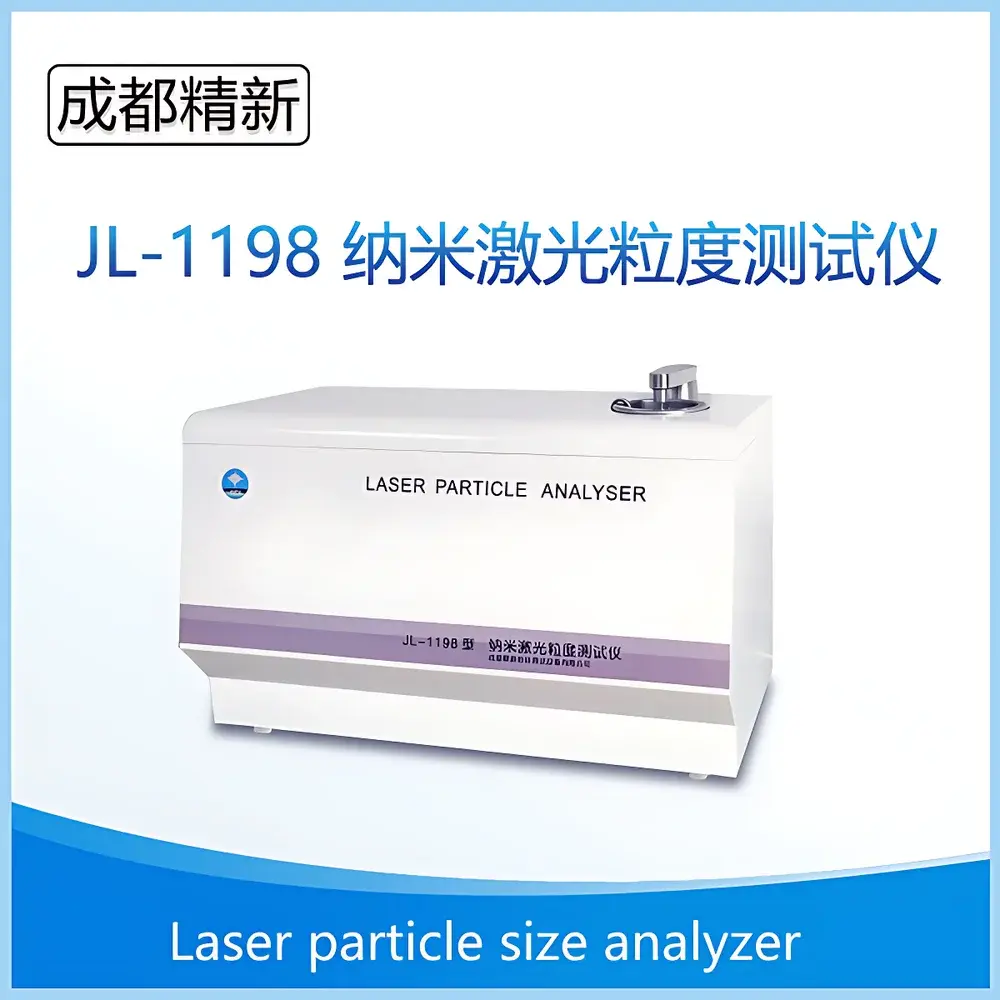
Jingxin JL-1198 Advanced Nanoparticle Size and Zeta Potential Analyzer
| Brand | Jingxin (Chengdu Jingxin Instrument Co., Ltd.) |
|---|---|
| Origin | Sichuan, China |
| Manufacturer Type | OEM Manufacturer |
| Product Category | Domestic |
| Model | JL-1198 |
| Price | Upon Request |
| Particle Size Range | 1 nm – 10,000 nm |
| Size Measurement Repeatability | ≤1% (D50 of NIST-traceable standard) |
| Temperature Control Range | 0–45 °C |
| Temperature Stability | ±0.002 °C |
| Correlation Time Resolution | 20 ns – 100 ms |
| Measurement Principle | Dynamic Light Scattering (DLS) / Photon Correlation Spectroscopy (PCS) |
| Sample Introduction | Wet Dispersion with Recirculating or Static Cell |
| Sample Volume (Static) | 2.5 mL |
| Sample Volume (Recirculating) | 500 mL |
| Concentration Range | 10 adjustable gain levels (ppm to 40% v/v) |
| Zeta Potential Range | ±500 mV |
| Measurement Duration | 1–5 min per run |
| Molecular Weight Estimation Range | 1 kDa – 10 MDa (via calibration) |
| Laser Source | Dual 30 mW solid-state lasers (405 nm) |
| Detection Geometry | Transmission mode (90°), Reflection mode (160°) |
| Detector | High-gain, low-noise photomultiplier tube (PMT) |
| Channels | 4000 autocorrelation channels |
| Delay Time Range | 50 ns – 100 ms |
| Ultrasound Dispersion | 60 W integrated probe |
| Dimensions | 740 × 360 × 530 mm |
| Weight | ~60 kg |
| Power Supply | AC 220 V ±10%, 50 Hz ±0.5 Hz |
| Operating Environment | 5–35 °C, <85% RH non-condensing |
Overview
The Jingxin JL-1198 Advanced Nanoparticle Size and Zeta Potential Analyzer is a high-precision instrument engineered for reliable characterization of colloidal dispersions and macromolecular solutions using dynamic light scattering (DLS) and photon correlation spectroscopy (PCS). It operates on the physical principle that nanoscale particles suspended in liquid undergo Brownian motion at velocities inversely proportional to their hydrodynamic diameter. Incident laser light (405 nm, dual 30 mW solid-state sources) is scattered by these moving particles; temporal fluctuations in scattered intensity are captured by a low-noise photomultiplier tube (PMT) and processed via digital autocorrelation to yield the intensity autocorrelation function. The instrument solves the cumulant and CONTIN algorithms to extract particle size distribution (PSD), polydispersity index (PdI), Z-average diameter (Z-Ave), and zeta potential—enabling quantitative assessment of colloidal stability, aggregation behavior, and formulation consistency. Its fully sealed metal chassis provides electromagnetic interference (EMI) shielding, ensuring signal integrity in shared laboratory environments.
Key Features
- Integrated dual-optical-path design: independent transmission (90° detection) and reflection (160° detection) configurations, enabling accurate sizing across wide concentration ranges—from sub-ppm dilute systems to highly concentrated suspensions up to 40% v/v.
- Automated parameter optimization: real-time selection of correlation channel count (up to 4000), delay time window (50 ns–100 ms), and gain level (10-step programmable) ensures optimal signal-to-noise ratio without user intervention.
- Dual sample introduction modes: recirculating 500 mL dispersion cell with integrated 60 W ultrasonic probe for routine QC testing, and static 2.5 mL precision capillary cell optimized for precious or limited-volume samples.
- High-resolution temperature control: Peltier-based thermal management with ±0.002 °C stability over 0–45 °C range, eliminating thermal drift during extended measurement sequences.
- Comprehensive molecular characterization: simultaneous DLS-based size analysis and electrophoretic light scattering (ELS) for zeta potential determination (±500 mV range), supporting ISO 13099 and ASTM E2490 compliance protocols.
- Robust hardware architecture: hermetically sealed optical bench, vibration-damped baseplate, and industrial-grade PMT detector ensure long-term reproducibility and minimal maintenance requirements.
Sample Compatibility & Compliance
The JL-1198 supports aqueous and organic media including deionized water, ethanol, acetone, and common surfactant solutions. It complies with ISO 13321:2020 (DLS methodology), GB/T 29022–2012 (Chinese national standard for nanoparticle sizing), and aligns with FDA-recommended practices for nanoparticle drug product characterization. Its software audit trail functionality meets GLP/GMP documentation requirements, including electronic signatures, version-controlled method files, and timestamped raw data export (with metadata). All measurements adhere to ICH Q5A(R2) guidelines for biopharmaceutical particulate assessment where applicable.
Software & Data Management
The proprietary Windows-compatible analysis suite (v5.x) supports both English and Chinese UI languages and runs natively on Windows 7/10/11 (64-bit). It delivers full statistical reporting—including volume-, number-, and surface-area-weighted distributions—as well as cumulative percentiles (D10, D50, D90, D97), specific surface area estimation, and polydispersity index (PdI). Data export options include PDF, CSV, TXT, and XML formats; batch processing allows automated sequential analysis of multiple samples with customizable pass/fail criteria. The software includes built-in validation tools for system suitability testing (SST) using NIST-traceable polystyrene latex standards and supports 21 CFR Part 11-compliant user access controls when configured with network authentication.
Applications
The JL-1198 serves critical roles in R&D and quality control laboratories across diverse sectors: nanomaterial synthesis (metal oxides, quantum dots, carbon nanotubes), pharmaceutical nanocarriers (liposomes, polymeric micelles), ceramic slurries (alumina, zirconia), pigment dispersion optimization (paints, inks, coatings), emulsion stability studies (oil-in-water, water-in-oil), cosmetic formulations (nanolipid carriers, sunscreens), nuclear fuel colloid behavior, and environmental nanotoxicology research. Its ability to quantify both size and surface charge enables predictive modeling of colloidal stability under varying pH, ionic strength, and surfactant conditions.
FAQ
What standards does the JL-1198 comply with?
It conforms to ISO 13321:2020, GB/T 29022–2012, and supports alignment with USP <729>, ICH Q5A(R2), and ASTM E2490 for nanoparticle characterization.
Can it measure zeta potential and molecular weight simultaneously with size?
Yes—zeta potential is measured via electrophoretic light scattering (ELS); molecular weight is estimated indirectly from hydrodynamic size using polymer calibration standards.
Is the instrument suitable for GMP-regulated environments?
With optional audit trail configuration and electronic signature support, it satisfies 21 CFR Part 11 requirements for regulated pharmaceutical and biotech applications.
How does the dual optical path improve measurement accuracy?
Transmission mode maximizes sensitivity for dilute samples; reflection mode minimizes multiple scattering artifacts in turbid or highly concentrated systems—both paths are calibrated independently.
What sample preparation accessories are included?
Standard delivery includes 500 mL recirculating cell with ultrasonic disperser, 2.5 mL static cuvette, cleaning kit, reference standards, and universal power adapter.



