
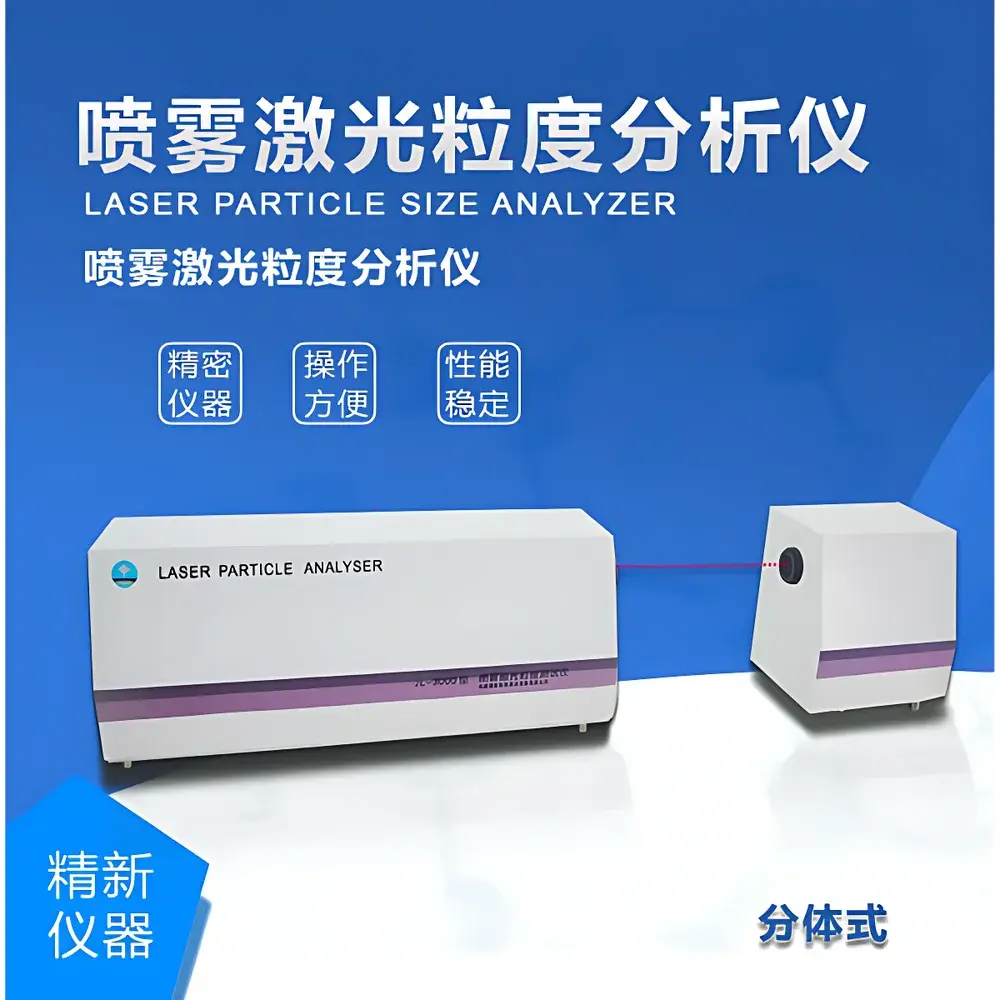
Jingxin JL-3000 Split-Body Spray Laser Particle Size Analyzer
| Brand | Jingxin (Chengdu Jingxin Instrument Co., Ltd.) |
|---|---|
| Origin | Sichuan, China |
| Manufacturer Type | Direct Manufacturer |
| Instrument Type | Laboratory Laser Diffraction Particle Size Analyzer |
| Dispersion Method | Wet Dispersion |
| Measurement Range | 0.01–3000 µm |
| Measurement Time | ≤10 s per analysis |
| Optical Principle | Full-Range Mie Scattering Theory |
| Detector Channels | 128 |
| Repeatability | ≤1% (D50 deviation against NIST-traceable standard reference materials) |
| Accuracy | ≤1% (D50 deviation) |
| Laser Source | Imported 650 nm semiconductor laser, 30 mW output, >70,000 h lifetime |
| Fourier Lens Diameter | 80 mm |
| Signal Interface | RS232 + USB (up to 100 m transmission distance) |
| Host–Slave Separation Distance | 1–10 m (field-adjustable) |
| Operating System Compatibility | Windows XP / 7 / 10 |
| Environmental Requirements | 5–35 °C, <85% RH |
| Power Supply | AC 220 V ±22 V, 50 Hz ±0.5 Hz |
Overview
The Jingxin JL-3000 Split-Body Spray Laser Particle Size Analyzer is a purpose-engineered optical instrument designed for high-fidelity, real-time characterization of aerosolized droplets—including water mist, oil fog, combustion smoke, pharmaceutical nebulates, and agricultural spray plumes. It operates on the physical foundation of full-range Mie scattering theory, rigorously applied across its entire detection spectrum (0.01–3000 µm), enabling quantitative derivation of volume-based particle size distribution (PSD) without empirical calibration assumptions. Unlike conventional benchtop laser diffraction systems optimized for static powders or slurries, the JL-3000 integrates a modular split-body architecture with a large-aperture Fourier optical system (80 mm lens diameter), wide-angle signal collection geometry, and dynamic alignment control—making it uniquely suited for transient, spatially extended, and optically heterogeneous spray fields. Its sealed stainless-steel enclosure provides IP54-level dust and moisture resistance, coupled with EMI-shielded electronics to ensure measurement integrity in industrial test cells, engine test beds, or cleanroom-adjacent environments.
Key Features
- Modular Split-Body Configuration: Host (optical core & detector) and slave unit (laser source & beam conditioning) are physically separable by up to 10 meters, allowing flexible integration into spray chambers, wind tunnels, or combustion rigs where spatial constraints prohibit monolithic placement.
- High-Resolution 128-Channel Detection Array: Each photodiode channel features independent background-light compensation and programmable gain control, ensuring linear response across five orders of magnitude in scattered intensity—critical for resolving bimodal or polydisperse sprays with sub-micron nuclei and coarse droplets simultaneously.
- Real-Time Beam Alignment & Diagnostics: Integrated CMOS imaging system continuously monitors laser spot morphology, uniformity, and positional stability at the sample zone, feeding back to automated collimation actuators—eliminating manual recalibration between tests.
- Dynamic Triggering Capability: TTL and mechanical switch inputs support synchronized acquisition at up to 50 full PSDs per second, enabling time-resolved analysis of transient spray events (e.g., nozzle opening/closing transients, pulsating injectors).
- Adjustable Laser Power Control: Continuous 0–100% output modulation maintains optimal signal-to-noise ratio across varying optical densities—from dilute laboratory mists to dense industrial smoke plumes—without saturating detectors or compromising resolution.
- Robust Mechanical & Thermal Design: Monolithic aluminum optical baseplate, passive thermal stabilization, and vibration-damped mounting minimize drift; no field adjustments required over extended operational cycles.
Sample Compatibility & Compliance
The JL-3000 is validated for continuous-flow measurement of liquid aerosols generated by pressure-swirl, air-assist, ultrasonic, and rotary atomizers. It accommodates both aqueous and non-aqueous media (e.g., diesel, ethanol, saline solutions, propellant blends) under ambient or controlled environmental conditions (5–35 °C, <85% RH). While not certified to ISO 13320 or ASTM E799 as a standalone device, its Mie-based algorithm adheres to the theoretical framework specified in those standards, and its repeatability/accuracy performance (≤1% D50 deviation against NIST SRM 1963 and SRM 2800) meets typical requirements for GLP-compliant R&D labs. Data audit trails, user access logs, and exportable raw scattering profiles support traceability in regulated development workflows.
Software & Data Management
Jingxin’s proprietary ParticleScan Pro software (v5.2+) runs natively on Windows XP through Windows 10 and offers dual-language UI (English/Chinese). It computes volumetric, surface-area, and number-based distributions; reports D10, D50, D90, D97, span, specific surface area, and moment ratios (e.g., μ₂/μ₁²); and exports results in CSV, PDF, or XML formats compliant with LIMS ingestion protocols. Raw scattering intensity arrays (128 × N frames) are preserved alongside metadata (timestamp, trigger event ID, laser power, ambient T/RH), enabling post-hoc reprocessing with alternative inversion kernels. USB and RS232 interfaces support remote operation up to 100 meters from the host PC—essential for hazardous-area deployments or integrated test-bench control systems.
Applications
- Optimization of fuel injector nozzles for gasoline direct injection (GDI) and aviation turbine engines
- Formulation screening of metered-dose inhalers (MDIs) and dry powder inhalers (DPIs) per USP <601>
- Performance validation of agricultural spray nozzles under variable pressure and viscosity conditions
- Smoke opacity and particulate emission profiling in fire suppression system development
- Characterization of cooling mist dynamics in high-speed machining and metalworking fluid delivery
- Fundamental research on droplet breakup mechanisms, coalescence thresholds, and evaporation kinetics
FAQ
What particle size standards are used to verify instrument accuracy?
NIST-traceable reference materials including SRM 1963 (10.03 µm polystyrene latex) and SRM 2800 (1.0 µm silica) are employed for routine D50 verification.
Can the system measure particles smaller than 0.1 µm?
The specified lower limit is 0.01 µm based on theoretical Mie sensitivity; however, reliable quantification below 0.1 µm requires strict control of background noise, solvent purity, and refractive index matching—conditions typically met only in dedicated nanoparticle laboratories.
Is the software compliant with FDA 21 CFR Part 11?
While the base software does not include electronic signature or audit trail modules required for Part 11 compliance, raw data files and metadata are fully exportable for integration into validated third-party LIMS or ELN platforms that provide such functionality.
How is the instrument calibrated for different refractive indices?
Users input material-specific real and imaginary components of the complex refractive index (e.g., 1.33 + 0.0i for water, 1.45 + 0.0i for hydrocarbon oils) directly into the inversion algorithm—no hardware recalibration is needed.
What maintenance is required for long-term stability?
Annual verification of laser power output and detector linearity using factory-provided calibration kits is recommended; optical path cleaning is performed only if particulate accumulation is observed via the built-in beam imaging system.



