
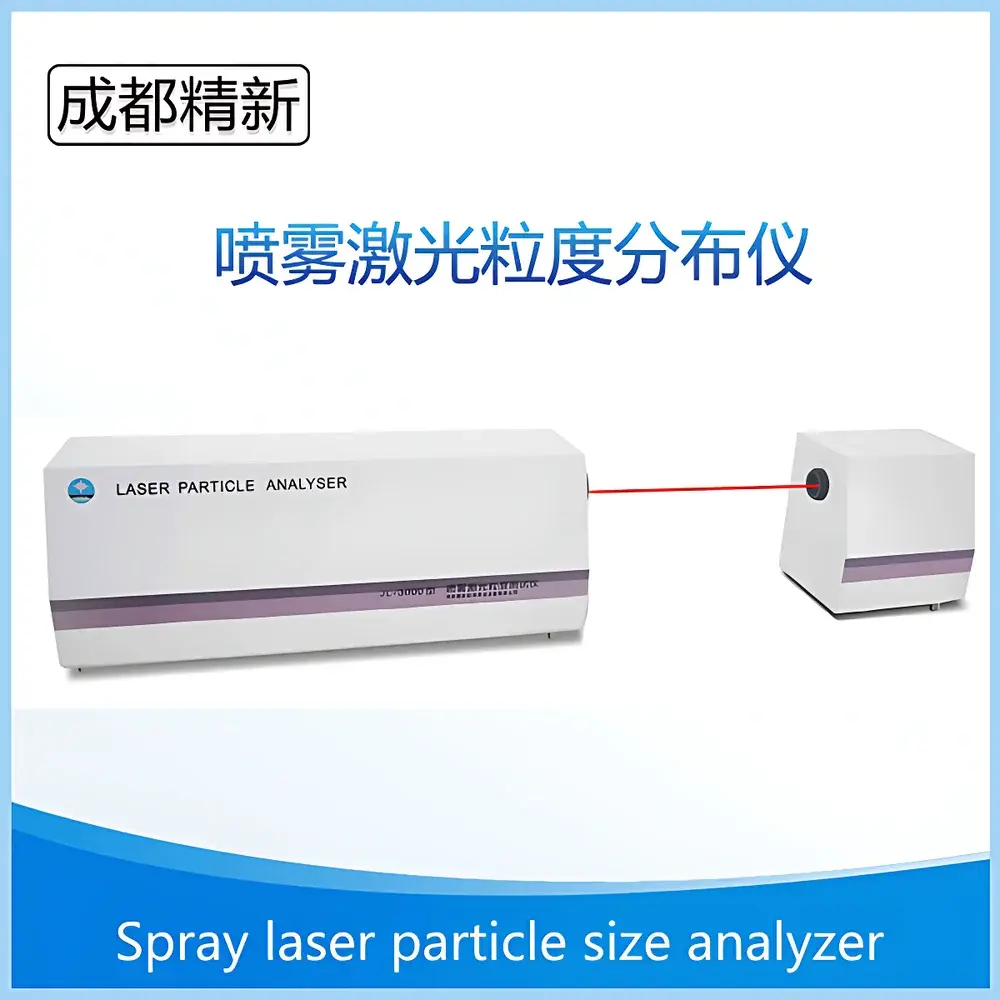
Jingxin JL-3000 Split-Design Spray Laser Particle Size Analyzer
| Brand | Jingxin (Chengdu Jingxin Instrument Co., Ltd.) |
|---|---|
| Origin | Sichuan, China |
| Manufacturer Type | OEM Manufacturer |
| Region of Origin | Domestic (China) |
| Model | JL-3000 |
| Price Range | USD 21,000–28,000 (FOB) |
| Dispersion Method | Wet Dispersion |
| Instrument Type | Laboratory Laser Diffraction Particle Size Analyzer |
| Measurement Range | 0.01 µm – 3000 µm |
| Repeatability | ≤1% (D50 of NIST-traceable standard reference material) |
| Measurement Time | 10–30 s per analysis |
| Measurement Principle | Full-range Mie Scattering Theory |
| Detector Channels | 128 |
| Optical System | Fourier Transform with 80 mm aperture lens |
| Laser Source | Imported semiconductor laser, 650 nm, 30 mW, >70,000 h lifetime |
| Host-Follower Separation Distance | 1–10 m (adjustable) |
| Data Interface | RS-232 and USB (up to 100 m transmission) |
| Software Compatibility | Windows XP / 7 / 10 |
| Environmental Operating Conditions | 5–35 °C, <85% RH |
| Power Supply | AC 220 V ±10%, 50 Hz ±0.5 Hz |
Overview
The Jingxin JL-3000 Split-Design Spray Laser Particle Size Analyzer is an engineered solution for real-time, non-invasive characterization of atomized droplets in industrial and research spray applications. Based on full-range Mie scattering theory—rigorously validated for submicron to millimeter-scale particles—the system delivers quantitative particle size distribution (PSD) data for aqueous mists, oil sprays, combustion aerosols, pharmaceutical nebulizers, and fire suppression water fog. Its split architecture separates the optical detection unit (follower) from the control and signal processing unit (host), enabling flexible deployment across large test benches, wind tunnels, or engine test cells where spatial constraints prohibit monolithic instrument placement. The system operates under ISO 13320:2020-compliant diffraction principles and supports traceability via NIST-certified silica and polystyrene latex standards.
Key Features
- Modular Split Configuration: Host and follower units communicate via shielded RS-232/USB link over distances up to 10 meters—ideal for integration into spray chambers, fuel injector test rigs, or aerospace combustion facilities where optical access and thermal isolation are critical.
- High-Fidelity Optical Design: Equipped with a 80 mm aperture Fourier lens and 128-channel logarithmic photodetector array, the system captures wide-angle scattering signals (0.01°–160°) with high angular resolution, ensuring accurate reconstruction of broad PSDs typical of polydisperse sprays.
- Automated Alignment & Stability: Integrated CCD-based beam centering system enables in-situ laser alignment verification without manual intervention; rigid stainless-steel optical housing provides electromagnetic shielding and mechanical stability—no recalibration required during extended operation.
- Dynamic Acquisition Capability: Supports TTL- and switch-triggered high-speed acquisition at up to 50 full PSD measurements per second, synchronized with external events such as solenoid valve actuation or pressure pulses—essential for transient spray dynamics studies.
- Adaptive Laser Power Control: Adjustable 650 nm laser output (30 mW nominal, >70,000 h lifetime) allows optimization of signal-to-noise ratio across varying droplet concentrations and optical depths, preserving resolution for both fine mist (1000 µm).
- Comprehensive Data Output: Reports D10, D50, D90, D97, span, specific surface area, volume-weighted (D[4,3]), and number-weighted distributions—exportable in CSV, PDF, or XML formats with GLP-compliant audit trail logging.
Sample Compatibility & Compliance
The JL-3000 is optimized for continuous or pulsed spray streams generated by nozzles, ultrasonic atomizers, rotary cup systems, or pneumatic injectors. It accommodates liquid-phase aerosols including water, ethanol, kerosene, diesel, glycerol-water mixtures, and pharmaceutical excipient suspensions. No sample preparation or dilution is required—measurements occur in situ under ambient or controlled environmental conditions (5–35 °C, <85% RH). The system complies with ISO 13320:2020 for laser diffraction methodology and meets key requirements for GMP-relevant environments, including configurable user access levels, electronic signature support, and 21 CFR Part 11–ready software audit logs when deployed with optional validation packages.
Software & Data Management
Jingxin Particle Analysis Software (v5.x) provides dual-language UI (English/Chinese), real-time scatter pattern visualization, and automated background subtraction using per-channel dark-current compensation. Raw scattering intensity profiles are processed via constrained non-negative least squares (NNLS) inversion with Mie kernel matrices precomputed for refractive indices ranging from 1.33 (water) to 1.52 (hydrocarbon oils). Batch analysis mode supports time-series PSD tracking, statistical comparison across multiple runs, and export to LIMS-compatible formats. All raw data, metadata (timestamp, operator ID, instrument configuration), and processing parameters are stored in encrypted SQLite databases with version-controlled backups.
Applications
- Aerospace: Fuel injector spray characterization for gas turbine and rocket propulsion systems
- Pharmaceuticals: Nebulizer performance validation per USP <601>, metered-dose inhaler (MDI) development
- Agrochemicals: Pesticide spray drift modeling, nozzle selection, and adjuvant formulation optimization
- Fire Safety Engineering: Water mist suppression system certification per NFPA 750
- Automotive: Direct injection gasoline (GDI) and common-rail diesel spray analysis
- Academic Research: Fundamental studies of atomization physics, breakup mechanisms, and evaporation kinetics
FAQ
What is the minimum detectable droplet size for this instrument?
The theoretical lower limit is 0.01 µm under optimal signal-to-noise conditions; practical resolution depends on sample concentration, optical path clarity, and refractive index contrast.
Can the system measure sprays in high-temperature or pressurized environments?
The follower unit may be installed behind quartz viewports rated for temperatures up to 200 °C and pressures up to 10 bar; custom thermal shrouds and purge ports are available upon request.
Is calibration traceable to national standards?
Yes—factory calibration uses NIST SRM 1963 (10.04 µm) and SRM 2800 (0.6–10 µm) polystyrene latex standards; annual recalibration services include uncertainty budget documentation per ISO/IEC 17025.
Does the software support automated pass/fail criteria for QC release?
Yes—user-defined specification limits (e.g., Dv50 ±0.5 µm) can be applied to batch reports with automatic flagging and PDF certificate generation.
How is laser safety ensured during operation?
The system conforms to IEC 60825-1:2014 Class 1 laser product requirements; all optical paths are fully enclosed, and interlock circuits disable emission if housing integrity is compromised.



