
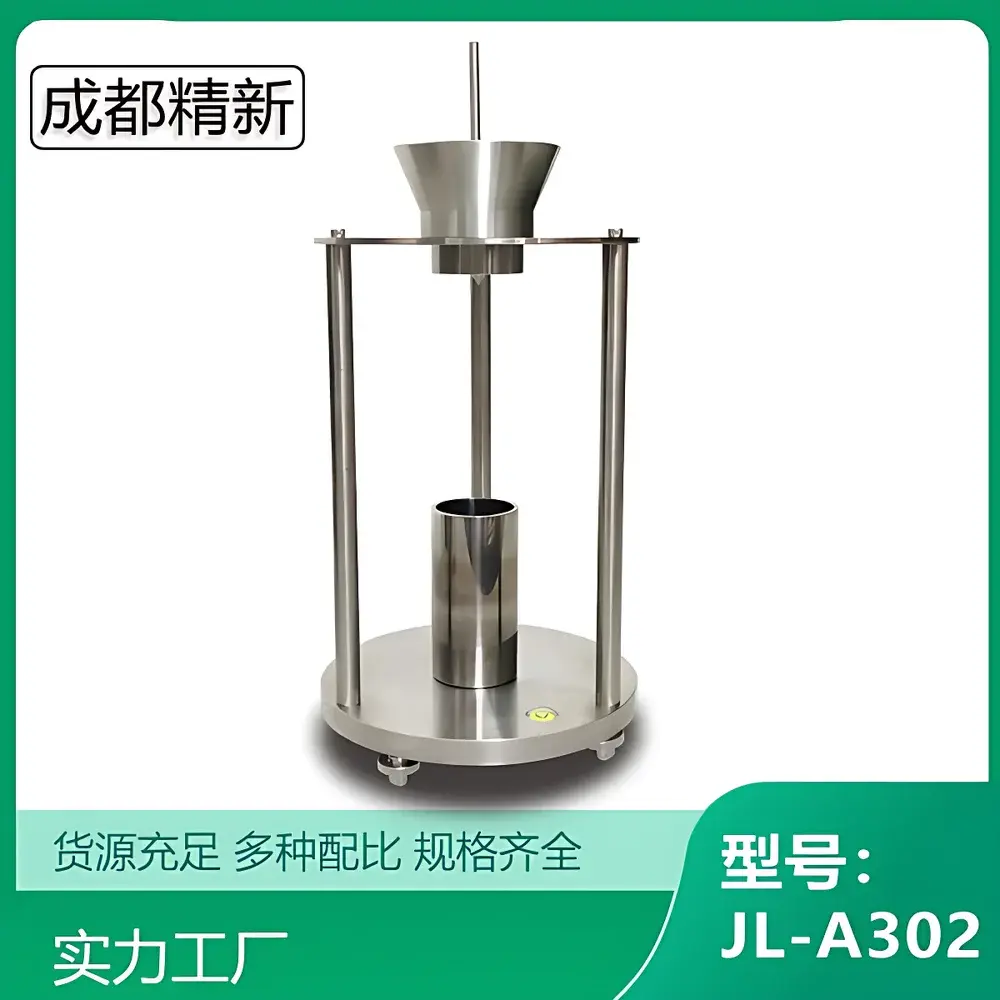
Jingxin JL-A302 Bulk Density Tester (Stainless Steel, ASTM/ISO-Compliant Natural Flow Method)
| Brand | Chengdu Jingxin (CDJX) |
|---|---|
| Origin | Sichuan, China |
| Manufacturer Type | Direct Manufacturer |
| Instrument Type | Bulk Density Tester |
| Design | Portable Benchtop Unit |
| Sample Form | Dry Powders & Granules |
| Standard Compliance | GB/T 16913–2008, ASTM D1473, ISO 3953 |
| Funnel Orifice Diameter | 12.7 mm |
| Funnel-to-Cylinder Height | 115 mm ± 2 mm |
| Cylinder Volume | 100 mL |
| Funnel Angle | 60° |
| Cylinder & Funnel Material | AISI 304 Stainless Steel |
| Scraper Blade Width | 25 mm |
| Overall Dimensions | ~160 × 160 × 300 mm |
| Net Weight | 3.7 kg |
| Required External Balance | Capacity ≥1000 g, Readability ≤0.02 g |
Overview
The Jingxin JL-A302 Bulk Density Tester is a precision-engineered, benchtop instrument designed for the standardized determination of bulk (loose) density of free-flowing dry powders and granular solids. It operates on the principle of natural gravitational flow—where powder is allowed to discharge freely from a fixed-height funnel into a calibrated cylindrical receiver—enabling reproducible measurement of mass per unit volume under unconfined, aerated conditions. This method aligns with internationally recognized test protocols including GB/T 16913–2008 (China), ASTM D1473 (Standard Test Method for Bulk Density (“Unit Weight”) of Molded Plastic Refuse), and ISO 3953 (Determination of Bulk Density of Metal Powders). The device delivers traceable, operator-independent results essential for raw material qualification, process consistency validation, and regulatory documentation in GMP-compliant environments.
Key Features
- Stainless steel (AISI 304) construction throughout—including funnel, cylinder, scraper blade, and stopper rod—ensuring corrosion resistance, mechanical stability, and ease of cleaning between samples.
- Precision-machined funnel with 60° conical angle and 12.7 mm orifice diameter, optimized for consistent powder flow initiation and minimal wall adhesion.
- Fixed vertical alignment: funnel outlet positioned at precisely 115 mm ± 2 mm above the top rim of the 100 mL receiving cylinder—critical for method reproducibility per GB/T 16913–2008.
- Integrated base plate and support column provide rigid, vibration-dampened mounting for both funnel and cylinder, minimizing positional drift during repeated testing.
- 25 mm wide stainless steel straight-edge scraper ensures uniform planar removal of excess powder without compaction—maintaining true loose-state geometry prior to weighing.
- Compact footprint (160 × 160 × 300 mm) and lightweight design (3.7 kg) enable deployment in QC labs, production floors, R&D workstations, or mobile field testing setups.
Sample Compatibility & Compliance
The JL-A302 is validated for use with non-cohesive to moderately cohesive dry particulates ranging from fine micronized powders (e.g., API excipients, catalysts) to coarse granules (e.g., battery cathode precursors, food aggregates, ceramic feedstocks). It excludes moisture-sensitive, hygroscopic, electrostatically charged, or fibrous materials unless preconditioned per SOP. Regulatory alignment includes full compatibility with quality systems governed by ISO/IEC 17025, USP , and FDA 21 CFR Part 11 when paired with compliant balance software and audit-trail-enabled data recording. Documentation packages support GLP/GMP audits through standardized test reports, calibration logs (funnel height verification, cylinder volume certification), and operator training records.
Software & Data Management
As a manually operated mechanical system, the JL-A302 does not incorporate embedded electronics or firmware. However, it integrates seamlessly with external laboratory balance systems supporting RS232/USB output and third-party LIMS or ELN platforms (e.g., LabWare, Veeva Vault QMS). Users may configure automated data capture workflows wherein balance weight readings are timestamped, linked to sample IDs, and stored with metadata (test date, operator ID, ambient temperature/humidity, lot number). Optional Excel-based calculation templates—validated per ICH Q2(R2) guidelines—are available for arithmetic averaging of triplicate measurements and uncertainty estimation per GUM (Guide to the Expression of Uncertainty in Measurement).
Applications
- Pharmaceutical manufacturing: Excipient characterization, blend uniformity assessment, capsule fill weight prediction, and tablet compression feasibility screening.
- Battery materials R&D: Cathode/anode powder handling evaluation, slurry formulation consistency control, and electrode coating density modeling.
- Food & nutraceuticals: Flow behavior indexing for dry mixes, portion control calibration, and packaging volumetric fill optimization.
- Chemicals & catalysts: Reactor loading calculations, transport silo design inputs, and dust explosion hazard classification (per EN 14034).
- Academic & metrology labs: Teaching fundamental powder rheology concepts; reference instrumentation for inter-laboratory round-robin studies.
FAQ
What standards does the JL-A302 comply with?
It is fully aligned with GB/T 16913–2008, ASTM D1473, and ISO 3953 for bulk density determination using the natural flow method.
Is calibration required before use?
Yes—users must verify funnel height (115 mm ± 2 mm), cylinder internal volume (100.0 ± 0.5 mL), and balance accuracy (≤0.02 g readability) prior to first use and at defined intervals per internal SOP.
Can this instrument measure tapped density?
No—the JL-A302 is configured exclusively for loose (untapped) density. Tapped density requires a separate apparatus complying with ASTM D4781 or USP .
What balance specifications are mandatory?
A top-loading balance with ≥1000 g capacity and ≤0.02 g readability is required; ISO/IEC 17025-accredited calibration certificates are recommended for regulated applications.
How many replicate tests are recommended per sample?
Per GB/T 16913–2008, three independent determinations are required; the final reported value is the arithmetic mean, with relative standard deviation (RSD) ≤2% indicating acceptable repeatability.



