
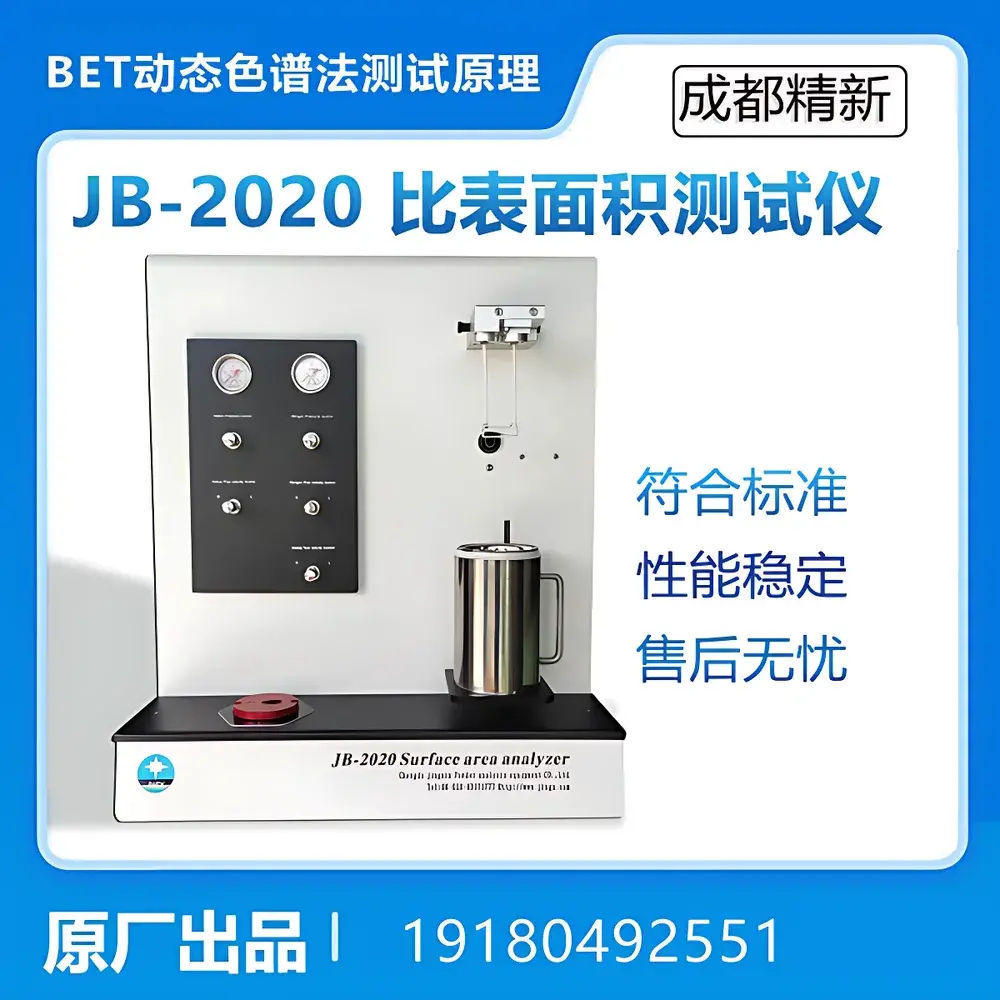
Jingxin JX2020 Automated Specific Surface Area Analyzer by Dynamic Nitrogen Adsorption
| Brand | Jingxin (Chengdu) |
|---|---|
| Origin | Sichuan, China |
| Manufacturer Type | Direct Manufacturer |
| Region Classification | Domestic (China) |
| Model | JX2020 |
| Instrument Category | Specific Surface Area Analyzer |
| Principle | Dynamic (Flow) Nitrogen Adsorption Method |
| Analysis Stations | 1 |
| Measurement Range | 0.0005 m²/g to unlimited |
| Theoretical Basis | Dynamic nitrogen adsorption combined with cryogenic adsorption and gas chromatographic detection principles |
| Calibration Standards | GBW(E)130275 certified reference materials |
| Compliance | GB/T 19587–2017 |
| Sample Tube Material | High-temperature-resistant borosilicate glass (GG-type, U-shaped) |
| Test Gases | Ultra-high-purity helium (carrier gas) and nitrogen (adsorbate) |
| Repeatability & Accuracy | ≤ ±3% (both) |
| Test Duration per Sample | ~3 minutes |
| Software Compatibility | Windows 7, Windows 10 |
| Dimensions | 700 mm × 360 mm × 710 mm |
| Weight | ~30 kg |
| Power Supply | AC 220 V ±22 V, 50 Hz ±0.5 Hz |
| Operating Environment | 5–35 °C, RH <85% |
Overview
The Jingxin JX2020 Automated Specific Surface Area Analyzer is an entry-level yet rigorously engineered instrument designed for rapid, reliable quantification of specific surface area (SSA) of solid powders and porous materials using the dynamic (flow) nitrogen adsorption method. Unlike static volumetric analyzers, the JX2020 operates on a continuous-flow principle: high-purity helium serves as the carrier gas, while nitrogen is introduced as the adsorptive species. As the sample—mounted in a U-shaped, high-temperature-resistant borosilicate glass tube—is immersed in liquid nitrogen, nitrogen molecules adsorb onto its surface; upon withdrawal from the cryobath, desorption occurs, generating a transient signal detected by a low-temperature, high-sensitivity thermal conductivity detector (TCD). This response curve is compared against a calibrated standard gas pulse to compute SSA via single-point or multi-point BET analysis. The system adheres strictly to GB/T 19587–2017, the Chinese national standard equivalent to ISO 9277 and ASTM D3037 for nitrogen adsorption surface area measurement.
Key Features
- Single-station configuration optimized for throughput: delivers full SSA results in approximately three minutes per sample—ideal for QC laboratories handling high-volume routine testing.
- Dual-gas dynamic flow architecture with ultra-high-purity helium (≥99.999%) and nitrogen (≥99.999%), minimizing baseline drift and cross-contamination risks.
- Proprietary precision gas dosing module ensures reproducible introduction of standardized nitrogen pulses, critical for trace-level surface area quantification down to 0.0005 m²/g.
- Robust TCD sensor operating at cryogenic-compatible temperatures, offering extended service life and immunity to compositional shifts in carrier/adsorbate gas mixtures.
- U-shaped GG-grade borosilicate sample tube design enables uniform thermal contact during immersion and consistent desorption kinetics—enhancing inter-run reproducibility.
- No external vacuum pump required; integrated pressure regulation and flow control eliminate dependency on auxiliary infrastructure, reducing footprint and operational complexity.
Sample Compatibility & Compliance
The JX2020 accommodates a broad spectrum of powdered and granular solids relevant to advanced materials R&D and industrial quality control. Validated applications include battery cathode precursors (e.g., LiCoO₂, LiMn₂O₄, Li₄Ti₅O₁₂), graphite anodes, pharmaceutical excipients and APIs, heterogeneous catalysts (e.g., Pt/C, Ni/Al₂O₃), adsorbents (activated carbon, silica gels), cementitious phases, and ceramic raw materials. All measurements comply with GB/T 19587–2017, which aligns methodologically with ISO 9277:2010 (BET surface area by nitrogen adsorption) and ASTM D3037–22 (Standard Test Method for Specific Surface Area of Catalysts and Catalyst Carriers). While not 21 CFR Part 11–enabled out-of-the-box, audit-trail-capable data export (CSV, PDF) supports GLP/GMP-aligned documentation workflows when integrated into validated laboratory information management systems (LIMS).
Software & Data Management
The JX2020 is controlled via native Windows-compatible software (Windows 7 and Windows 10 supported) featuring intuitive workflow navigation, real-time signal visualization, and automated peak integration. Users may select between single-point, multi-point BET, or comparative analysis modes. Raw chromatograms, calibration curves, and final SSA values are timestamped and stored with metadata (operator ID, date/time, sample ID, gas lot numbers). Export functions support CSV for spreadsheet analysis, PDF for report generation, and image capture for presentation. Data management includes full CRUD functionality: users can search historical runs by parameter filters, compare up to six datasets side-by-side, annotate results, and generate customizable test reports compliant with internal QA templates.
Applications
- Battery materials development: monitoring SSA changes during calcination, coating, or surface modification of cathode/anode powders.
- Pharmaceutical solid-state characterization: correlating surface area with dissolution rate, blend uniformity, and stability of micronized APIs.
- Catalyst formulation: evaluating metal dispersion and support porosity effects on active site density.
- Construction materials science: quantifying specific surface area of clinker phases, supplementary cementitious materials (SCMs), and nano-silica additives.
- Adsorbent performance screening: rapid ranking of activated carbons, zeolites, and MOFs for gas capture or water treatment applications.
- Quality assurance in ceramics and refractories: verifying batch-to-batch consistency of raw material fineness and reactivity.
FAQ
What standards does the JX2020 comply with?
It conforms to GB/T 19587–2017, which is technically harmonized with ISO 9277 and ASTM D3037 for nitrogen adsorption-based surface area determination.
Can the instrument perform pore size distribution analysis?
No—the JX2020 is dedicated exclusively to specific surface area measurement via dynamic nitrogen adsorption. It does not support isotherm acquisition or BJH/KJS pore modeling.
Is helium mandatory as the carrier gas?
Yes. Helium is required due to its inertness, high thermal conductivity, and optimal separation characteristics in the TCD-based detection scheme.
What sample mass is typically required?
Recommended mass ranges from 0.05 g to 1.0 g depending on expected SSA; low-SSA samples (e.g., dense metals) require larger masses to ensure detectable signal amplitude.
Does the system require liquid nitrogen refilling during operation?
Yes—liquid nitrogen is consumed continuously during adsorption/desorption cycles; typical usage is ~1 L per 10–15 samples under standard conditions.
Is remote operation or network connectivity supported?
The base configuration supports local PC control only; Ethernet or USB data export is available, but no built-in remote desktop or cloud sync capability is provided.



