
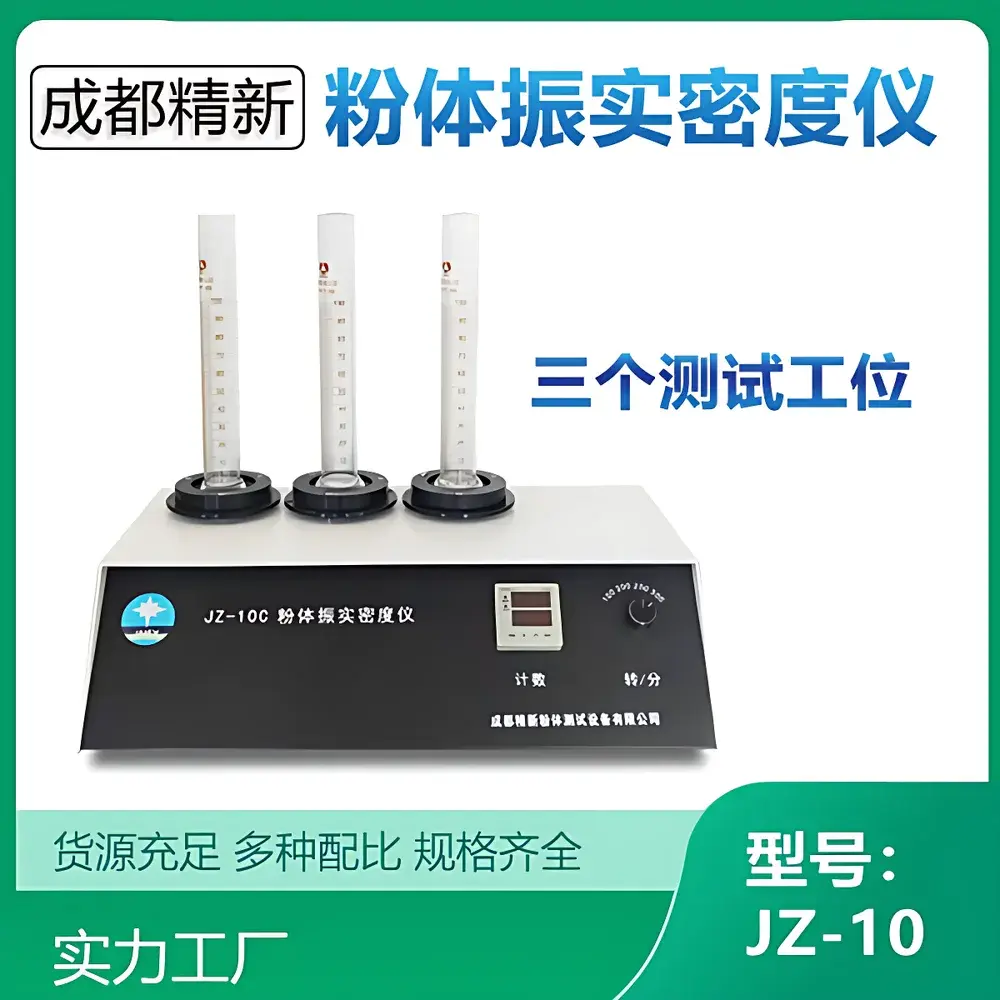
Jingxin JZ-10C Triple-Station Tap Density Tester
| Brand | Chengdu Jingxin (CDJX) |
|---|---|
| Origin | Sichuan, China |
| Manufacturer Type | Direct Manufacturer |
| Regional Category | Domestic (China) |
| Model | JZ-10C |
| Instrument Type | Tap Density Tester |
| Instrument Class | Benchtop (Not Portable — corrected per technical specification: fixed installation, 15 kg, 455×280×125 mm) |
| Sample Form | Powders & Granules |
| Measurement Principle | Mechanical Tapping (Rotational + Vertical Oscillation) |
| Density Range | 0–10 g/cm³ |
| Density Accuracy | ±1% repeatability (per GB/T 5162–2021 & USP <616>) |
| Vibration Amplitude | 3.0 ± 0.2 mm |
| Tapping Frequency Options | 100 / 200 / 250 / 300 taps/min |
| Tapping Count Range | 1–9999 cycles (user-defined) |
| Sample Vessels | Three removable 25 mL and three 100 mL borosilicate glass cylinders |
| Data Output Formats | PDF, Word, Excel |
| Compliance Standards | GB/T 5162–2021, GB/T 31057.2–2018, ChP 2020 General Chapter 0993, USP <616> |
| Power Supply | AC 220 V, 110 W |
| Dimensions (L×W×H) | 455 × 280 × 125 mm |
| Net Weight | ~15 kg |
Overview
The Jingxin JZ-10C Triple-Station Tap Density Tester is an engineered benchtop instrument designed for standardized determination of tap density (also known as tapped density or settled density) and bulk density of free-flowing powders and granular solids. It operates on the internationally recognized mechanical tapping principle defined in ASTM D4781, ISO 3953, USP , and Chinese national standards GB/T 5162–2021 and ChP 2020 Section 0993. Unlike single-axis vibratory devices, the JZ-10C employs synchronized vertical tapping and controlled horizontal rotation—ensuring uniform particle rearrangement and minimizing surface segregation. This dual-motion mechanism enhances measurement reproducibility (<±1% RSD under controlled conditions) and aligns with regulatory expectations for method robustness in pharmaceutical excipient qualification, battery cathode/anode material characterization, and metal powder sintering feedstock assessment.
Key Features
- Triple independent test stations enable parallel processing of up to three samples—significantly improving throughput for QC labs conducting routine batch release testing or comparative formulation studies.
- Precision-engineered tapping motion: fixed 3.0 ± 0.2 mm amplitude combined with four selectable tapping frequencies (100, 200, 250, or 300 taps/min), each calibrated against traceable mechanical reference standards.
- Modular cylinder mounting system allows rapid interchange of borosilicate glass volumetric cylinders (25 mL and 100 mL, supplied in triplicate), facilitating cleaning, calibration verification, and cross-lot comparability without tooling.
- Microprocessor-controlled timer with full-cycle counting (1–9999 taps) and non-volatile memory retention ensures protocol consistency across shifts and operators.
- Integrated thermal management via rear-panel ventilation apertures maintains stable motor performance during extended operation (>8-hour continuous duty cycle validated).
- Benchtop footprint (455 × 280 × 125 mm) and 15 kg mass provide inherent mechanical stability—minimizing resonance interference during high-frequency tapping sequences.
Sample Compatibility & Compliance
The JZ-10C accommodates a broad spectrum of dry, cohesionless to moderately cohesive particulates—including metallic powders (e.g., Ni, Co, Al alloys), ceramic precursors (LiCoO₂, SiO₂), pharmaceutical actives and excipients (lactose, microcrystalline cellulose), food-grade starches and spices, and graphite/silicon anode materials for lithium-ion batteries. All measurements conform to GLP-aligned documentation practices: each test record includes timestamp, operator ID (manually entered), cylinder ID, tap count, frequency setting, ambient temperature/humidity (optional external sensor input), and raw volume/mass inputs. The instrument’s design supports audit readiness for FDA 21 CFR Part 11–compliant environments when paired with validated software deployment protocols.
Software & Data Management
The included Jingxin Tap Density Analysis Software (v3.2+) runs on Windows OS (7/10/11, 64-bit) and interfaces via USB or manual data import. It performs automated calculation of both tap density (ρt = m/Vt) and bulk density (ρb = m/Vb), where mass (m) is user-entered from analytical balance readings and tapped/bulk volumes (Vt, Vb) are selected from pre-defined cylinder calibrations. Results display to 0.01 g/cm³ resolution with uncertainty propagation based on balance readability (0.001 g typical) and cylinder tolerance (±0.5% for Class A glassware). Reports generate natively in PDF (archival), Word (editing-ready), and Excel (statistical post-processing), including embedded metadata, digital signature fields, and configurable header/footer templates for lab-specific branding.
Applications
- Pharmaceutical development: Excipient flowability screening per USP , capsule fill weight uniformity prediction, and granulation endpoint monitoring.
- Battery materials QA: Cathode density profiling for electrode coating consistency; anode tap density correlation with slurry rheology and calendering response.
- Metallurgy & additive manufacturing: Gas-atomized metal powder qualification per ASTM F3049, density-based lot acceptance for Ti-6Al-4V and Inconel 718 feedstocks.
- Food & cosmetics: Powder blend homogeneity assessment, packaging volume optimization, and anti-caking agent efficacy validation.
- Academic research: Fundamental studies on particle packing dynamics, interparticle friction effects, and humidity-dependent densification behavior.
FAQ
Is the JZ-10C compliant with USP and EP 2.9.34?
Yes—the mechanical specifications (amplitude, frequency range, cylinder geometry) and operational protocols fully satisfy USP requirements for tap density apparatus qualification. Validation documentation packages are available upon request.
Can the instrument be integrated into a LIMS or ELN system?
Direct API integration is not supported; however, exported Excel reports are LIMS-compatible, and CSV output mode enables scripted ingestion into most enterprise data platforms.
What maintenance is required for long-term accuracy?
Annual verification of tap amplitude (using certified displacement sensor) and cylinder volume calibration (gravimetrically traceable to NIST SRM) is recommended. Motor brushes require replacement only after >10,000 operating hours.
Does the software support multi-user permissions or electronic signatures?
The standalone software does not include role-based access control or digital signature modules; such functionality must be implemented at the host OS or LIMS layer per 21 CFR Part 11 Annex 11 guidelines.
Are stainless steel or custom-volume cylinders available as accessories?
Yes—optional 5 mL, 50 mL, and 250 mL cylinders (borosilicate or electropolished 316L SS) are available with NIST-traceable calibration certificates. Custom engineering for OEM integration is also supported.



