

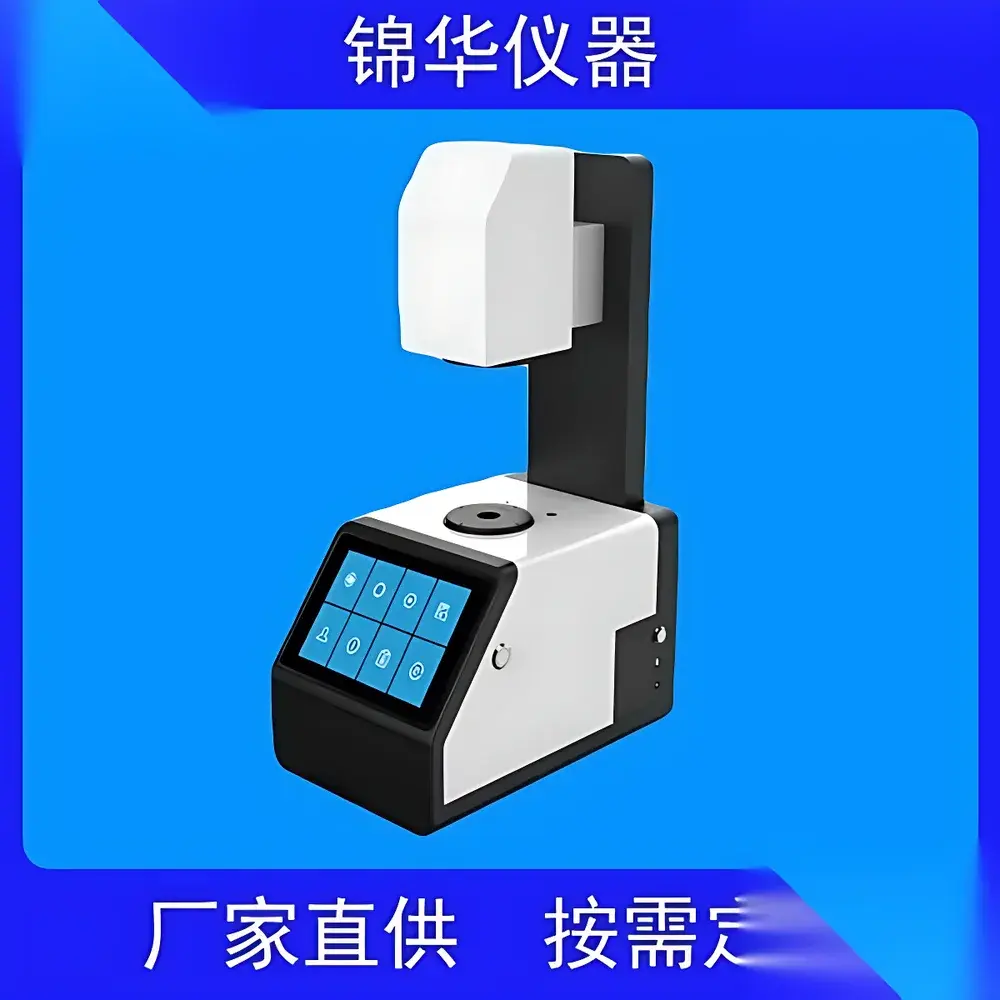
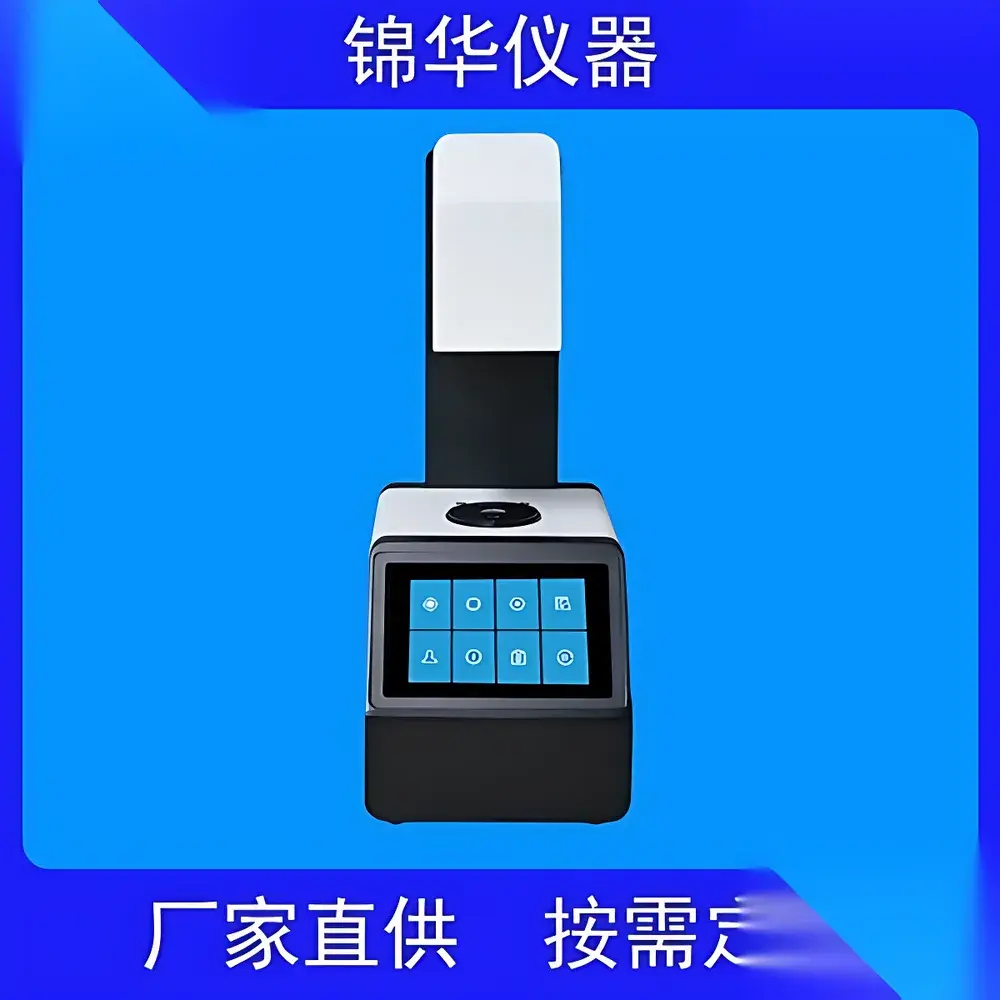
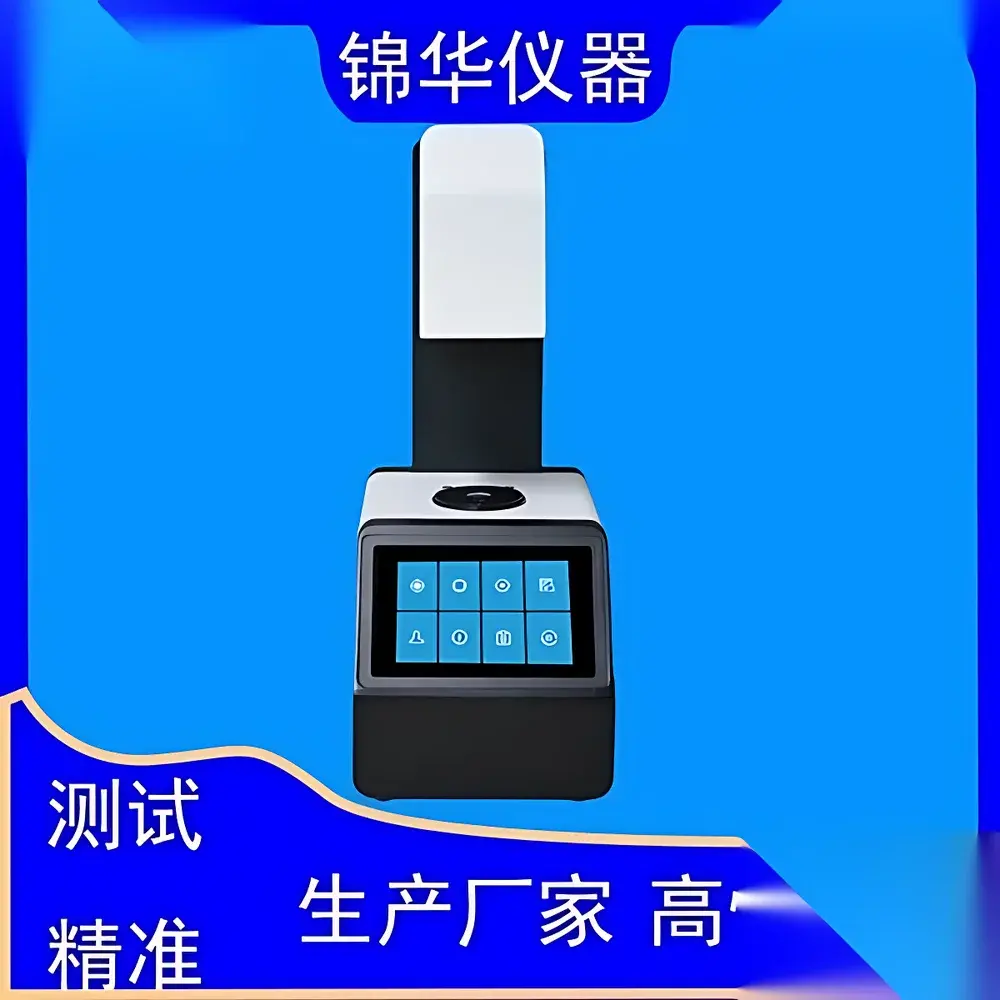
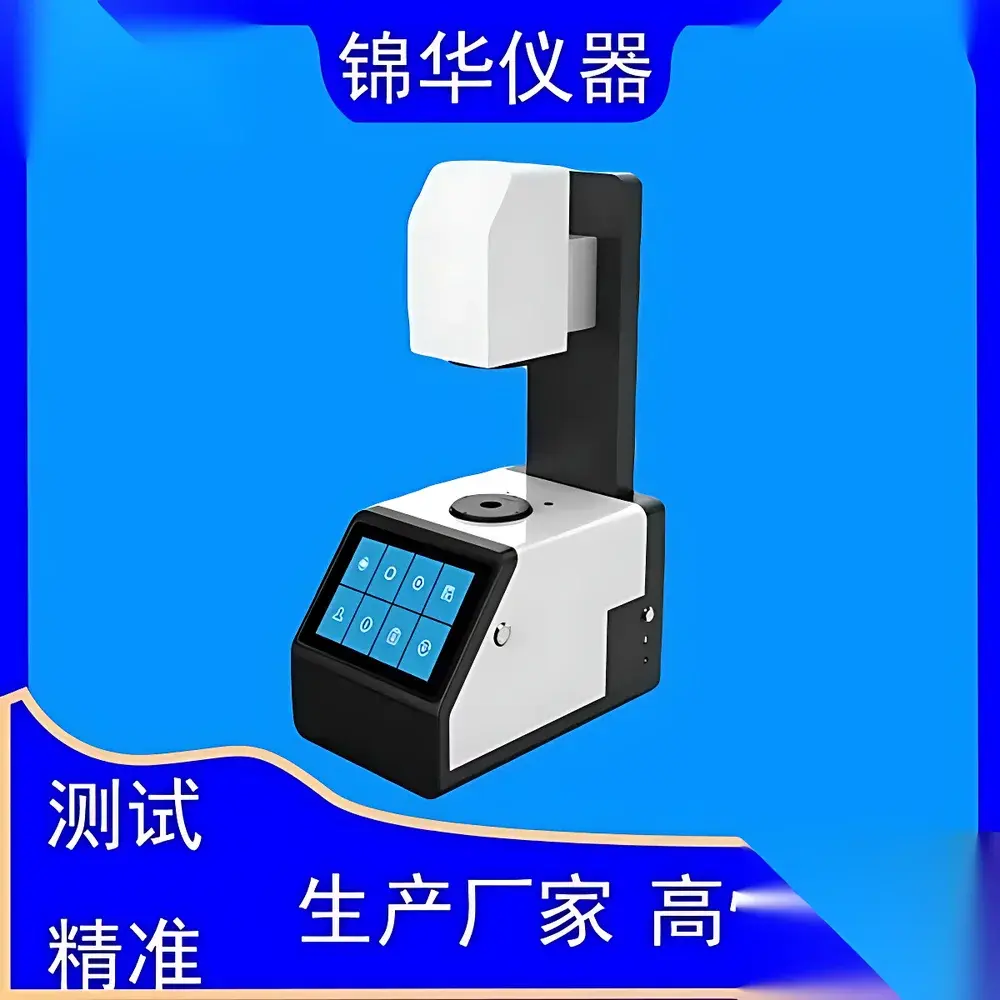
Jinhuatester TH-02 Haze and Luminous Transmittance Meter
| Brand | Jinhuatester |
|---|---|
| Model | TH-02 |
| Measurement Principle | 0°/Diffuse (CIE 15:2018 compliant) |
| Standards Compliance | ASTM D1003, ASTM D1044, ISO 13468, ISO 14782, GB/T 2410, JIS K 7105, JIS K 7361, JIS K 7136 |
| Illuminants | CIE A, C, D65 |
| Measured Parameters | Haze (%), Total Luminous Transmittance (%) |
| Aperture Sizes | 21 mm, 7 mm |
| Response Time | ≤1.5 s |
| Repeatability | ±0.05% |
| Resolution | 0.01% |
| Sample Thickness Limit | ≤145 mm |
| Display | 7-inch capacitive touchscreen (Android OS) |
| Optical Geometry | 0/D (Illumination Normal / Diffuse Collection) |
| Light Source | Long-life LED (rated >50,000 h) |
| Data Storage | Internal flash memory (≥100,000 records) |
| Interface | USB Type-A |
| Power Supply | DC 12 V / 3 A |
| Operating Temperature | 5–40 °C, RH ≤80% (non-condensing at ≤35 °C) |
| Storage Temperature | −20–45 °C, RH ≤80% (non-condensing at ≤35 °C) |
| Dimensions (L×W×H) | 310 × 215 × 540 mm |
| Weight | 6 kg |
Overview
The Jinhuatester TH-02 Haze and Luminous Transmittance Meter is a dual-standard optical measurement instrument engineered for precise, repeatable quantification of haze and total luminous transmittance in transparent and translucent materials. It operates on the 0°/diffuse (0/D) geometry defined in CIE Publication 15:2018 and aligned with ASTM D1003 Annex A1 and ISO 13468-1, where collimated illumination at normal incidence is coupled with diffuse light collection over a solid angle ≥2π sr. This configuration ensures compliance with regulatory and industrial requirements for quality control in optical-grade polymers, architectural glazing, display cover lenses, pharmaceutical packaging films, and laminated safety glass. Unlike integrating sphere-based systems requiring warm-up stabilization, the TH-02 employs thermally stabilized LED sources with spectral output traceable to NIST-traceable reference standards—enabling immediate measurement without pre-conditioning. Its modular mechanical design supports both vertical and horizontal sample positioning, accommodating rigid plates up to 145 mm thick or flexible films mounted on auxiliary holders.
Key Features
- Simultaneous dual-standard compliance: fully configurable for ASTM D1003 (Method A), ASTM D1044, ISO 13468-1/-2, ISO 14782, GB/T 2410–2008, and multiple JIS standards (K 7105, K 7361, K 7136)
- Triple CIE illuminant selection (A, C, D65) with real-time spectral correction—ensuring metrological consistency across daylight, tungsten-filament, and average noon-sky conditions
- Dual aperture options (21 mm and 7 mm) for optimized signal-to-noise ratio: large aperture for low-scatter bulk materials; small aperture for localized analysis of micro-defects or gradient films
- 0/D optical path with calibrated baffle system and stray-light suppression—minimizing edge diffraction artifacts and enabling accurate haze measurement down to 0.1%
- 7-inch capacitive touchscreen running Android OS 9.0 with intuitive UI, on-device data review, histogram visualization, and pass/fail threshold tagging
- No warm-up requirement: stable photometric output achieved within <100 ms after power-on; measurement cycle completes in ≤1.5 seconds with full parameter readout
- LED light source rated for >50,000 hours—eliminating recalibration drift associated with halogen lamp aging and filament shift
Sample Compatibility & Compliance
The TH-02 accommodates diverse physical forms without accessory dependency: flat rigid sheets (e.g., tempered glass, polycarbonate panels), flexible roll-fed films (PET, PC, TPU), liquid-filled cuvettes (for solution clarity assessment), and molded optical components. Its open-access measurement chamber permits vertical insertion of tall specimens (up to 540 mm height) and horizontal placement of oversized substrates exceeding 310 mm width. All reported haze and transmittance values are traceable to SI units via factory calibration against certified reference standards (NIST SRM 1979 for haze, NIST SRM 2036 for transmittance). The instrument meets GLP documentation requirements: each measurement record includes timestamp, operator ID, illuminant mode, aperture size, environmental sensor readings (ambient temperature/humidity), and digital signature metadata. Audit trails comply with FDA 21 CFR Part 11 when exported via USB to validated LIMS environments.
Software & Data Management
Embedded firmware supports local storage of ≥100,000 test records with searchable metadata (batch ID, material code, standard used, pass/fail status). Data export is available in CSV and PDF formats via USB mass-storage mode—retaining all raw intensity values, calculated haze percentages, and transmittance curves. No proprietary software installation is required on host PCs. For enterprise integration, the device exposes a HID-compliant serial-over-USB interface compatible with LabVIEW, MATLAB, and custom Python scripts using pySerial. Firmware updates are delivered via signed ZIP packages loaded from FAT32-formatted USB drives—validated with SHA-256 checksums prior to installation. All stored data persists through power cycles and retains integrity under thermal shock (−20 °C to 45 °C storage range).
Applications
- Quality assurance in automotive glazing production: monitoring haze drift during anti-fog coating curing or laminated interlayer extrusion
- Pharmaceutical packaging validation: verifying clarity and uniformity of blister foil lidding films per USP <661.2> and EP 2.2.1
- Display manufacturing: screening cover glass for laser-etched diffusers, AR-coated substrates, and OLED encapsulation barriers
- Recycled polymer certification: detecting gel particles and phase-separation-induced scattering in post-consumer PET flake batches
- Academic research in optical polymer science: correlating haze profiles with crystallinity indices derived from DSC and XRD
- Food packaging R&D: assessing moisture-induced haze development in biodegradable cellulose films under accelerated aging
FAQ
Does the TH-02 require annual recalibration?
No scheduled annual recalibration is mandated; however, users must perform verification using supplied reference standards (certified haze plate and neutral density filter) before each shift or after any physical impact. Full factory recalibration is recommended every 24 months or following exposure to ambient humidity >80% RH for >72 consecutive hours.
Can the TH-02 measure curved or textured surfaces?
It is designed exclusively for planar, optically homogeneous samples. Curved substrates introduce beam deviation and violate the collimated-normal illumination assumption; textured surfaces require specialized goniophotometers per ISO 13666.
Is USB export compliant with 21 CFR Part 11?
Yes—when used in conjunction with validated third-party audit-log software that enforces electronic signatures, role-based access, and immutable record archiving. The TH-02 itself provides timestamped, unalterable raw data files meeting §11.10(a) requirements.
What is the minimum measurable haze value?
The instrument achieves reliable detection down to 0.1% haze (±0.05% repeatability) under CIE D65 illumination with the 21 mm aperture on samples exhibiting <1% surface reflectance.
How is stray light corrected in the 0/D optical path?
Through a combination of precision-machined baffles, black-anodized internal surfaces (reflectance <0.5% at 400–700 nm), and real-time dark-current subtraction during each measurement cycle—verified per ISO 9037 Annex B protocols.



