
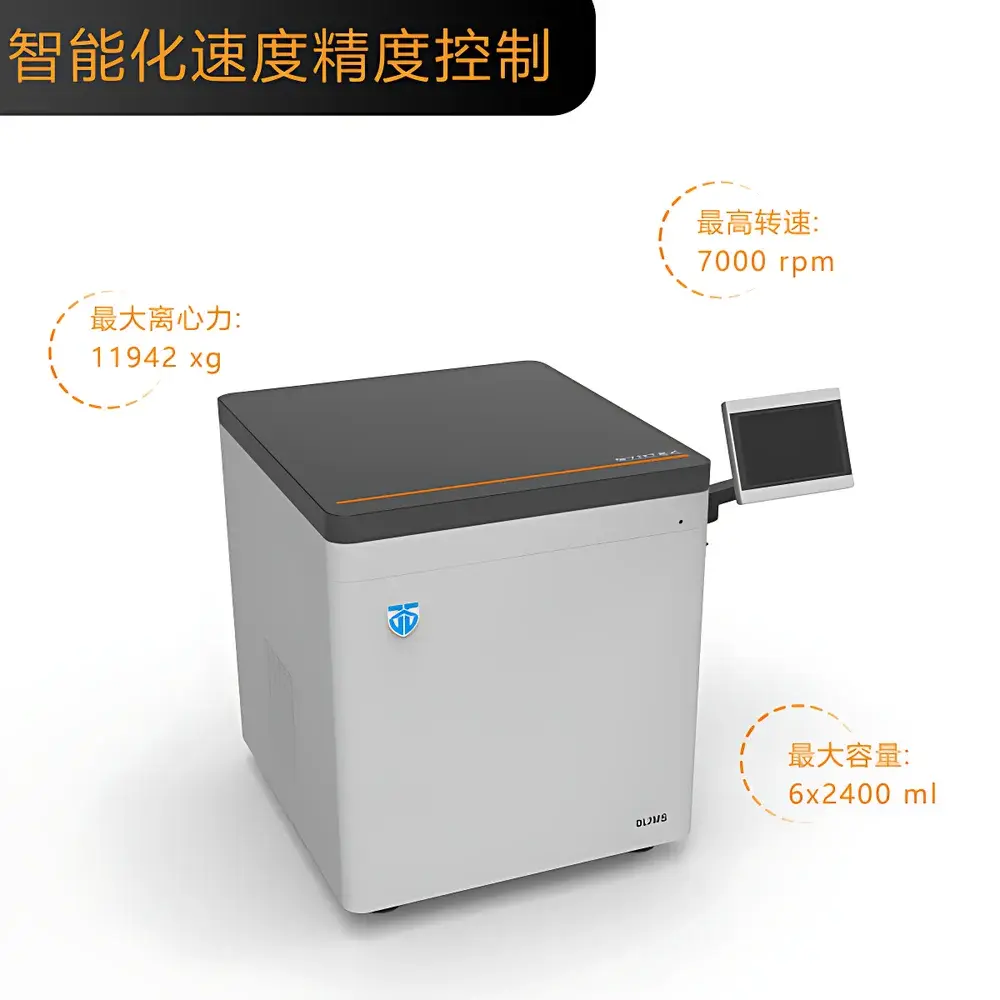
Jintaishi DL7MS Ultra-High-Capacity Refrigerated Low-Speed Centrifuge
| Brand | Jintaishi |
|---|---|
| Origin | Hunan, China |
| Model | DL7MS |
| Instrument Type | Floor-Standing Centrifuge |
| Speed Range | 300–7000 rpm |
| Max RCF | 11942 × g |
| Max Capacity | 6 × 2400 mL |
| Temperature Range | −20 °C to +40 °C |
| Temp. Accuracy | ±1 °C |
| Speed Accuracy | ±10 rpm |
| Acceleration/Deceleration | 9-step programmable |
| Noise Level | ≤65 dB(A) at 1 m |
| Power Supply | AC 220 V ±10 %, 50 Hz, 32 A |
| Dimensions (W×D×H) | 870 × 950 × 1000 mm |
| Weight | 580 kg |
| Refrigerant | R404A |
| Drive Motor | Inverter-Controlled Asynchronous Motor |
| Safety Features | Door Interlock, Overspeed Detection, Imbalance Detection, Overtemperature Protection |
| Data Storage | ≥3 months of operational logs, fault records, and user activity with export capability |
| Display | 10-inch full-color capacitive touchscreen |
| Compliance | Designed for GLP-compliant workflows |
Overview
The Jintaishi DL7MS Ultra-High-Capacity Refrigerated Low-Speed Centrifuge is an engineered solution for high-volume, temperature-sensitive separation tasks in blood banking, biopharmaceutical manufacturing, academic research, and industrial biochemistry laboratories. Operating on the principle of sedimentation under controlled gravitational force (RCF), the DL7MS delivers precise, reproducible separation of cellular components—including whole blood, peripheral blood mononuclear cells (PBMCs), bacteria, yeast, and large particulates—without inducing shear-induced damage common in high-speed ultracentrifugation. Its design prioritizes thermal stability, mechanical robustness, and operational safety: a dual-stage refrigeration system with imported R404A compressors and optimized copper-tube layout ensures rapid cooling and sustained temperature uniformity (±1 °C) across the entire rotor chamber—even at maximum load and 7000 rpm. The unit’s structural integrity is reinforced by a fully welded steel frame, multi-layer protective housing, and electrostatically applied corrosion-resistant coating, meeting ISO 13485-aligned build standards for medical device support equipment.
Key Features
- Ultra-high sample throughput: 6 × 2400 mL horizontal rotor configuration enables single-run processing of up to 14.4 L—ideal for plasma fractionation, vaccine bulk harvest, or large-scale cell pellet recovery.
- Intelligent motion control architecture: Patented speed regulation algorithms (ZL202110746004.4 & ZL202121485461.4) maintain rotational accuracy within ±10 rpm across the full 300–7000 rpm range, with real-time imbalance and overspeed detection triggering automatic deceleration and alarm activation.
- Energy-efficient thermal management: Adaptive standby mode automatically disables compressor operation after user-defined idle periods, reducing power consumption without compromising cold retention during short interruptions.
- Human-centered interface: 10-inch capacitive touchscreen provides simultaneous display of setpoints and real-time parameters (speed, RCF, temperature, time, acceleration profile); supports RTC (Real-Time Control) for mid-run parameter adjustment and step-gradient centrifugation protocols.
- Triple-status LED indicator (yellow = standby, green = active, red = fault) offers immediate visual assessment of operational state from across the lab floor.
- Modular rotor compatibility: Includes standard 6-place horizontal rotor (4100 rpm / 5431 × g), two high-RCF angle rotors (7000 rpm / 11942 × g and 5000 rpm / 7295 × g), all featuring aluminum alloy inserts and precision-machined adapter sleeves for 50–2500 mL tube formats.
Sample Compatibility & Compliance
The DL7MS accommodates a broad spectrum of primary and secondary containment vessels—from clinical blood bags and stainless-steel canisters to polypropylene centrifuge bottles—across its certified rotor configurations. All rotors are validated for use with ISO-certified tube materials and undergo routine dynamic balancing per ISO 15837. The system meets IEC 61010-1:2010 safety requirements for laboratory electrical equipment and incorporates redundant hardware-based safety interlocks (door latch, rotor recognition, thermal cutoff). When deployed in regulated environments (e.g., GMP-compliant bioprocessing suites or CLIA-certified diagnostic labs), the DL7MS supports traceable operation through timestamped log exports (CSV/USB), multi-tier user authentication (admin/operator/guest), and configurable audit trails—aligning with FDA 21 CFR Part 11 expectations for electronic records and signatures when paired with validated LIMS integration.
Software & Data Management
Embedded firmware enables storage of ≥100 user-defined programs, each with descriptive metadata fields (e.g., “Plasma Separation – Blood Bank Protocol v2.1”). Operational logs—including start/stop timestamps, rotor ID, speed/temperature profiles, error codes, and operator login IDs—are retained for ≥90 days and exportable via USB 2.0 port. Optional Ethernet connectivity allows remote monitoring and centralized fleet management through third-party laboratory infrastructure platforms. Firmware updates are delivered via signed binary packages to ensure integrity and version control.
Applications
- Blood banking: Large-volume plasma and platelet-rich plasma (PRP) separation from whole blood units.
- Vaccine production: Clarification and harvesting of bacterial or viral antigens from fermentation broths.
- Cell therapy: Gentle pelleting of mesenchymal stem cells (MSCs) and induced pluripotent stem cells (iPSCs) prior to cryopreservation.
- Industrial enzymology: Recovery of extracellular enzymes from fungal or bacterial cultures.
- Environmental microbiology: Concentration of waterborne pathogens (e.g., Legionella, protozoan cysts) for downstream PCR analysis.
- Academic core facilities: High-throughput sample preparation for proteomics, metabolomics, and extracellular vesicle isolation.
FAQ
What is the maximum allowable ambient temperature for continuous operation?
The DL7MS is rated for uninterrupted operation between 2 °C and 40 °C ambient; however, optimal thermal performance (±1 °C stability at 4 °C setpoint) is guaranteed only within 15–25 °C ambient per IEC 61010-1 environmental classification.
Can the DL7MS be validated for IQ/OQ/PQ in GMP environments?
Yes—the unit includes factory-provided calibration certificates for speed, temperature, and timer accuracy; optional validation support packages include protocol templates, traceable sensor calibration reports, and FAT/SAT documentation.
Is rotor identification automated or manual?
Rotor recognition is semi-automated: each rotor carries a laser-etched serial number scanned during installation; firmware cross-references this against stored mechanical limits to prevent unsafe parameter entry.
Does the system support gradient centrifugation?
While not designed for density-gradient ultracentrifugation, the DL7MS supports multi-step “staircase” protocols with programmable hold times and temperature transitions—suitable for discontinuous sucrose or Ficoll gradients in clinical PBMC isolation.
How is data integrity ensured during power interruption?
Critical operational states (current speed, temperature, elapsed time) are preserved in non-volatile memory; upon restart, the system resumes from last valid checkpoint or enters safe-coast mode depending on user-configured fail-safe policy.



