
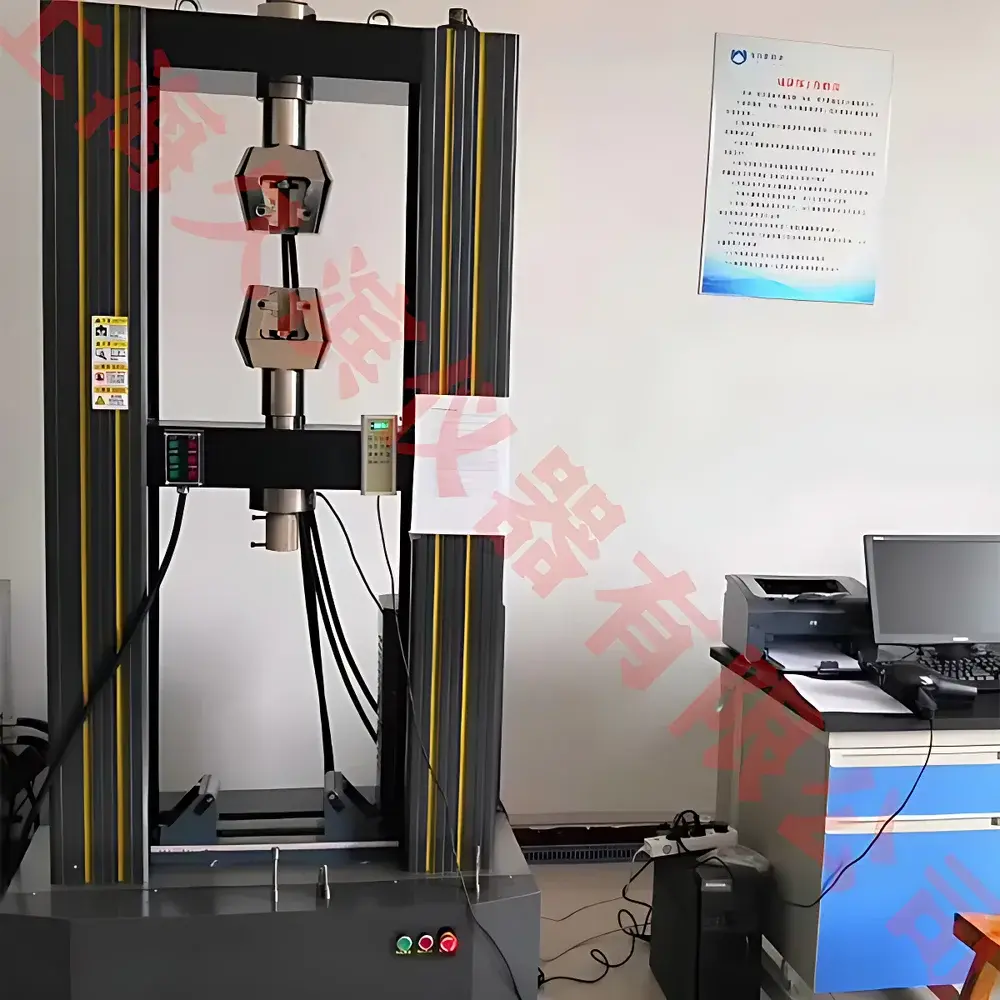
Jiubin Instruments JB-121 Advanced Tensile Tester for PV Module Encapsulant Adhesion (EVA Film)
| Brand | Jiubin Instruments |
|---|---|
| Origin | Shanghai, China |
| Manufacturer Type | Authorized Distributor |
| Country of Origin | China |
| Model | JB-121 |
| Price | USD 4,850 (FOB Shanghai) |
| Max Load Capacity | 20 kN |
| Effective Test Height | 800 mm |
| Force Sensor | Transcell (USA), 20 kN |
| Drive System | Panasonic AC Servo Motor & Controller (Japan) |
| Force Resolution | ±1/500,000 FS |
| Force Accuracy | ±0.5% of reading |
| Displacement Resolution | 0.05 mm |
| Displacement Accuracy | ±0.5% of reading |
| Strain Measurement Range | 0.2–100% FS |
| Strain Resolution | ±1/300,000 FS |
| Strain Accuracy | ±0.5% of reading |
| Speed Range | 0.001–500 mm/min (infinitely variable, segmented control) |
| Speed Accuracy | ±1% (<0.01 mm/min) |
| Force Rate Control | 0.5–6% FS/s |
| Strain Rate Control | 0.2–6% FS/s |
| Power Supply | AC 220 V, 50 Hz |
| Dimensions (W×D×H) | 800 × 400 × 1800 mm |
| Weight | ~300 kg |
| Software | Dual-language (English/Chinese) PC-based testing platform compliant with ASTM D903, ISO 8510-2, GB/T 2790-1995 |
Overview
The Jiubin Instruments JB-121 Advanced Tensile Tester is a precision electromechanical system engineered for quantitative mechanical characterization of photovoltaic (PV) module encapsulants—specifically ethylene-vinyl acetate (EVA) films—under standardized 180° peel and tensile loading conditions. Based on the Couette-type servo-controlled actuation principle, the instrument applies controlled uniaxial displacement to specimen grips while synchronously acquiring high-fidelity force, displacement, and strain data via calibrated transducers. Its architecture complies with fundamental metrological requirements defined in ISO/IEC 17025 for mechanical testing laboratories and supports traceable calibration against national standards (e.g., CNAS-accredited reference loads). Designed explicitly for solar energy R&D and QC labs, the JB-121 enables reproducible evaluation of interfacial adhesion integrity between EVA and rigid substrates—including tempered glass (3.2 mm) and polymer-based backsheets—critical parameters directly correlated with long-term module reliability, delamination resistance, and field performance degradation.
Key Features
- High-stability dual-servo actuation system utilizing Panasonic AC servo motor and digital controller, ensuring minimal thermal drift and position repeatability better than ±0.01 mm over extended test cycles.
- Transcell (USA)-sourced 20 kN load cell with resolution of ±1 part in 500,000 full scale, enabling accurate quantification of low-force peel events (e.g., initial debonding at <1 N) as well as high-load tensile rupture of composite laminates.
- Integrated extensometer-grade strain measurement capability with fixed-gauge-length sensor (0.2–100% FS range, ±0.5% accuracy), eliminating operator-dependent clip-on attachments and supporting simultaneous acquisition of stress–strain curves for EVA crosslink density assessment.
- Modular grip configuration optimized for 15 mm wide peel specimens per GB/T 2790–1995 and ASTM D903; includes pneumatic upper jaw and self-aligning lower jaw with adjustable torque clamping (0–15 N·m).
- Real-time closed-loop control of force rate (0.5–6% FS/s), displacement rate (0.001–500 mm/min), and strain rate (0.2–6% FS/s), meeting dynamic loading protocols required for accelerated aging correlation studies.
- Compliance-ready firmware architecture supporting audit trails, user access levels, electronic signatures, and raw data export in CSV and XML formats—aligned with GLP and internal QA documentation workflows.
Sample Compatibility & Compliance
The JB-121 accommodates standard PV encapsulant test geometries defined in IEC 61215-2 (MQT 18), UL 1703, and GB/T 2790–1995. Validated specimen types include: EVA/glass laminates (300 × 300 × 3.2 mm), EVA/backsheet composites (310 × 310 mm), and pre-conditioned peel strips (15 mm × 300 mm). Specimen conditioning follows GB/T 2918–1998 (23 °C / 50% RH, ≥2 h equilibration). The system fully supports post-boiling validation per industry practice: specimens immersed in deionized water at 100 °C for 3 h prior to retesting, with pass/fail thresholds set at ≥15 N/15 mm for EVA–backsheet interfaces. All mechanical outputs are traceable to SI units and compatible with ISO 14272 (peel strength of metallic coatings) and ASTM D1876 (T-peel test) comparative frameworks.
Software & Data Management
The bundled dual-language (English/Chinese) PC software provides ISO/IEC 17025-aligned test method templates—including “180° Peel Strength (GB/T 2790)” and “Tensile Modulus (ASTM D882)”—with automated calculation of mean peel force, normalized peel strength (N/mm), coefficient of variation (CV%), and graphical overlay of up to eight curves. Raw data files retain metadata such as operator ID, environmental log (via optional external hygrothermograph integration), calibration certificate IDs, and timestamped version history. Export options include PDF reports with embedded digital signatures, Excel-compatible .csv datasets, and XML schemas compliant with LIMS interfaces. Software updates—including regulatory patches for FDA 21 CFR Part 11 readiness—are provided at no cost for the instrument’s service lifetime.
Applications
- Quantitative peel strength verification of EVA adhesion to soda-lime glass and fluoropolymer-coated PET backsheets under ambient and post-humidity-stress conditions.
- Interlaboratory round-robin testing for PV materials qualification per IEC RECI 61215 Ed.3 Annex A.
- Correlation of EVA crosslink density (via gel content or FTIR) with mechanical performance metrics derived from stress–strain hysteresis loops.
- QC screening of incoming EVA rolls prior to lamination line integration, using statistical process control (SPC) dashboards embedded in the software.
- Research into alternative encapsulants (POE, silicone, thermoplastic polyolefins) requiring identical mechanical boundary conditions and data reporting structures.
FAQ
What standards does the JB-121 support for EVA peel testing?
It natively implements GB/T 2790–1995, ASTM D903, and ISO 8510-2 methodologies, with configurable test parameters matching the 180° peel geometry, speed (100 ±10 mm/min), and specimen dimensions specified in these documents.
Can the system perform tensile tests on bulk EVA film?
Yes—the fixture set includes ASTM D882-compliant dog-bone grips and programmable extension limits, enabling modulus, yield point, and elongation-at-break measurements on unreinforced EVA sheets (thickness 0.4–0.6 mm).
Is third-party calibration certification included?
A factory calibration report traceable to NIM (China National Institute of Metrology) is supplied with each unit; optional UKAS or A2LA-accredited field calibration services are available upon request.
Does the software meet regulatory requirements for electronic records?
The current v3.2 firmware supports ALCOA+ principles (Attributable, Legible, Contemporaneous, Original, Accurate), including audit trail logging, role-based permissions, and exportable raw data archives—sufficient for internal GLP audits and preliminary FDA submission preparation.
What maintenance intervals are recommended?
Biannual inspection of load cell zero balance, servo encoder alignment, and grip jaw surface wear is advised; full recalibration is recommended every 12 months or after 5,000 test cycles, whichever occurs first.



