
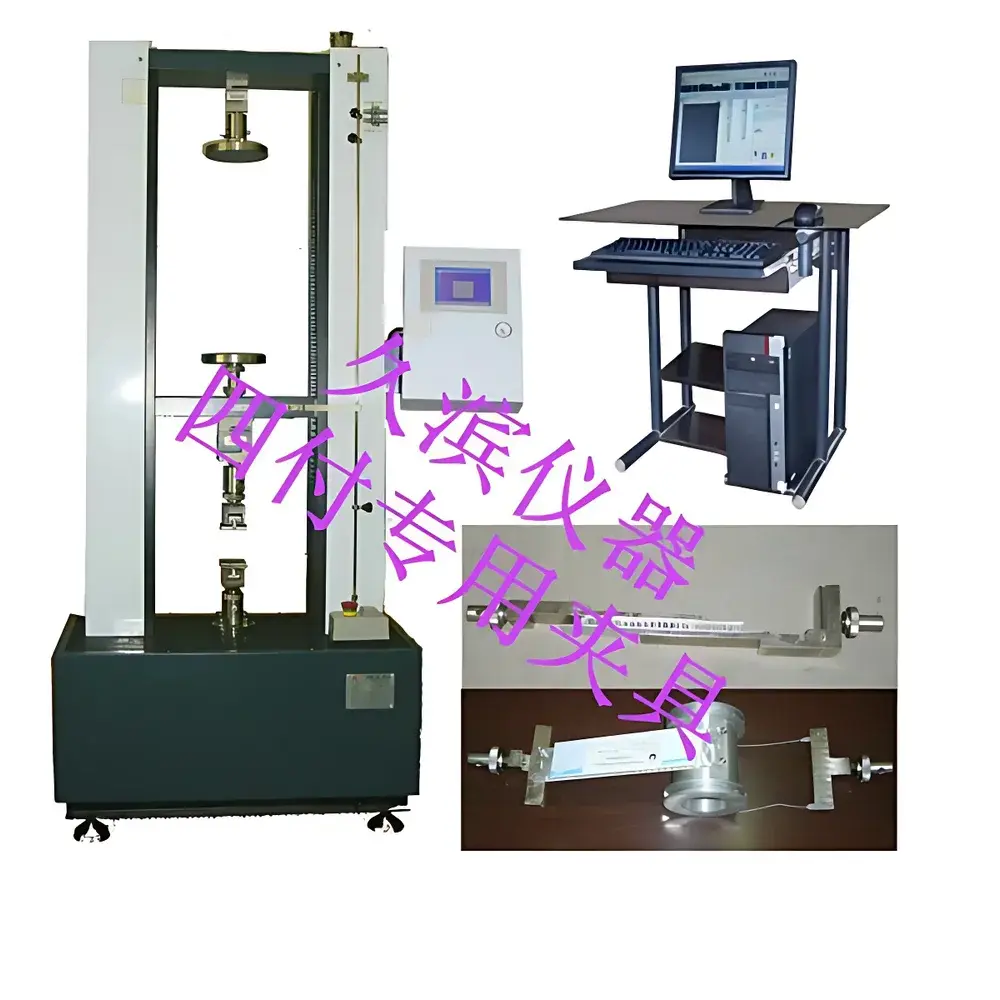
Jiubin JB-117A-F Honeycomb Aluminum Panel Drum Peel Strength Tester
| Brand | Jiubin |
|---|---|
| Model | JB-117A-F |
| Origin | Shanghai, China |
| Application | Packaging & Aerospace Composite Materials Testing |
| Max Load Capacity | 20 kN / 50 kN (selectable) |
| Effective Test Height | 1000 mm |
| Effective Test Width | 380 mm (customizable) |
| Force Accuracy | ±0.5% of full scale |
| Displacement Resolution | 0.001 mm |
| Speed Range | 0.001–500 mm/min |
| Force Resolution | 1/500,000 |
| Power Supply | AC 220 V, 50 Hz |
| Weight | ~350 kg |
| Operating Temperature | –20 ± 2 °C or 22 ± 5 °C (ambient) |
Overview
The Jiubin JB-117A-F Honeycomb Aluminum Panel Drum Peel Strength Tester is a precision-engineered universal testing system designed specifically for evaluating interfacial bond integrity in sandwich-structured composites—particularly aluminum honeycomb core panels bonded to face sheets via adhesive or brazing processes. Unlike conventional tensile testers, this instrument implements a standardized drum peel configuration per aerospace and packaging industry protocols, where the specimen is wrapped around a rotating cylindrical mandrel while a controlled tensile force is applied perpendicular to the bond line. This geometry induces uniform peel stress distribution along the adhesive interface, enabling quantitative assessment of peel resistance, failure mode classification (cohesive vs. adhesive), and long-term durability under cyclic loading conditions. The system complies with fundamental mechanical testing principles defined in ISO 8510-2 and ASTM D1781, while its structural rigidity and load train calibration support high-reproducibility data acquisition essential for QC/QA validation and material qualification workflows in certified manufacturing environments.
Key Features
- Modular dual-load-cell architecture supporting selectable 20 kN and 50 kN capacity configurations, optimized for both thin-gauge honeycomb laminates and heavy-duty structural panels.
- High-resolution electromechanical drive system with closed-loop speed control (0.001–500 mm/min), ensuring stable velocity maintenance across low-force peel initiation and high-force delamination phases.
- Integrated digital displacement encoder with 0.001 mm resolution and traceable calibration, synchronized with force acquisition at ≥1 kHz sampling rate for accurate energy-to-failure calculation (J/m²).
- Rigid C-frame construction (350 kg mass) minimizes frame compliance and vibration coupling—critical for maintaining measurement fidelity during dynamic peel events.
- Thermally stabilized test chamber compatibility (–20 ± 2 °C and ambient 22 ± 5 °C operation) enables environmental conditioning per HB5443-90 and GB/T 1457-2005 requirements.
Sample Compatibility & Compliance
The JB-117A-F accommodates standard honeycomb panel specimens per GB/T 1453-2005 (flatwise compression), GB/T 1455-2005 (shear strength), and GB/T 1457-2005 (edgewise compression), as well as non-standard geometries up to 380 mm width and 1000 mm height. Its drum peel fixture conforms to the mandrel diameter and wrap angle specifications outlined in HB5443-90 for aviation-grade aluminum honeycomb assemblies. The system supports test method alignment with ISO 11339 (adhesive peel testing), ASTM D903 (peel resistance of adhesive bonds), and EN 13445-4 Annex C (structural bonding evaluation). All force and displacement transducers are calibrated to ISO/IEC 17025-accredited standards, and raw data output meets GLP/GMP audit trail requirements—including timestamped metadata, operator ID, and calibration certificate references.
Software & Data Management
The embedded Windows-based control software provides real-time force-displacement curve visualization, automatic peak detection, and customizable pass/fail thresholds based on user-defined peel strength limits (N/mm or kN/m). Test reports export in PDF and CSV formats compliant with FDA 21 CFR Part 11 (electronic signatures, audit logs, and data immutability). Raw data files retain full-resolution time-series traces with hardware-level timestamps, enabling post-hoc analysis of crack propagation kinetics and interfacial debonding onset. Software modules include batch reporting, statistical process control (SPC) charting, and comparative overlay of multiple specimens under identical thermal-mechanical conditions.
Applications
- Qualification of adhesive systems used in aircraft radomes, wing leading edges, and interior panels per FAA AC 20-107B composite bonding guidelines.
- Process validation of hot-melt lamination parameters for lightweight transportation interiors (rail, marine, EV battery enclosures).
- Failure analysis of debonding mechanisms in fire-retardant honeycomb cores subjected to thermal cycling per UL 94 and EN 45545-2.
- Comparative evaluation of surface pretreatment efficacy (e.g., plasma activation, chromic acid etching) on aluminum foil adhesion performance.
- Supporting R&D of hybrid metal-polymer sandwich structures for architectural cladding and cleanroom wall systems.
FAQ
Does the JB-117A-F comply with ASTM D1781 for drum peel testing?
Yes—the machine’s mandrel geometry, grip alignment tolerances, and speed regulation meet all dimensional and procedural requirements specified in ASTM D1781-16.
Can the system be integrated into an existing MES or LIMS environment?
Yes—via OPC UA or TCP/IP protocol support, enabling bidirectional data exchange with LabVantage, Thermo Fisher SampleManager, or Siemens Opcenter.
Is third-party calibration certification included with delivery?
Each unit ships with a factory-issued ISO/IEC 17025-compliant calibration certificate covering force, displacement, and speed subsystems, valid for 12 months.
What safety standards does the mechanical design satisfy?
The frame and emergency stop circuitry conform to CE Machinery Directive 2006/42/EC, including EN ISO 13857 (safety distances) and EN 60204-1 (electrical equipment).
Are custom fixtures available for non-standard honeycomb core densities or cell sizes?
Yes—Jiubin offers engineering consultation and CNC-manufactured mandrels, grips, and alignment jigs tailored to specific cell diameters (1.5–12 mm), foil thicknesses (0.005–0.1 mm), and core heights (6–100 mm).




