
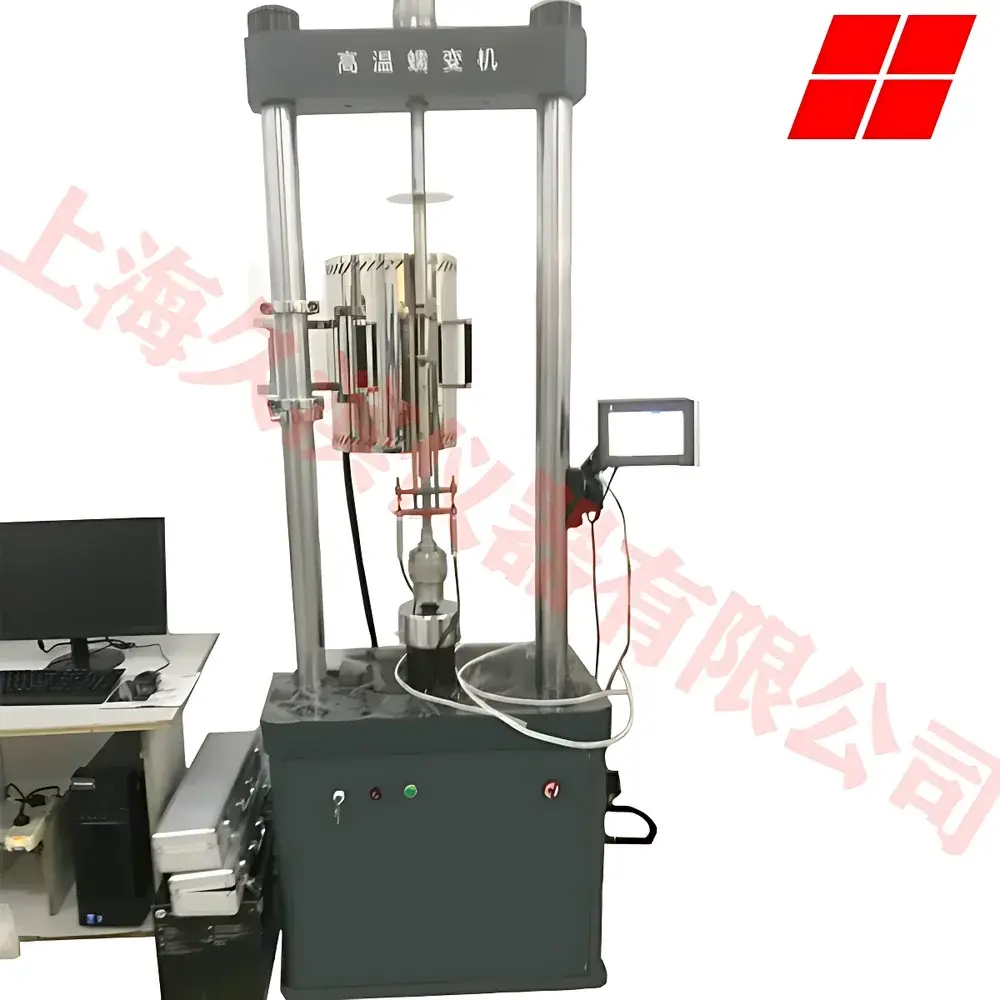
Jiubin JB/RD Electronic High-Temperature Creep and Stress Rupture Testing Machine
| Brand | Jiubin |
|---|---|
| Origin | Shanghai, China |
| Model | JB/RD |
| Type | Electromechanical Testing System |
| Max Test Load | 30 kN |
| Maximum Crosshead Travel | 500 mm |
| Dimensions (L×W×H) | 2100 × 710 × 540 mm |
| Unit Weight | 500 kg |
| Compliance | JJG 276–2009, JJF 1298–2011, GB/T 2039–1997 |
Overview
The Jiubin JB/RD Electronic High-Temperature Creep and Stress Rupture Testing Machine is a precision-engineered electromechanical system designed for time-dependent mechanical characterization of metallic materials under sustained load at elevated temperatures. It operates on the fundamental principles of uniaxial tensile creep testing—measuring strain evolution as a function of time under constant load and temperature—and stress rupture testing—determining time-to-failure at fixed stress levels across a defined thermal range. Unlike purely mechanical or hydraulic systems, this instrument integrates a high-resolution servo-controlled actuator with a fully digital closed-loop control architecture, enabling precise load regulation, real-time displacement feedback, and synchronized thermal profiling via integrated furnace interfaces. The system supports continuous operation up to 1200 °C (dependent on furnace configuration), with thermal uniformity compliant with ASTM E220 and ISO 15148 standards for high-temperature dimensional stability. Its modular design accommodates interchangeable load frames, extensometers, and environmental chambers, making it suitable for both standardized qualification testing and advanced research protocols in metallurgy, power generation, and aerospace material development.
Key Features
- Electromechanical actuation system with ±0.5% load accuracy and <0.1% full-scale resolution over the 1–30 kN range
- Digital closed-loop control with programmable ramp-hold profiles for load, temperature, and displacement sequences
- Integrated high-temperature furnace with axial thermal gradient control (<±2 °C over 100 mm gauge length per ASTM E111)
- High-stability quartz or ceramic extensometry options (contact and non-contact) compatible with temperatures up to 1100 °C
- Robust structural frame with 500 kg mass and vibration-damped base mounting for long-duration tests (>10,000 h)
- Compliance with national metrological verification requirements per JJG 276–2009 and type evaluation criteria per JJF 1298–2011
- Support for multi-stage testing protocols including creep–fatigue interaction, stress relaxation, and interrupted tensile testing
Sample Compatibility & Compliance
The JB/RD system accommodates standard cylindrical and flat-sheet specimens per ASTM E139, ISO 204, and GB/T 2039–1997 geometries, with gauge lengths from 25 mm to 100 mm and diameters up to 12 mm. Specimen heating is achieved via split-tube or three-zone furnaces, ensuring radial symmetry and axial homogeneity essential for valid creep data acquisition. All test configurations adhere to GLP-compliant documentation practices, and raw measurement logs include timestamped metadata traceable to NIST-traceable calibration certificates. The system satisfies functional requirements for ISO/IEC 17025-accredited laboratories and supports audit-ready reporting for regulatory submissions under ASME BPVC Section II, Part D and EN 10291.
Software & Data Management
Control and analysis are performed using Jiubin’s proprietary CreepTest Suite v4.x—a Windows-based application supporting IEC 62443-aligned cybersecurity protocols and FDA 21 CFR Part 11-compliant electronic signatures. The software provides real-time visualization of creep curves (strain vs. time), derivative creep rate plots, Larson–Miller parameter calculation, and rupture life extrapolation via Monkman–Grant and Orr–Sherby–Dorn models. All datasets are stored in vendor-neutral HDF5 format with embedded metadata (test parameters, calibration IDs, operator credentials, environmental logs). Export modules support CSV, XML, and ASTM E1431-compliant ASCII formats for integration into LIMS and enterprise QA/QC platforms.
Applications
- Creep property mapping of Ni-based superalloys for turbine disk and blade qualification
- Stress rupture life assessment of pressure vessel steels in nuclear and fossil-fuel power plants
- Time-dependent deformation modeling for additive-manufactured Ti-6Al-4V components
- Intergranular embrittlement studies under combined thermal–mechanical loading
- Validation of constitutive models used in finite element simulations (e.g., ABAQUS CREEP, ANSYS Norton-Bailey)
- Research-grade fatigue–creep interaction experiments under out-of-phase thermal cycling
FAQ
What temperature range is supported for creep testing?
Standard furnace configurations support 20 °C to 1100 °C; optional high-temp furnaces extend capability to 1200 °C with appropriate specimen fixturing.
Is the system compatible with third-party data acquisition hardware?
Yes—via analog voltage outputs (±10 V) and Ethernet TCP/IP API, enabling integration with external DAQ systems and SCADA networks.
Does the software support automated pass/fail evaluation against specification limits?
Yes—user-defined acceptance criteria can be applied to rupture time, minimum creep rate, and total elongation metrics with configurable alerts and report flags.
Can the machine perform simultaneous creep and fatigue cycling?
Yes—the system supports superimposed sinusoidal or trapezoidal load waveforms on static creep bias, per ASTM E2714 and ISO 1099 guidelines.
What calibration standards are used for load cell and extensometer traceability?
Load cells are calibrated per ISO 376 Class 0.5; extensometers are verified using NIST-traceable gauge blocks and laser interferometry per ISO 9513.



