
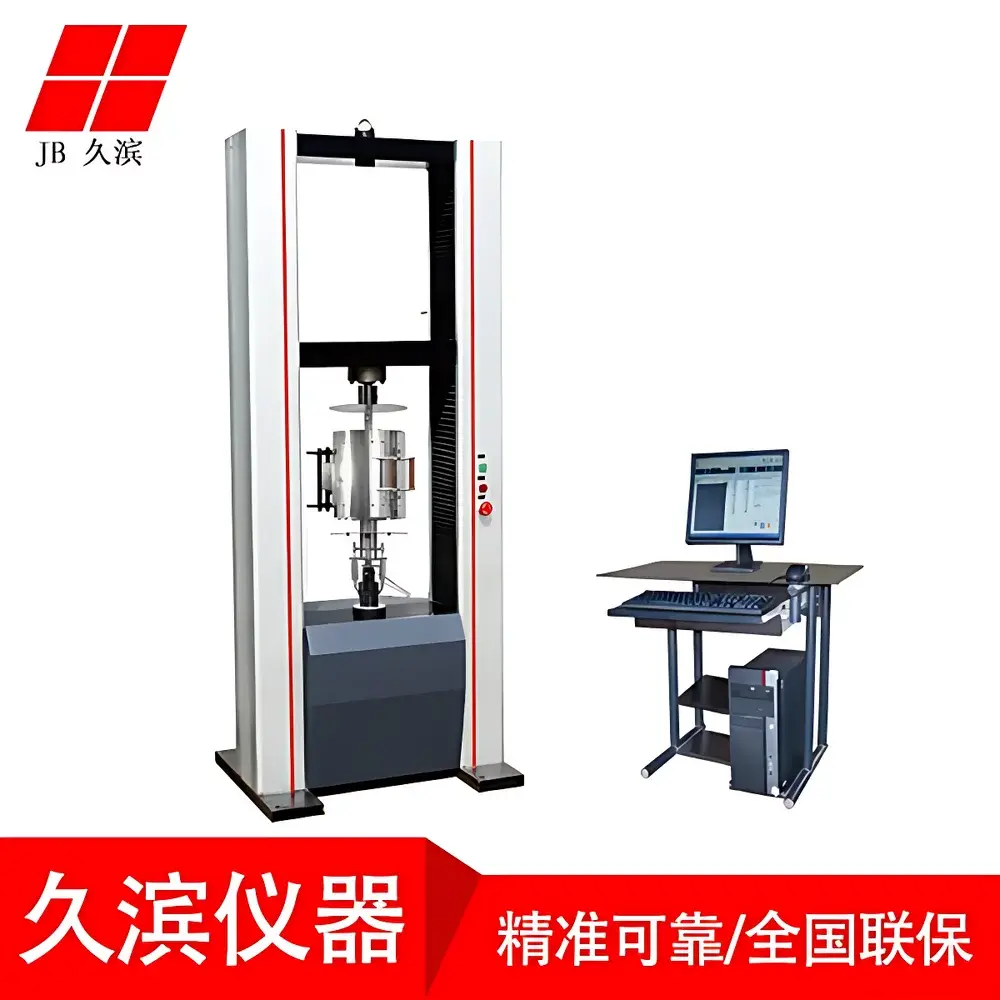
Jiubin JB-H Series High-Temperature Electronic Universal Testing Machine
| Brand | Jiubin |
|---|---|
| Origin | Shanghai, China |
| Manufacturer Type | Authorized Distributor |
| Country of Origin | China |
| Model | JB-H |
| Instrument Type | Electronic Universal Testing Machine |
| Compliance Standards | GB/T 4338, HB 5195, GB/T 2039, HB 5150 |
| Temperature Range | Up to 1200 °C (configurable) |
| Furnace Configuration | Split-cylindrical or monolithic three-zone controlled high-temperature furnace |
| Test Capabilities | Tensile, creep, and stress-rupture testing under elevated temperature |
| Specimen Compatibility | Cylindrical rods, rectangular bars, tubular specimens |
| Extensometry | High-temperature clip-on or non-contact extensometer options |
| Load Frame Integration | Modular mounting for compatibility with standard electromechanical UTM frames |
Overview
The Jiubin JB-H Series High-Temperature Electronic Universal Testing Machine is an engineered solution for mechanical property evaluation of metallic and advanced non-metallic materials under thermally elevated conditions. It operates on the fundamental principle of controlled uniaxial force application—via precision servo-controlled electromechanical actuation—while maintaining specimen temperature stability within a calibrated high-temperature furnace environment. Designed in strict accordance with internationally referenced national standards—including GB/T 4338 (Metallic Materials — Tensile Testing at Elevated Temperatures), HB 5195 (Creep Testing of Metals), GB/T 2039 (Creep and Stress-Rupture Testing), and HB 5150 (High-Temperature Tensile Testing of Metals)—the system supports standardized tensile, creep, and stress-rupture test protocols across temperatures up to 1200 °C. Its modular architecture allows seamless integration with existing universal testing frames, enabling laboratories to retain capital investment in mechanical load frames while upgrading thermal capability as needed.
Key Features
- Modular high-temperature furnace system: Available in split-cylindrical (two-halves) or monolithic configurations, both featuring three independently controlled heating zones for uniform axial temperature distribution and minimized thermal gradient across gauge length.
- Thermally compensated mechanical train: Includes high-temperature pushrods, water-cooled load train interfaces, and refractory-alloy grips rated for continuous operation at ≥1100 °C.
- Integrated high-temperature extensometry: Supports both contact-type high-temperature clip-on extensometers (with ceramic knife-edges and air/water cooling) and non-contact optical extensometers (for applications requiring zero mechanical interference).
- Real-time thermal-mechanical synchronization: Dual-channel closed-loop control ensures simultaneous regulation of furnace temperature (±1 °C accuracy) and applied load/displacement (per ISO 7500-1 Class 1 or better).
- Quick-change ambient-to-high-temperature configuration: The furnace assembly mounts/dismounts without recalibration; ambient testing resumes immediately upon furnace removal—no requalification required.
- Robust mechanical interface: Standardized ISO M12 and M16 mounting patterns enable compatibility with major UTM brands including Instron, ZwickRoell, and MTS load frames.
Sample Compatibility & Compliance
The JB-H accommodates standardized specimen geometries per GB/T 4338 and ASTM E21, including round bars (diameters 3–12 mm), flat rectangular coupons (thickness ≤6 mm), and thin-walled tubing (OD ≤25 mm). All furnace and grip assemblies are traceably calibrated against NIM (National Institute of Metrology, China) certified reference standards. System validation documentation supports GLP-compliant environments and satisfies audit requirements for ISO/IEC 17025 accredited testing laboratories. Test reports generated include full metadata: furnace zone temperatures, load history, displacement, strain rate, and time-at-temperature—structured to align with FDA 21 CFR Part 11 electronic record integrity expectations where configured with compliant software modules.
Software & Data Management
Control and data acquisition are managed via Jiubin’s proprietary TMS-Link™ software platform, compatible with Windows 10/11 (64-bit). The software provides real-time dual-axis plotting (load vs. displacement, temperature vs. time), automated test sequence scripting, and compliance mode selection (e.g., “GB/T 4338 Mode” enforces mandatory hold times, ramp rates, and data sampling intervals). Raw data exports in CSV and XML formats preserve all channel timestamps and engineering units. Optional audit-trail module logs user actions, parameter changes, and calibration events with digital signatures—meeting minimum requirements for regulated quality systems operating under GMP or AS9100 frameworks.
Applications
- Evaluation of superalloys (Inconel, Hastelloy, Waspaloy) for aerospace turbine components.
- Creep life prediction of stainless steels and titanium alloys used in power generation piping.
- Stress-rupture qualification of ceramic matrix composites (CMCs) and refractory metals.
- High-temperature modulus and yield strength characterization of nickel-based brazing alloys.
- Material certification per MIL-STD-883, ASTM E139, and ISO 204 for defense and nuclear applications.
- R&D of next-generation battery electrode substrates and high-temperature polymer composites.
FAQ
What maximum temperature can the JB-H furnace achieve?
Standard configurations support up to 1200 °C; custom variants extend to 1400 °C using molybdenum disilicide (MoSi₂) heating elements and sintered alumina insulation.
Is the system compatible with third-party UTM frames?
Yes—mechanical and electrical interfaces follow ISO 26203-2 guidelines; adapter kits are available for Instron 5500R, Zwick Z100/Z250, and MTS Criterion series frames.
Does the system support automatic creep testing with multi-step loading?
Yes—TMS-Link™ includes pre-defined creep test templates (constant-load, step-load, ramp-hold) with configurable dwell durations and termination criteria (e.g., strain threshold or time limit).
How is thermal expansion of the load train compensated during measurement?
The system employs a dual-sensor compensation algorithm that subtracts thermal drift from the extensometer signal using real-time furnace zone temperature feedback and material-specific CTE coefficients stored in the calibration database.
Can test data be exported to LIMS or ERP platforms?
Yes—via OPC UA server integration or scheduled CSV/XML export with configurable naming conventions and folder mapping; API documentation is provided under NDA for enterprise IT integration.



