
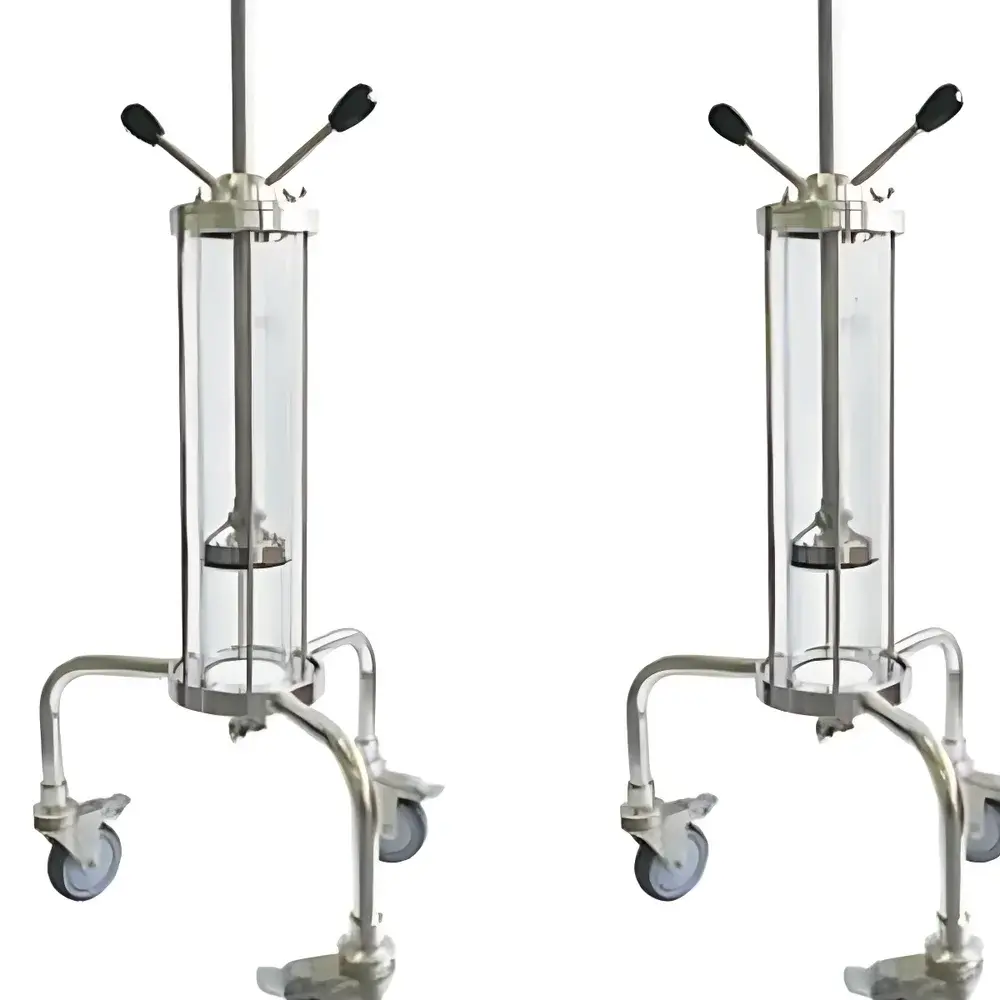
JIZHOU MCH Series Sanitary Manual Axial Compression Chromatography Column
| Brand | JIZHOU |
|---|---|
| Origin | Jiangsu, China |
| Manufacturer Type | Authorized Distributor |
| Country of Origin | China |
| Model | MCH |
| Pricing | Upon Request |
| Column Tube ID | 70–450 mm |
| Column Tube Height | 500–1000 mm |
| Packing Height Range | 0–82 cm |
| Max Operating Pressure | ≤8 bar |
| Weight | 15–230 kg |
| Material Compliance | USP Class VI (USP <88> In Vivo Biological Reactivity Testing) |
| Sealing | O-ring interface between platen and column tube |
| Screen Retention | Snap-fit design |
| Construction | Precision borosilicate glass tube (bubble-free, scratch-free surface) |
Overview
The JIZHOU MCH Series Sanitary Manual Axial Compression Chromatography Column is an engineered solution for scalable, GMP-aligned chromatographic purification in biopharmaceutical process development and pilot-scale manufacturing. Designed around axial compression mechanics—where a manually actuated screw-driven platen applies uniform, controllable pressure to the packed bed—the system ensures consistent bed density and minimizes channeling or void formation during packing and operation. Unlike fixed-bed or gravity-fed columns, axial compression enables reproducible column performance across variable resin compressibility (e.g., agarose- vs. rigid polymer-based media), making it especially suitable for high-resolution separations of monoclonal antibodies (mAbs), viral vectors, recombinant enzymes, vaccine antigens, and natural product extracts. The column’s all-glass construction—using optically clear, low-metallic-impurity borosilicate tubing—provides full visual bed inspection, eliminates leachables, and supports rigorous cleaning-in-place (CIP) and sterilization-in-place (SIP) protocols.
Key Features
- Precision borosilicate glass column tube: Manufactured to optical-grade clarity with zero bubbles, micro-scratches, or surface defects—critical for microbial control and long-term column integrity.
- Sanitary mechanical design: Fully compliant with core principles of Good Manufacturing Practice (GMP); smooth internal surfaces, crevice-free geometry, and absence of dead-legs reduce bioburden risk and support validation of cleaning efficacy.
- Manual axial compression mechanism: A calibrated, stainless-steel screw drive enables precise, repeatable adjustment of bed height and packing pressure—no external power source or hydraulic system required.
- O-ring sealed platen interface: Ensures leak-tight operation up to 8 bar while permitting rapid disassembly for maintenance or resin replacement.
- Tool-free screen retention: Snap-fit stainless-steel or polyetheretherketone (PEEK) frits allow quick, sterile-compatible exchange without wrenches or torque tools—reducing downtime and cross-contamination risk.
- USP Class VI-compliant polymers: All wetted elastomers and structural plastics meet United States Pharmacopeia <88> requirements for in vivo biological reactivity, supporting use in clinical-grade purification workflows.
Sample Compatibility & Compliance
The MCH column accommodates a broad spectrum of chromatographic media—including but not limited to Sepharose™, Capto™, Toyopearl®, SOURCE™, and custom functionalized resins—for size exclusion (SEC/GFC), ion exchange (IEX), hydrophobic interaction (HIC), affinity (e.g., Protein A, Ni-NTA), and multimodal chromatography. Its pressure rating (≤8 bar) aligns with standard laboratory and pilot-scale peristaltic or low-pressure HPLC systems. Regulatory documentation—including material traceability, extractables testing summaries, and USP Class VI certification—is available upon request to support FDA submissions, EMA Annex 1 assessments, and ISO 13485 quality system audits. The column’s design inherently supports ALCOA+ data integrity principles when integrated with validated chromatography software platforms.
Software & Data Management
While the MCH column operates manually, its mechanical repeatability and dimensional consistency enable robust integration into digitally controlled purification workflows. When paired with third-party chromatography systems (e.g., Cytiva ÄKTA, Bio-Rad NGC, or Shimadzu LC-20), column parameters—including inner diameter, bed height, and void volume—are programmatically referenced in method files. All physical dimensions and pressure limits are pre-configured in common instrument control software to prevent operational overpressure events. Audit trails, calibration logs, and packing history can be maintained externally using LIMS or electronic batch record (EBR) systems compliant with 21 CFR Part 11 requirements.
Applications
- Process development of therapeutic proteins: Optimization of loading capacity, elution gradient, and wash stringency under GMP-relevant conditions.
- Pilot-scale purification of viral vectors (AAV, lentivirus): Handling large-particle, shear-sensitive biomolecules with minimal aggregation.
- Downstream processing of biosimilars: Reproducible scaling from lab to clinical manufacturing via geometric similarity (constant L/D ratio).
- Natural product isolation: High-yield capture of alkaloids, terpenoids, or polysaccharides from complex botanical extracts.
- QC/QA release testing: Use as a qualification tool for new resin lots or column re-packing validation per ICH Q5A and Q5D guidelines.
FAQ
What is the maximum recommended operating pressure for the MCH column?
The column is rated for continuous operation up to 8 bar; short-term pressure spikes must remain below 10 bar to preserve glass integrity and seal longevity.
Can the MCH column be autoclaved?
Yes—the glass tube, stainless-steel platen, and USP Class VI-compliant O-rings are compatible with steam sterilization at 121°C for 30 minutes; PEEK frits require validation per resin compatibility guidelines.
Is column calibration required before each run?
No formal recalibration is needed; however, users should verify bed height and platen position using the engraved scale on the column body prior to packing to ensure method transfer fidelity.
How is cleaning validation supported?
Smooth internal glass surfaces and absence of threaded joints or weld seams simplify rinse efficiency studies; residue recovery tests may be performed using conductivity, UV absorbance, or ELISA-based assays per ASTM E3069 or PDA TR75.
Does JIZHOU provide column qualification documentation?
Yes—certificates of conformance, material declarations, and USP <88> test reports are supplied with each unit; additional IQ/OQ documentation packages are available under NDA.
Related Products




