
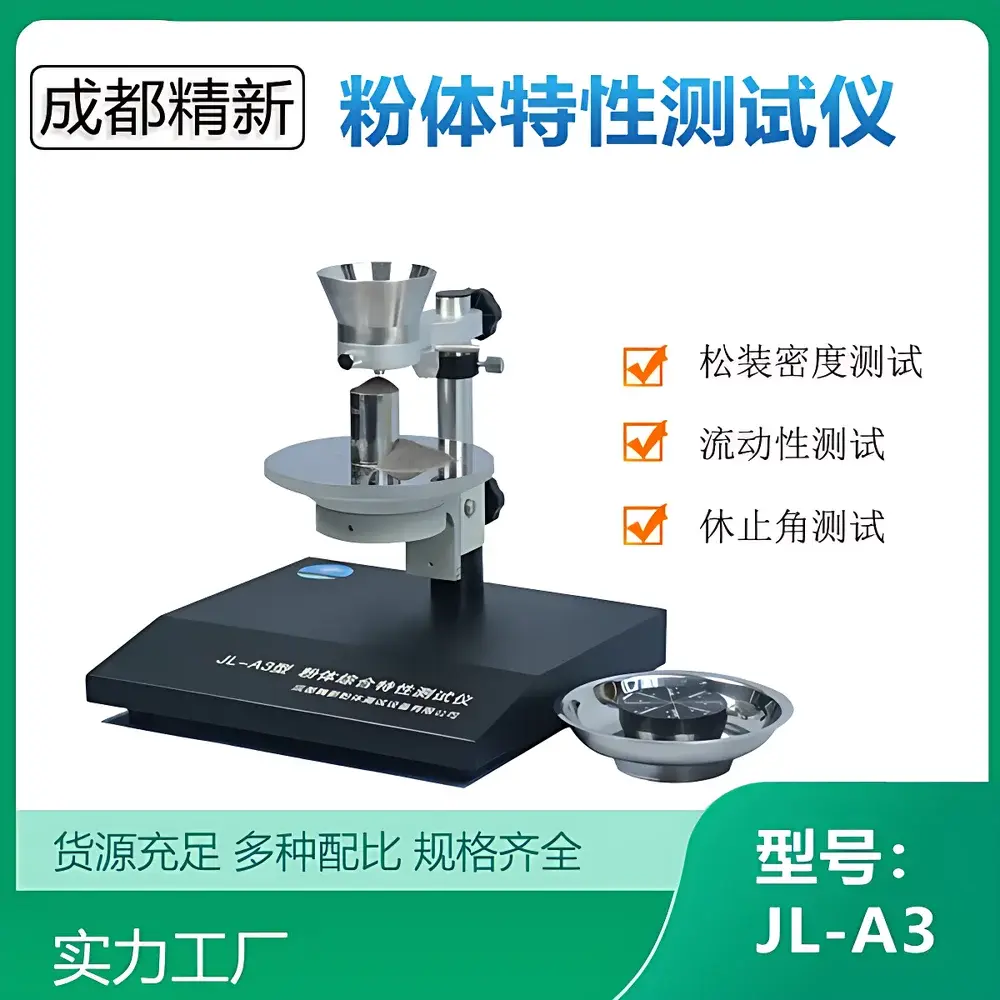
JL-A3 Powder Flowability, Angle of Repose, and Bulk Density Tester
| Brand | JL (Chengdu Jingxin) |
|---|---|
| Model | A-3 |
| Origin | Sichuan, China |
| Manufacturer Type | Direct Manufacturer |
| Instrument Type | Angle of Repose Tester, Bulk Density Tester, Powder Flowability Tester |
| Measurable Parameters | Angle of Repose, Flow Time (Haller Flow Rate), Bulk Density |
| Maximum Sample Capacity | 100 g |
| Minimum Sample Requirement | 50 g |
| Funnel Outlet Diameter | 5 mm (standard), optional 2.5 mm |
| Stainless Steel Cup Volume | 25 mL |
| Funnel Cone Angle | 60° |
| Repose Plate Diameter | 80 mm |
| Scale Resolution | 1 mm |
| Dimensions | 300 × 260 × 260 mm |
| Net Weight | ~5 kg |
Overview
The JL-A3 Powder Flowability, Angle of Repose, and Bulk Density Tester is a manually operated, benchtop tri-functional instrument engineered for standardized physical characterization of dry free-flowing powders and granular materials. It implements three fundamental ASTM- and ISO-aligned powder property measurement principles: Hall flow rate (mass/time through a calibrated orifice), angle of repose (static stability of a conical powder heap), and bulk density (mass per unit volume under gravity-fed, unconfined conditions). Designed in strict compliance with GB/T 1482–2010 (equivalent to ISO 4490:2018 for metal powders), GB/T 1479.1–2017 (aligned with ASTM B527 and ISO 3953), and GB/T 16913.4–2008 (corresponding to ISO 4762 and ASTM D6393), the system provides reproducible, operator-independent data essential for QC/QA workflows in powder metallurgy, battery cathode/anode material production, pharmaceutical solid dosage development, food ingredient formulation, and academic powder mechanics research.
Key Features
- Tri-functional modular design: single platform supports Hall flow time, angle of repose, and bulk density determinations without hardware reconfiguration—only positional adjustment of funnel, plate, or cup.
- High-precision stainless steel (AISI 304) components: funnel, 25 mL volumetric cup, and 25 mm wide leveling ruler are electropolished to minimize surface adhesion and ensure long-term dimensional stability.
- Adjustable height mechanism with calibrated micrometer-style scale (1 mm resolution): enables precise vertical positioning of the repose plate relative to the funnel outlet—critical for consistent heap formation per GB/T 16913.4.
- Integrated shutter gate at funnel base: eliminates manual occlusion; ensures repeatable start/stop timing and prevents premature powder discharge during sample loading.
- Standardized geometry: 60° funnel cone angle and 5 mm orifice diameter conform to Hall flow specifications; optional 2.5 mm orifice available for fine or cohesive powders per ASTM D6393 Annex A2.
- Benchtop footprint (300 × 260 × 260 mm) and lightweight construction (~5 kg): facilitates placement in fume hoods, gloveboxes, or shared lab environments without structural reinforcement.
Sample Compatibility & Compliance
The JL-A3 is validated for use with non-cohesive to moderately cohesive dry powders exhibiting particle sizes from 10 µm to 500 µm. It is not suitable for hygroscopic, electrostatically charged, or highly aerated materials without prior conditioning (e.g., 105 °C oven drying per GB/T 1479.1–2017). All test protocols adhere to internationally recognized standards: Hall flow testing follows GB/T 1482–2010 (ISO 4490), bulk density determination complies with GB/T 1479.1–2017 (ASTM B527, ISO 3953), and angle of repose measurement conforms to GB/T 16913.4–2008 (ISO 4762, ASTM D6393). The instrument supports GLP-aligned documentation when used with its companion software—data inputs, operator ID, date/time stamps, and calculation logs are retained for audit readiness.
Software & Data Management
The included Windows-based calculation software (v3.2+) accepts raw inputs—flow time (s), repose heap height (mm), small plate radius (mm), and mass (g)—and applies standardized formulas per referenced national and international methods. Output reports are generated in user-selectable languages (English or Chinese) and exportable to Word (.docx), Excel (.xlsx), and PDF formats. Each report includes instrument ID, test standard reference, raw input fields, calculated values (e.g., g/s for flow rate, ° for angle of repose, g/cm³ for bulk density), and operator metadata. While the software does not support real-time sensor integration or 21 CFR Part 11 electronic signatures, it maintains full traceability of manual entries and permits local archival—meeting minimum requirements for ISO/IEC 17025 Clause 7.7 record retention in accredited laboratories.
Applications
- Quality control of lithium iron phosphate (LFP), NMC, and graphite powders prior to electrode slurry preparation.
- Batch release testing of metal injection molding (MIM) feedstocks and additive manufacturing (AM) metal powders (e.g., Ti-6Al-4V, Inconel 718).
- Formulation screening of excipients (microcrystalline cellulose, lactose monohydrate) in tablet development per USP <1174>.
- Raw material qualification for food-grade starches, cocoa powders, and powdered dairy products under Codex Alimentarius guidelines.
- Fundamental research on powder rheology correlations—e.g., linking angle of repose to internal friction angle in DEM simulations.
- Third-party certification labs performing routine testing per CNAS-CL01:2018 (equivalent to ISO/IEC 17025).
FAQ
What standards does the JL-A3 comply with?
It conforms to GB/T 1482–2010 (ISO 4490), GB/T 1479.1–2017 (ISO 3953), and GB/T 16913.4–2008 (ISO 4762), with method equivalence documented in the user manual.
Can the instrument measure cohesive or moisture-sensitive powders?
Yes—provided samples are preconditioned per GB/T 1479.1: dried at 105 °C until constant mass, then cooled in a desiccator prior to testing.
Is calibration traceable to national standards?
The stainless steel volumetric cup (25 mL) and linear scale (1 mm resolution) are factory-verified against certified dimensional standards; users should perform periodic verification using NIST-traceable calipers and certified weights.
Does the software support automated data logging from external balances or timers?
No—the software accepts only manual entry of measured values; it does not interface with USB/RS232 balances or digital stopwatches.
What maintenance is required?
Daily cleaning of funnel interior and cup with lint-free cloth; quarterly inspection of shutter gate alignment and scale readability; annual verification of funnel orifice diameter using optical comparator or pin gauge set.



