
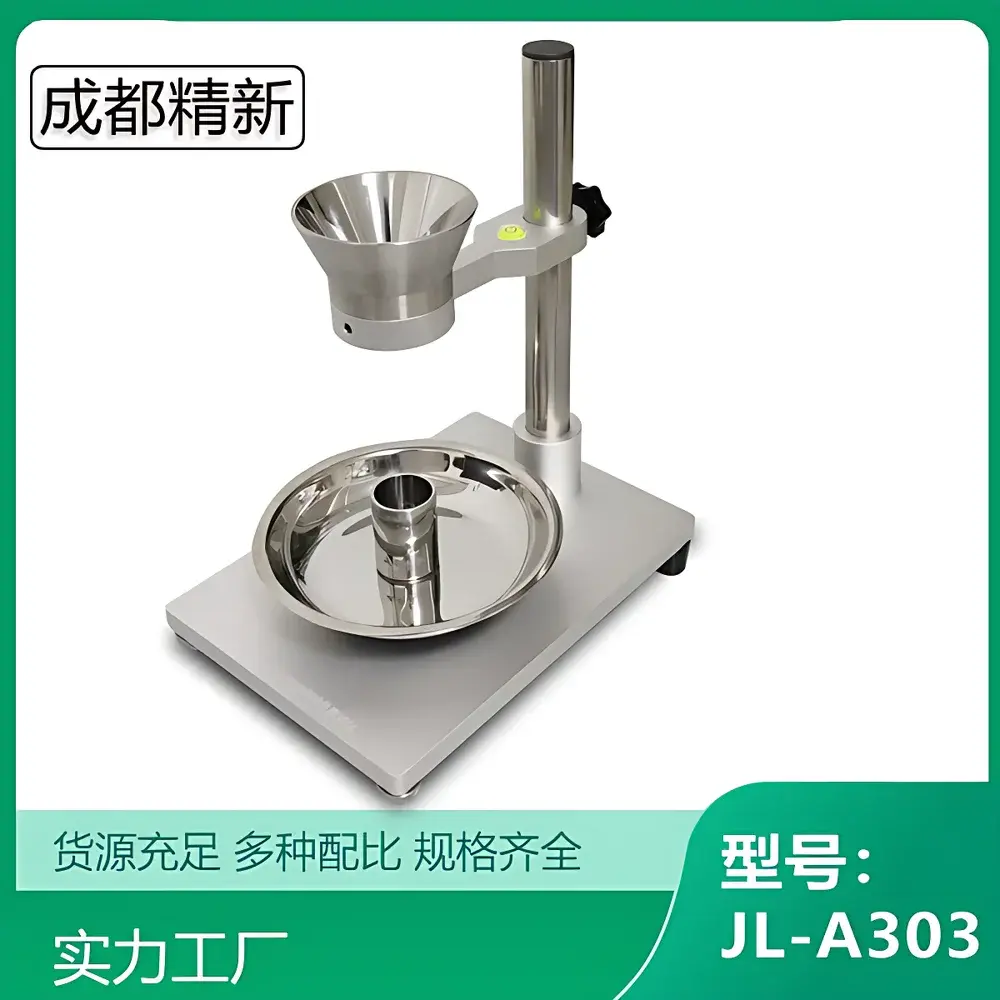
JL-A303 JinXin Metal Powder Bulk Density and Flow Rate Tester (Standard Funnel Method)
| Brand | Chengdu JinXin (CDJX) |
|---|---|
| Origin | Sichuan, China |
| Manufacturer Type | Direct Manufacturer |
| Instrument Type | Bulk Density & Flow Tester |
| Design | Portable Benchtop Unit |
| Measurement Principle | Standard Funnel Flow (Hall Flowmeter) & Gravimetric Bulk Density |
| Applicable Standards | GB/T 1482–2010, GB/T 1479.1–2011 |
| Funnel Orifice Diameters | 2.5 mm and 5.0 mm |
| Funnel-to-Cylinder Distance | 25 mm ± 2 mm (adjustable) |
| Funnel Angle | 60° |
| Cylinder Volume | 25 mL (stainless steel 304) |
| 刮刀 (Steel Ruler) | 25 mm wide, stainless steel 304 |
| Stopper Rod | Stainless steel 304 |
| Dimensions | ≈ 230 × 170 × 300 mm |
| Weight | 3.7 kg |
| Required Ancillaries | Analytical balance (max 1 kg, d = 0.02 g), stopwatch (0.01 s resolution) |
Overview
The JL-A303 JinXin Metal Powder Bulk Density and Flow Rate Tester is a precision-engineered benchtop instrument designed for the standardized determination of two critical powder physical properties: bulk density (also termed “apparent density” or “loose density”) and flow rate — commonly referred to as Hall flow rate for metallic powders. It implements the classical gravitational funnel method in strict accordance with internationally recognized national standards, including GB/T 1482–2010 (equivalent in principle to ASTM B213 and ISO 4490 for metal powder flow rate) and GB/T 1479.1–2011 (aligned with ISO 3953 for bulk density of metal powders). The device operates on fundamental principles of gravity-driven powder discharge under controlled geometric conditions: flow rate is quantified as mass per unit time (g/s), while bulk density is derived from the ratio of mass to fixed volumetric capacity (g/mL) after free-fall compaction into a calibrated cylinder. Its design emphasizes repeatability, operator independence, and compliance-ready documentation — making it suitable for routine QC in powder metallurgy, additive manufacturing feedstock qualification, battery cathode/anode material evaluation, and academic research laboratories.
Key Features
- Interchangeable stainless steel (304) funnels with precisely machined orifices of 2.5 mm and 5.0 mm — enabling testing across diverse powder particle size distributions and flow regimes.
- Adjustable funnel-to-cylinder vertical distance (25 mm ± 2 mm), maintained via calibrated height-locking bracket assembly to ensure consistent aerodynamic entry conditions.
- 60° conical funnel geometry optimized to minimize wall adhesion and promote laminar, unobstructed powder discharge — validated against GB/T 1482–2010 dimensional tolerances.
- Integrated stainless steel (304) cylindrical receiver (25 mL nominal volume), precision-machined to ISO/IEC 17025 traceable dimensional specifications for gravimetric density calculation.
- Dedicated stainless steel straight-edge scraper (25 mm width) and stopper rod — corrosion-resistant, non-reactive, and dimensionally stable for repeatable powder leveling and flow initiation.
- Modular, rigid aluminum alloy frame with anti-slip rubber feet and detachable powder collection tray — ensuring mechanical stability during dynamic discharge and ease of cleaning between samples.
- Compact footprint (230 × 170 × 300 mm) and lightweight construction (3.7 kg) support flexible deployment in cleanrooms, gloveboxes, and multi-station testing labs without requiring dedicated anchoring.
Sample Compatibility & Compliance
The JL-A303 is validated for free-flowing metallic powders — including but not limited to stainless steel, titanium alloys (e.g., Ti-6Al-4V), nickel-based superalloys, aluminum alloys, and copper powders — provided they pass through a 2.5 mm or 5.0 mm orifice without bridging or rat-holing. It is unsuitable for cohesive, hygroscopic, or electrostatically charged powders unless preconditioned (e.g., via controlled humidity conditioning or antistatic treatment). All structural components comply with ISO 80000-1 for metric units and GB/T 1220–2007 for stainless steel 304 material certification. The instrument facilitates adherence to GLP (Good Laboratory Practice) and GMP-aligned workflows when paired with a calibrated balance (0.02 g readability) and NIST-traceable stopwatch. Test reports generated using this system satisfy documentation requirements for internal audit trails, supplier qualification dossiers, and regulatory submissions referencing GB, ASTM, or ISO powder characterization protocols.
Software & Data Management
The JL-A303 is a manual, hardware-only tester with no embedded electronics or proprietary software. This architecture eliminates firmware dependencies, cybersecurity risks, and vendor lock-in — aligning with ISO/IEC 17025 Clause 6.4.3 (equipment verification) and FDA 21 CFR Part 11 flexibility for paper-based or LIMS-integrated data capture. Users record raw measurements (mass, time, replicate identifiers) directly into laboratory notebooks or validated spreadsheets. For digital workflow integration, test data may be imported into LIMS or ELN platforms supporting CSV/Excel ingestion. Built-in repeatability checks — such as mandatory triplicate measurement per sample and arithmetic mean reporting — enforce statistical rigor consistent with ISO 5725-2:2019 accuracy and precision guidelines. Calibration certificates for ancillary equipment (balance, stopwatch) are required to maintain full metrological traceability.
Applications
- Quality control of atomized metal powders prior to laser powder bed fusion (LPBF) or binder jetting processes.
- Batch release testing for sintered component manufacturers verifying feedstock consistency across production lots.
- Research into powder surface modification effects (e.g., plasma treatment, stearic acid coating) on flow dynamics and packing behavior.
- Comparative assessment of particle morphology impact — e.g., spherical vs. irregular powders — on bulk density and Hall flow rate.
- Supporting ASTM F3049–14 (standard guide for metal powder characterization) and ISO/ASTM 52901:2021 (additive manufacturing vocabulary) compliance documentation.
- Educational use in materials science curricula for hands-on demonstration of powder rheology fundamentals and standard test methodology.
FAQ
What standards does the JL-A303 comply with?
It conforms to GB/T 1482–2010 (metal powder flow rate, funnel method) and GB/T 1479.1–2011 (bulk density, funnel method), with functional equivalence to ASTM B213, ISO 4490, and ISO 3953.
Is calibration service available for this instrument?
The JL-A303 itself requires no calibration; however, users must maintain calibration records for the analytical balance (ISO/IEC 17025 accredited) and stopwatch (traceable to national time standard). Dimensional verification of the funnel orifice and cylinder volume is recommended annually.
Can non-metallic powders be tested?
Yes — provided they exhibit free-flowing behavior and pass through the 2.5 mm or 5.0 mm orifice without clogging. Common applications include ceramic oxides, polymer microspheres, and pharmaceutical excipients meeting USP <1174> flow classification criteria.
What accessories must be supplied by the user?
A Class II analytical balance (capacity ≥1 kg, readability ≤0.02 g) and a digital stopwatch with 0.01 s resolution are mandatory. Optional accessories include desiccators for moisture-sensitive powders and vibration-free lab tables.
How is measurement reproducibility ensured?
Through strict adherence to standardized procedures: triplicate testing per sample, consistent powder conditioning (e.g., tapping or sieving per GB/T 1482), controlled ambient humidity (40–60% RH), and operator training aligned with ISO/IEC 17025 competency requirements.



