
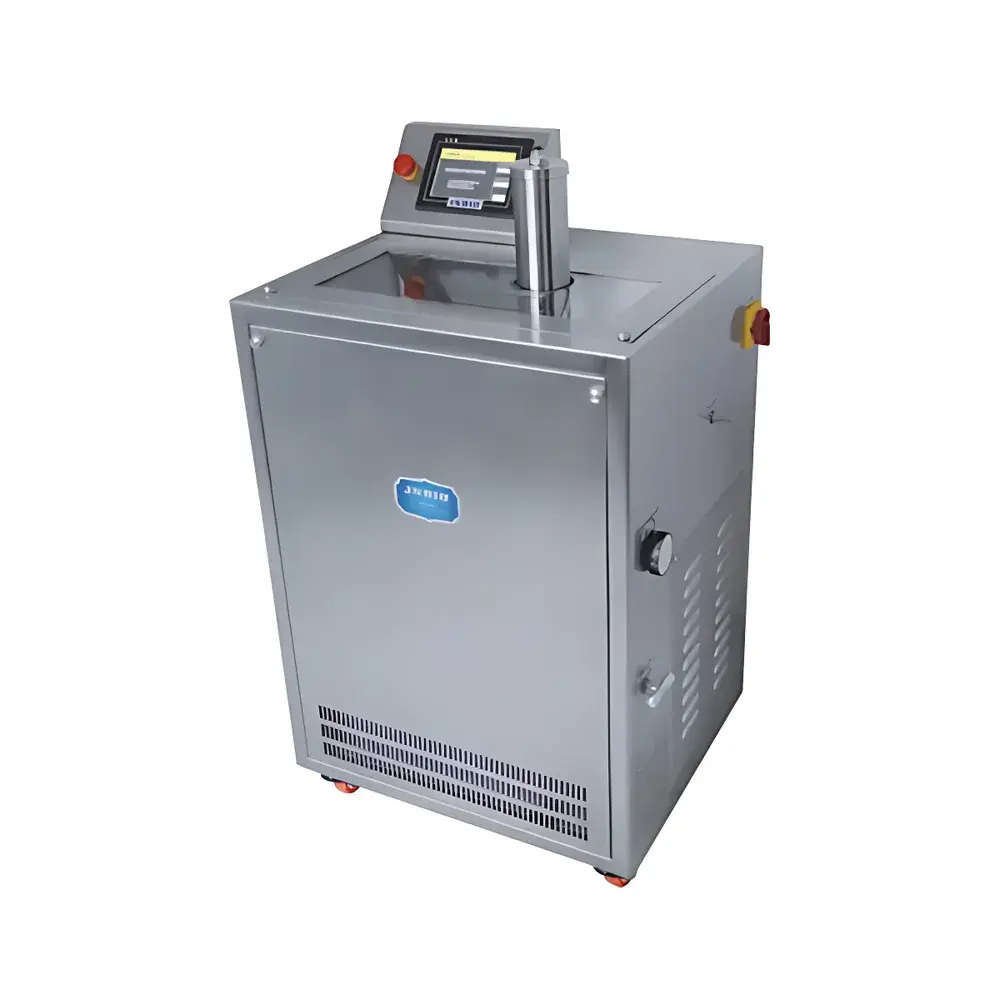
JNBIO JN-10C Low-Temperature High-Pressure Continuous-Flow Cell Disruptor
| Brand | JNBIO |
|---|---|
| Model | JN-10C |
| Type | High-Pressure Homogenizer (Continuous-Flow) |
| Max Operating Pressure | 207 MPa (2070 bar) |
| Flow Rate at Max Pressure | 10 L/h |
| Cooling Capacity | Integrated Chiller System |
| Ultrasonic Power Input | 1.1 kW |
| Sample Throughput | 1.5 L/h |
| Electrical Supply (Main Unit) | 380 V, 50/60 Hz, 2.25 kW |
| Electrical Supply (Chiller) | 220 V, 50/60 Hz, 1.1 kW |
| Net Dimensions (W×D×H, mm) | Host Unit: 680 × 585 × 1167 |
| Chiller Unit | 525 × 750 × 940 |
| Transport Dimensions (W×D×H, mm) | Host Unit: 750 × 750 × 1250 |
| Chiller Unit | 640 × 875 × 1125 |
| Origin | Guangdong, China |
| Regulatory Classification | CE-compliant design for laboratory use under IEC 61010-1 |
Overview
The JNBIO JN-10C Low-Temperature High-Pressure Continuous-Flow Cell Disruptor is an engineered solution for scalable, reproducible lysis of microbial, yeast, mammalian, and plant cells under precisely controlled thermal and mechanical conditions. It operates on the principle of high-pressure homogenization—subjecting cell suspensions to rapid pressure-driven shear, cavitation, and impact forces as they pass through a narrow orifice valve at pressures up to 207 MPa (2070 bar). Unlike batch ultrasonication or bead-beating methods, this continuous-flow architecture enables consistent processing of thermally sensitive samples without localized overheating, supported by an integrated chiller system maintaining sample temperature near 0 °C throughout operation. Designed for integration into upstream bioprocessing workflows—including recombinant protein purification, vaccine antigen release, and extracellular vesicle isolation—the JN-10C meets the engineering requirements of GLP-compliant laboratories and early-stage process development environments.
Key Features
- Stainless-steel fluid path constructed from ASTM A276 Type 316 stainless steel, resistant to corrosion from biological buffers and low-pH lysates.
- Two-stage pressure regulation with digital pressure transducer feedback loop, enabling stable setpoint control within ±0.5% of target pressure across the full 0–207 MPa range.
- Dual-cooling architecture: primary cooling via recirculating chiller (−5 °C to +10 °C operating range), supplemented by heat-exchange jacketing on the homogenization valve and sample inlet manifold.
- Modular design allows separation of main drive unit and chiller cabinet—facilitating placement in ISO Class 7 cleanrooms or adjacent equipment rooms with remote coolant routing.
- Compliance-ready electrical architecture: main motor and chiller modules independently certified to IEC 61010-1 Edition 3 for safety in laboratory environments; all control logic implemented using SIL-2 rated PLC components.
Sample Compatibility & Compliance
The JN-10C accommodates aqueous suspensions ranging from 0.5 to 10% w/v total solids, including Escherichia coli, Saccharomyces cerevisiae, CHO and HEK293 suspension cultures, and plant protoplasts. Its continuous-flow configuration supports seamless transition from lab-scale optimization (1.5 L/h throughput) to pilot-scale validation (10 L/h at reduced pressure). The system conforms to key regulatory expectations for instrument qualification: documented IQ/OQ protocols are provided, and all pressure, temperature, and flow sensors are traceable to NIST standards. While not pre-certified for GMP manufacturing, its design aligns with FDA 21 CFR Part 11 data integrity principles when operated with validated electronic logbook software, and supports audit-trail generation for critical process parameters.
Software & Data Management
The JN-10C operates via a touchscreen HMI (Human-Machine Interface) running embedded Linux with deterministic real-time kernel extensions. All operational parameters—including pressure ramp rate, dwell time at maximum pressure, chiller setpoint, and total processed volume—are logged at 100 ms intervals to internal encrypted NAND flash memory. Export formats include CSV and XML, compatible with LIMS platforms such as LabVantage and STARLIMS. Optional Ethernet/IP and Modbus TCP interfaces enable integration into SCADA systems for centralized monitoring. Audit trails record operator ID, timestamp, parameter changes, and alarm events—meeting ALCOA+ data integrity criteria when deployed in validated environments.
Applications
- Release of inclusion bodies from E. coli without denaturation, enabling downstream refolding efficiency improvement.
- Preparation of subcellular fractions (e.g., mitochondria, nuclei) from mammalian tissues with minimal organelle damage.
- Disruption of Gram-positive bacteria (e.g., Bacillus subtilis) and fungal cell walls where enzymatic lysis proves inefficient.
- Generation of nano-sized extracellular vesicles (EVs) from mesenchymal stem cells for therapeutic characterization studies.
- Process development support for viral vector manufacturing, particularly adenovirus and AAV lysis prior to chromatographic purification.
FAQ
What is the minimum sample volume required for stable operation?
The system achieves hydraulic stability at flow rates ≥0.8 L/h; however, optimal reproducibility is observed above 1.2 L/h. For method development, a 500 mL minimum batch volume is recommended to ensure representative pressure and temperature equilibration.
Can the JN-10C be used with organic solvents or high-salt buffers?
The wetted materials are compatible with ≤20% (v/v) ethanol, isopropanol, and standard phosphate- or Tris-based buffers up to 1 M NaCl. Solvent compatibility beyond this requires consultation with JNBIO engineering for seal material verification.
Is remote monitoring supported out-of-the-box?
Yes—the standard firmware includes HTTP API endpoints for real-time parameter polling and alarm status retrieval. Secure remote access requires customer-configured firewall rules and TLS 1.2 certificate deployment.
How often does the homogenization valve require replacement?
Under typical use with clarified bacterial lysates at 150 MPa, valve service life exceeds 300 operational hours. Wear is monitored via pressure decay diagnostics embedded in the HMI; replacement kits include calibrated orifice inserts and ceramic seat assemblies.
Does the system meet ISO 22442 (medical device biological safety) requirements?
The JN-10C is intended for R&D and process development—not direct medical device manufacturing. Its construction materials comply with ISO 10993-5 cytotoxicity screening, but full biological evaluation must be conducted per end-use application context.
Related Products





