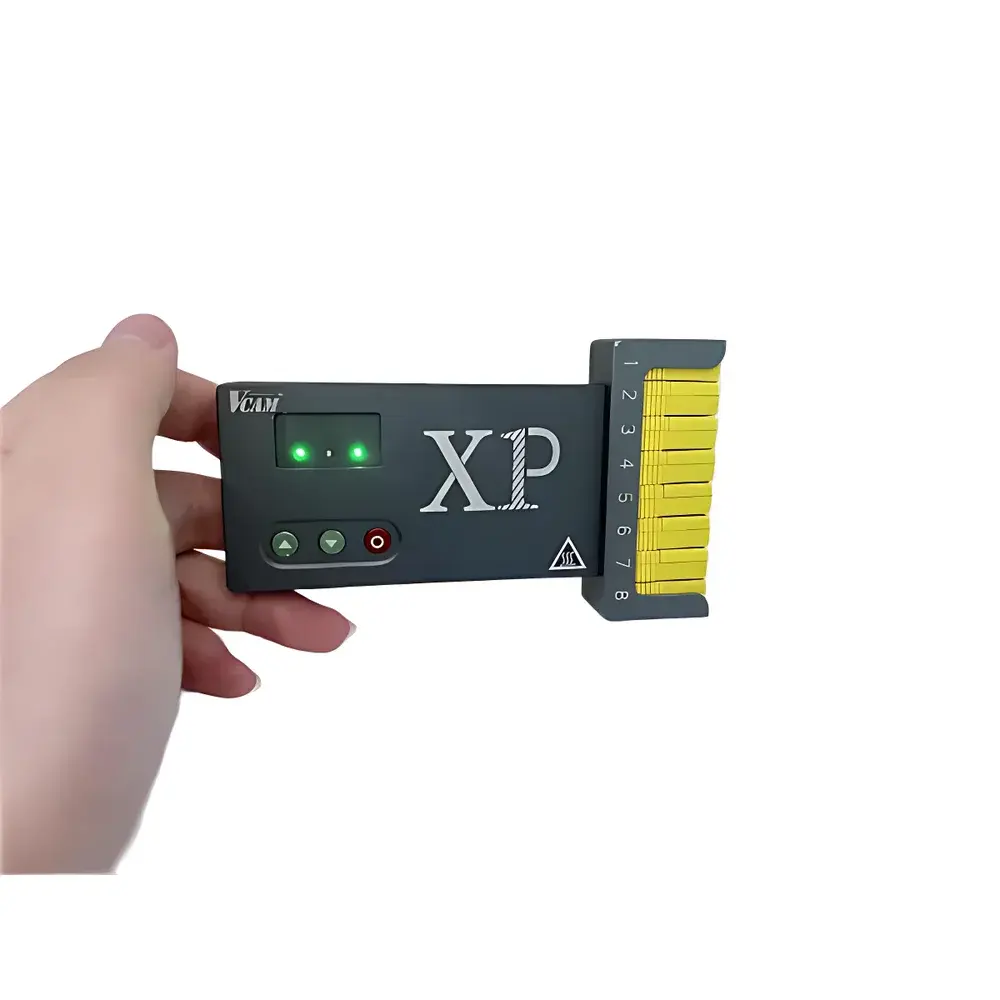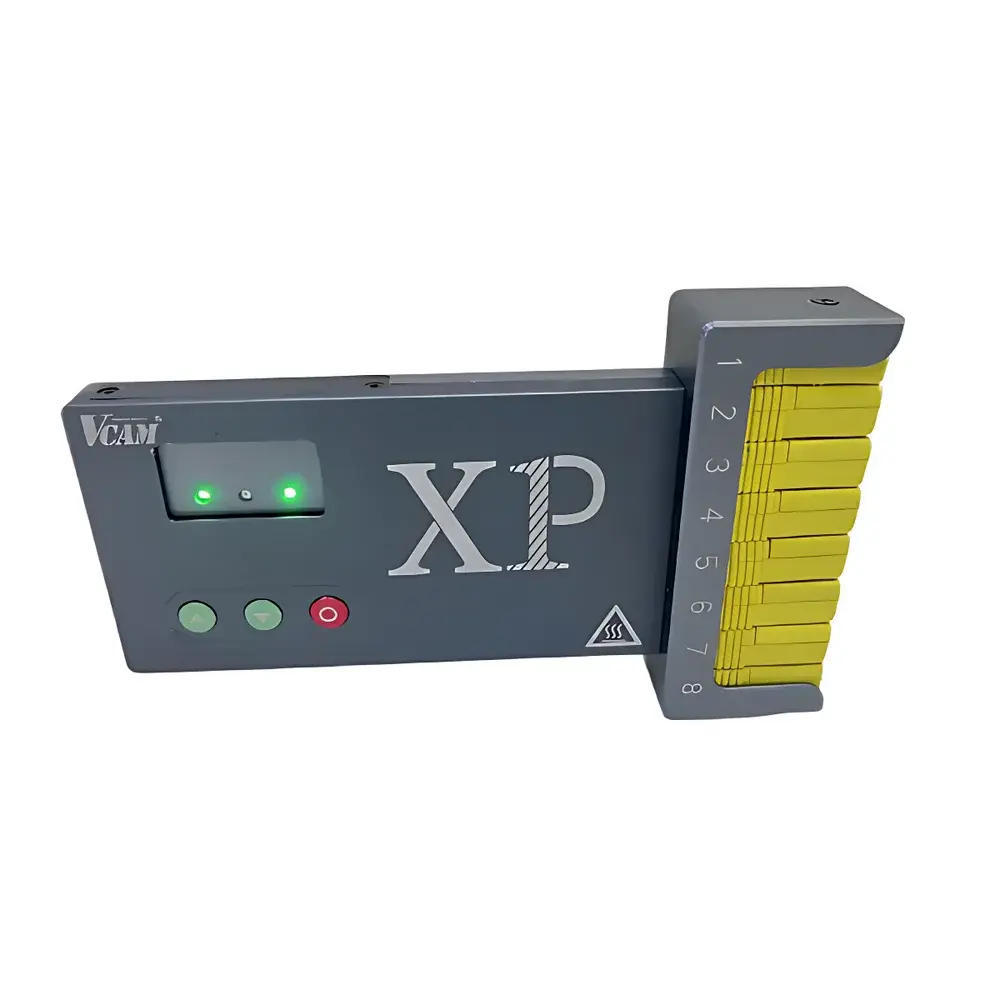
JOFRA MTC Series Marine-Grade Dry-Block Calibrator
| Brand | JOFRA |
|---|---|
| Origin | Denmark |
| Model | MTC Marine Dry-Block Calibrator |
| Temperature Range | 28 to 650°C |
| Stability | ±0.1°C |
| 1-Year Accuracy | ±0.9°C |
| 3-Year Accuracy | ±1.8°C |
| Power Supply Immunity | MVI (Microprocessor-Based Voltage Independence) Technology |
| Weight | Lightweight, Portable Design |
| Block Configuration | Multi-Hole Insert Kit Included |
| Application | In-Situ Calibration on Vessels and Offshore Platforms |
Overview
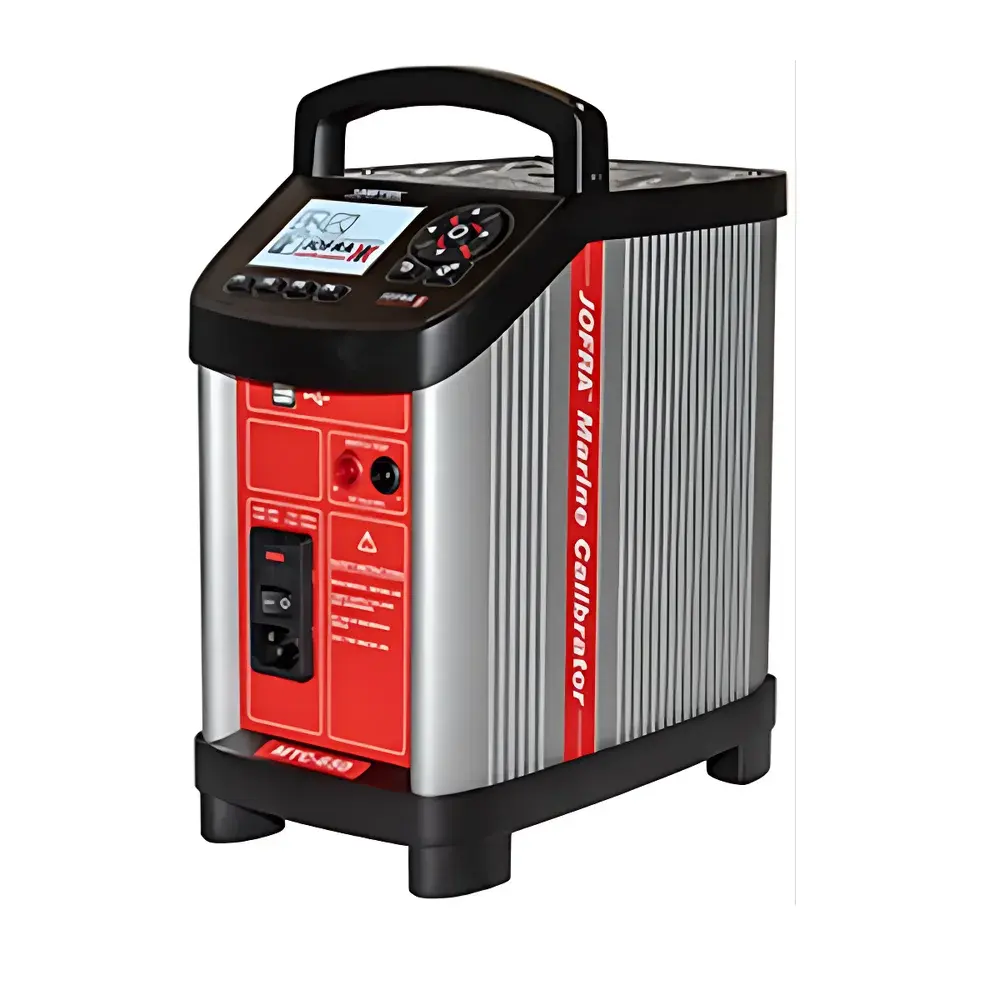
The JOFRA MTC Series Marine-Grade Dry-Block Calibrator is an ISO/IEC 17025-aligned portable temperature calibration system engineered specifically for maritime and offshore environments. It operates on the principle of resistive heating within a precisely machined metal block, where thermal energy is uniformly distributed via high-conductivity aluminum or stainless-steel inserts. Unlike liquid-bath calibrators, the dry-block design eliminates fluid handling, leakage risk, and maintenance downtime—critical advantages aboard ships where space, safety, and operational continuity are constrained. The MTC series meets IEC 60529 IP54 ingress protection requirements for dust and water resistance, and its structural integrity complies with DNV-GL and ABS marine environmental classification standards (including vibration, shock, and tilt tolerance per IMO MSC.287(87)). Designed for traceable calibration of RTDs, thermocouples (Types B, E, J, K, N, R, S, T), and digital temperature sensors, it supports on-board verification in engine rooms, cargo control systems, HVAC monitoring loops, and fire-detection sensor networks.
Key Features
- Marine-optimized thermal architecture: Dual-zone heating elements with independent PID control ensure uniform axial and radial temperature distribution across all insert holes—even under vessel pitch/roll motion.
- MVI (Microprocessor-Based Voltage Independence) technology: Maintains ±0.1°C stability despite input voltage fluctuations between 90–264 VAC, 47–63 Hz—essential for shipboard generators with variable output profiles.
- Intuitive color-coded HMI: High-contrast TFT display with thermal-status icons (blue = cooling, red = heating, green = stable); real-time stability indicator with countdown timer confirms thermal equilibrium before calibration start.
- One-touch automated procedures: Pre-programmed Auto-Step and Auto-Switch test sequences reduce operator dependency and minimize human error during multi-point calibration campaigns.
- Lightweight modular construction: Total mass <4.2 kg; integrated carrying handle and ruggedized rubber overmold meet MIL-STD-810G drop-test requirements for deck-level transport.
- Multi-hole interchangeable insert kit: Standard configuration includes five 6.35 mm and three 9.5 mm bores; optional inserts support 3.2 mm, 4.8 mm, and 12.7 mm probe diameters per ASTM E644-22 Annex A3 guidelines.
Sample Compatibility & Compliance
The MTC calibrator accommodates temperature sensors compliant with IEC 60751 (RTDs), IEC 60584-1 (thermocouples), and ISO 17025 Clause 6.4.2 for measurement uncertainty evaluation. Its block geometry satisfies the minimum immersion depth requirements defined in EURAMET cg-13 (v3.0, 2021): ≥15× probe diameter or ≥75 mm, whichever is greater. All factory calibrations are performed against NIST-traceable PRT standards (uncertainty ≤ ±0.02°C at 100°C), with full calibration certificates issued per ISO/IEC 17025:2017 Annex A. The device is CE-marked, RoHS-compliant, and certified to EN 61000-6-2 (immunity) and EN 61000-6-4 (emissions) for electromagnetic compatibility in marine electrical systems.
Software & Data Management
The MTC integrates seamlessly with JOFRA’s CalSuite™ v4.2 calibration management software (Windows/Linux/macOS), enabling automated generation of audit-ready reports compliant with FDA 21 CFR Part 11 (electronic signatures, audit trails, role-based access). Raw temperature readings, stability logs, and deviation records are timestamped and exported in CSV, PDF/A-1b, or XML formats. Optional Bluetooth 5.0 module supports wireless data streaming to onboard CMMS platforms (e.g., SAP PM, IBM Maximo) for predictive maintenance scheduling. All firmware updates preserve calibration history and maintain GLP/GMP data integrity through cryptographic checksum validation.
Applications
- In-situ verification of engine coolant, lube oil, and exhaust gas temperature sensors prior to port state control inspections.
- Calibration of bilge alarm thermistors and cargo tank vapor-phase temperature monitors under SOLAS Chapter II-2 requirements.
- Field validation of HVAC duct-mounted sensors in crew accommodation zones per ISO 16745-1:2020 indoor air quality protocols.
- Supporting ISO 5167 flow meter temperature compensation audits in fuel transfer systems.
- Onboard training and competency assessment for marine engineers performing mandatory annual sensor verification per IMO Resolution A.1120(30).
FAQ
What marine classification societies recognize the MTC for onboard calibration use?
DNV-GL, ABS, LR, BV, and ClassNK accept the MTC as a primary field standard when used within its specified environmental envelope (–10°C to +50°C ambient, ≤95% RH non-condensing) and supported by current ISO/IEC 17025 calibration documentation.
Does the MTC require periodic recalibration, and how often?
Yes—annual recalibration is recommended per ISO/IEC 17025; however, its extended 3-year accuracy specification (±1.8°C) allows for reduced frequency in low-risk applications under documented risk assessment per ILAC G8:2022.
Can the MTC calibrate sensors with non-standard sheath diameters?
Yes—custom bore inserts are available upon request, manufactured to ISO 2768-mK general tolerances and validated per EURAMET cg-13 Section 5.3 for thermal contact resistance minimization.
Is external reference equipment required during operation?
No—the MTC functions as a self-contained primary standard; however, for uncertainty budgets below ±0.3°C, users may optionally connect a secondary reference PRT via the rear-panel PT100 input for real-time correction.