
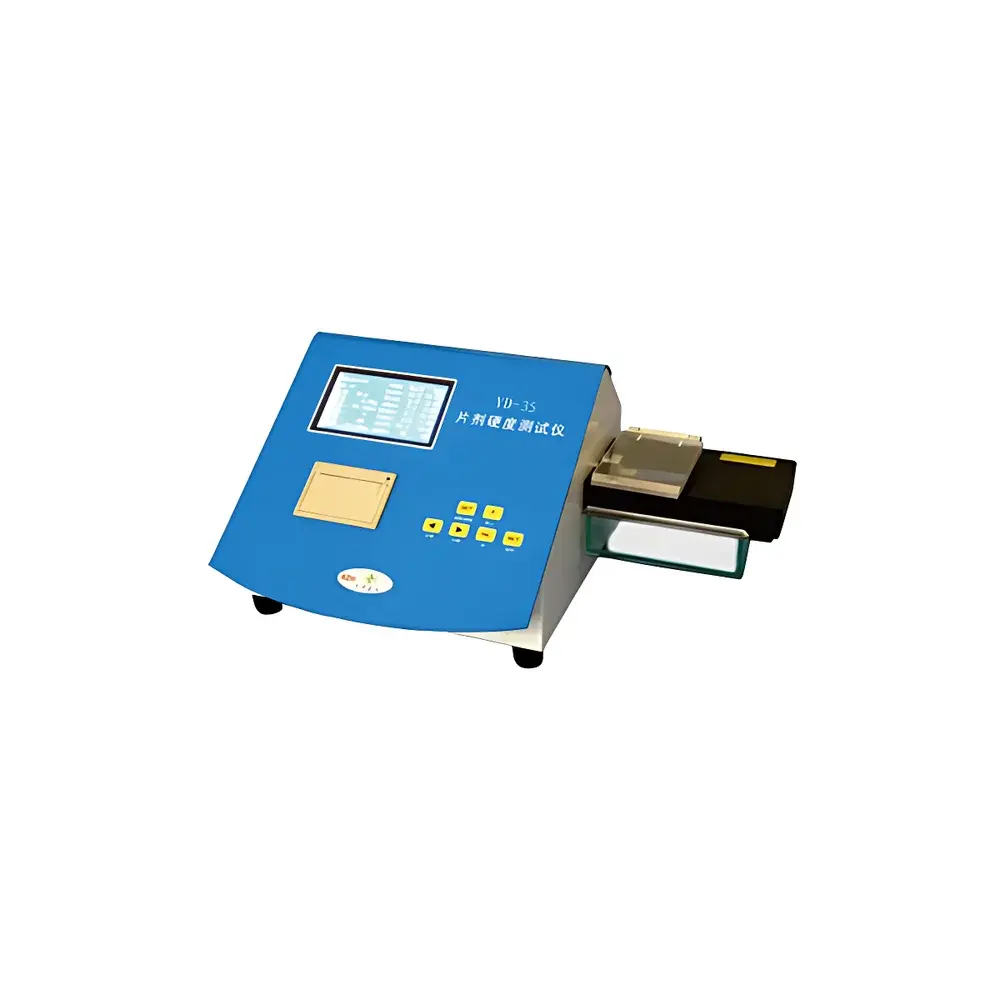
Josvok YD-35 Intelligent Tablet Hardness Tester
| Brand | Josvok |
|---|---|
| Origin | Tianjin, China |
| Model | YD-35 |
| Hardness Range | 1–350 N (Resolution: 0.1 N, Accuracy: ±0.03 kg) |
| Diameter Range | 2.0–30.0 mm (Accuracy: ±0.01 mm) |
| Units | N / kg / Sc (hardness), mm / inch (diameter) |
| Measurement Modes | Manual single-tablet, Automatic batch (up to 160 tablets) |
| Display | LCD, 4×8 Chinese or 8×16 English |
| Data Output | Statistical analysis, timestamped reporting, calibration logging, self-diagnostic alerts |
| Compliance | Designed for pharmacopeial compliance per USP <1217>, EP 2.9.8, and ChP IV |
Overview
The Josvok YD-35 Intelligent Tablet Hardness Tester is a dedicated mechanical testing instrument engineered for precise, repeatable quantification of tablet mechanical integrity in pharmaceutical development, manufacturing, and quality control environments. It operates on the principle of axial compression force measurement—applying controlled, perpendicular load to a tablet until fracture occurs—thereby determining hardness as the peak compressive force (in newtons or kilograms-force) required to break the dosage form. This parameter directly correlates with tablet robustness during packaging, shipping, and handling, and serves as a critical in-process control (IPC) and release criterion aligned with regulatory expectations. The YD-35 integrates a high-stability load cell (0.1 N resolution, ±0.03 kg accuracy) and precision linear displacement sensing to simultaneously capture hardness and diameter—two interdependent physical attributes essential for evaluating compaction consistency and formulation performance.
Key Features
- Microprocessor-based control architecture enabling intuitive operation via dual-language LCD interface (Chinese or English, user-selectable at startup)
- Dual-parameter acquisition: simultaneous hardness (1–350 N) and diameter (2.0–30.0 mm) measurement with traceable metrological accuracy
- Three operational modes: manual single-tablet testing, automated sequential testing (up to 160 tablets per session), and programmable test protocols
- Onboard statistical engine computing mean, standard deviation, CV%, min/max, and histogram distribution; results exportable via integrated thermal printer
- Real-time RTC (real-time clock) stamping all reports with date/time of test execution and calibration events—supporting audit readiness under GLP/GMP frameworks
- Self-diagnostic firmware that monitors sensor linearity, actuator response, and power stability—flagging anomalies such as overload, zero drift, or mechanical binding before data corruption occurs
- Persistent parameter memory: user-defined units (N/kg/Sc; mm/inch), pass/fail thresholds, and calibration offsets retained across power cycles without battery backup dependency
Sample Compatibility & Compliance
The YD-35 accommodates flat-faced, convex, concave, and bevel-edged tablets within the 2.0–30.0 mm diameter range, including film-coated, sugar-coated, and uncoated formulations. Its adjustable anvil spacing and low-inertia loading mechanism minimize edge chipping and ensure consistent contact geometry—critical for minimizing measurement variability across heterogeneous batches. The instrument is designed to support compliance with major pharmacopeial standards: USP General Chapter <1217> “Tablet Breaking Force”, European Pharmacopoeia 2.9.8 “Mechanical Strength of Tablets”, and Chinese Pharmacopoeia Volume IV “Physical Tests for Solid Dosage Forms”. While not certified to ISO/IEC 17025, its metrological traceability path aligns with national calibration standards (e.g., CNAS-accredited labs in China), and its timestamped calibration logs meet foundational requirements for FDA 21 CFR Part 11–aligned documentation when paired with validated SOPs.
Software & Data Management
The YD-35 operates autonomously without external PC dependency. All data processing—including statistical summary, pass/fail evaluation against configurable limits, and report generation—is performed onboard. Printed outputs include full test metadata: operator ID (manually entered), sample ID, test date/time, environmental temperature (optional external probe input), hardness/diameter values per tablet, batch statistics, and calibration certificate reference. The thermal printer produces permanent, smudge-resistant records suitable for archival in quality records. For laboratories requiring electronic data interchange, the device supports RS-232 serial output (ASCII protocol) compatible with LIMS integration or custom data aggregation scripts—enabling structured transfer of raw measurements and summaries into validated databases while preserving audit trails.
Applications
- Formulation development: Correlating binder concentration, granule moisture, and compression force with tablet hardness profiles
- Process validation: Establishing hardness acceptance criteria for roller compaction, direct compression, and wet granulation unit operations
- In-process testing: Monitoring tablet strength trends across compression runs to detect tooling wear or feed frame inconsistencies
- Stability studies: Quantifying hardness degradation under accelerated aging conditions (40°C/75% RH) per ICH Q1 guidelines
- Quality assurance: Final release testing per internal specifications and pharmacopeial monographs
- Educational use: Teaching mechanical property fundamentals in pharmacy and pharmaceutics curricula
FAQ
Does the YD-35 comply with 21 CFR Part 11 requirements?
The instrument itself does not provide electronic signature capability or system-level audit trail encryption. However, its timestamped printed reports and deterministic calibration logging support Part 11 compliance when embedded within a broader validated quality system—including procedural controls for operator authentication, change management, and record retention.
Can the YD-35 measure coated tablets without damaging the film layer?
Yes—the low-speed, constant-rate compression profile (adjustable via firmware) and smooth-surface anvils minimize localized stress concentration, preserving coating integrity during measurement unless the coating is inherently brittle or improperly cured.
Is external calibration certification included with purchase?
A factory calibration certificate (traceable to national standards) is supplied. Users are responsible for periodic recalibration per internal SOPs or regulatory frequency requirements (typically every 6–12 months or after impact damage).
What maintenance is required to sustain measurement accuracy?
Monthly verification using certified test weights and diameter gauges is recommended. Annual inspection of anvil alignment, load cell zero stability, and print head functionality ensures long-term reproducibility.




