
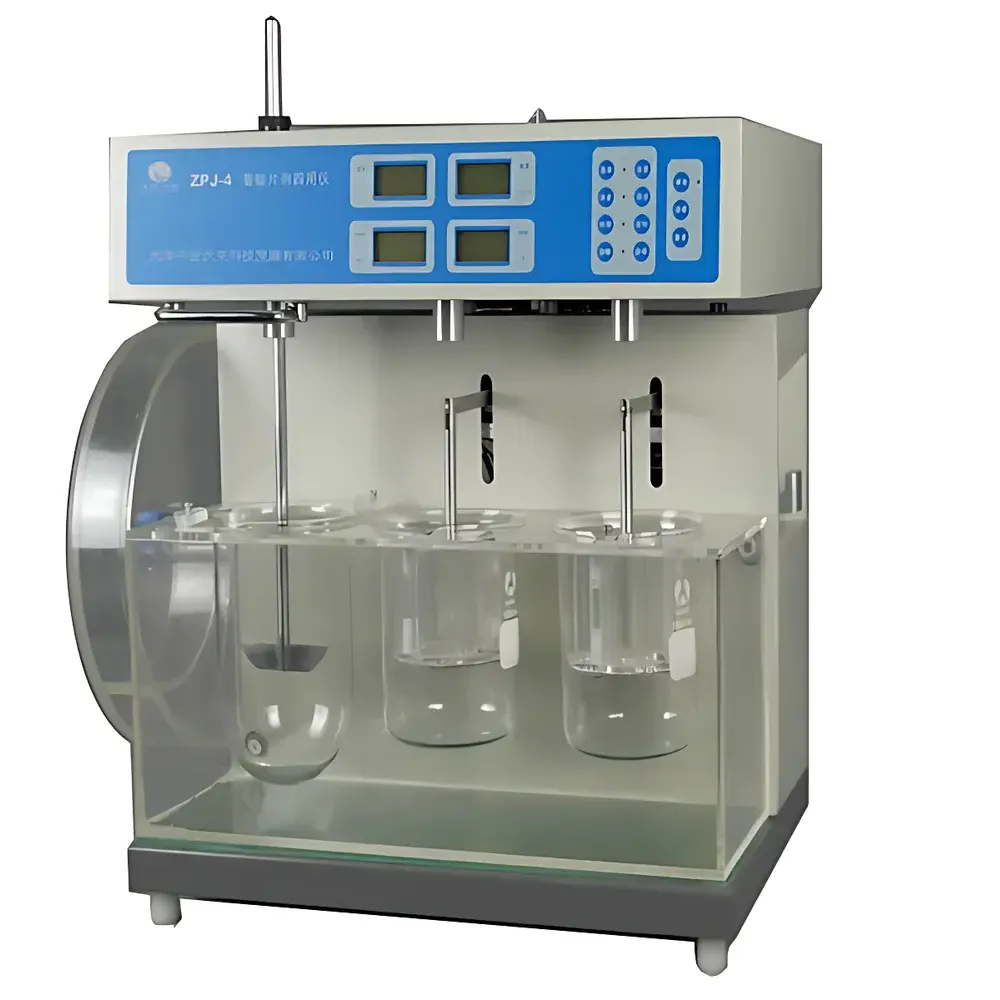
Josvok ZPJ-4 Intelligent Tablet Quad-Tester
| Brand | Josvok |
|---|---|
| Origin | Tianjin, China |
| Manufacturer Type | Authorized Distributor |
| Country of Origin | China |
| Model | ZPJ-4 |
| Price | USD 2,050 (FOB Tianjin) |
| Temperature Control Range | 20–40 °C ±0.3 °C |
| Speed Adjustment Range | 20–200 rpm ±2 rpm |
| Timing Range | 1–900 min ±0.5 min |
| Paddle Wobble | ±0.5 mm |
| Basket Wobble | ±1.0 mm |
| Disintegration Stations | 2 |
| Reciprocating Frequency | 30–32 cycles/min |
| Stroke Distance | 55 mm ±2 mm |
| Friability Drum | 1 unit, internal diameter 286 mm, depth 39 mm, drop height 156 mm, rotation speed 25 rpm ±1 rpm, total revolutions 100 ±1 |
| Hardness Measurement Range | 2–199 N ±1 N |
| Tablet Diameter Compatibility | 3–40 mm |
| Power Supply | 220 V / 50 Hz / 600 W |
| Dimensions (W×D×H) | 520 × 380 × 470 mm |
Overview
The Josvok ZPJ-4 Intelligent Tablet Quad-Tester is a fully integrated, laboratory-grade pharmaceutical testing platform engineered for compliance with pharmacopoeial requirements including USP <701> (Disintegration), <705> (Friability), <1217> (Hardness), and <711> (Dissolution). Designed in accordance with ISO/IEC 17025-aligned validation principles, the instrument implements four distinct but interdependent solid dosage form quality control assays within a single compact architecture. Its modular mechanical design separates functional modules—hardness tester, friability drum, disintegration apparatus, and three-vessel dissolution system—while sharing a unified microprocessor-based control interface and centralized thermal management subsystem. The device operates on a closed-loop temperature-regulated water bath system utilizing magnetic-drive circulation pumps to ensure uniform thermal distribution across all test zones, minimizing inter-test variability and supporting GLP-compliant data integrity.
Key Features
- Four-in-one assay capability: simultaneous or sequential execution of tablet hardness, friability, disintegration time, and dissolution profiling—eliminating cross-platform calibration drift and inter-instrument reproducibility gaps.
- Dual independent disintegration stations with programmable reciprocating motion (30–32 cycles/min, 55 mm stroke), each equipped with individual timing control and automatic termination upon endpoint detection.
- Friability module featuring a precision-engineered stainless-steel drum (SUS316L, Ø286 mm × 39 mm depth) with gravimetric drop-height consistency (156 mm), motorized rotation at 25 rpm ±1 rpm, and exact cycle counting (100 ±1 revolutions) per test sequence.
- Three-vessel dissolution system configured in linear alignment (single-row layout), compliant with USP Apparatus 1 (basket) and Apparatus 2 (paddle); includes SUS316L baskets and paddles, adjustable shaft wobble (±0.5 mm for paddles, ±1.0 mm for baskets), and manual flip-type head mechanism for ergonomic vessel access.
- High-fidelity hardness measurement using calibrated load cells (2–199 N range, ±1 N accuracy), supporting tablets from 3 mm to 40 mm diameter; features auto-loading assist, real-time force curve capture, digital display, auto-hold, and sequential cycling without operator intervention.
- Intelligent thermal regulation via PID-controlled water bath with ±0.3 °C stability across 20–40 °C operating range; temperature monitoring and logging integrated into main controller with timestamped audit trail.
Sample Compatibility & Compliance
The ZPJ-4 accommodates standard pharmaceutical tablet formats—including uncoated, film-coated, enteric-coated, and effervescent tablets—within defined dimensional limits (3–40 mm diameter, thickness up to 15 mm). All wetted components contacting dissolution media or disintegration fluid are constructed from electropolished SUS316L stainless steel, ensuring corrosion resistance and extractables/leachables compliance per ICH Q5C and USP <661.1>. The system supports full traceability under FDA 21 CFR Part 11 when paired with validated third-party LIMS or ELN software, and meets essential requirements for GMP Annex 11 documentation workflows. Mechanical tolerances—including paddle/basket concentricity, shaft verticality, and basket immersion depth—are maintained within USP-specified limits during routine operation and after preventive maintenance.
Software & Data Management
The embedded controller provides local parameter configuration, real-time monitoring, and event-triggered data capture without external PC dependency. All test parameters—including setpoints, actual values, timestamps, and pass/fail status—are stored internally with non-volatile memory retention (≥10,000 test records). Export is supported via USB 2.0 port in CSV format for downstream analysis in Excel, MATLAB, or statistical process control (SPC) platforms. Optional RS-232 or Ethernet interfaces enable integration into enterprise-level QC informatics systems. Audit trails record user logins, method changes, calibration events, and alarm acknowledgments—fully aligned with ALCOA+ principles for data reliability and regulatory inspection readiness.
Applications
- Pre-formulation screening of excipient effects on tablet mechanical strength and disintegration kinetics.
- In-process quality control during tablet compression and coating operations.
- Stability study support: comparative dissolution profiling across accelerated and long-term storage conditions.
- Comparative bioequivalence assessment via intrinsic dissolution rate (IDR) determination under controlled hydrodynamic conditions.
- Root cause analysis of batch failures linked to friability loss, hardness inconsistency, or delayed disintegration.
- Method transfer validation between R&D, pilot plant, and commercial manufacturing sites.
FAQ
Does the ZPJ-4 comply with current USP and EP monographs for dissolution testing?
Yes—the three-vessel system meets mechanical calibration criteria for USP Apparatus 1 and 2, including wobble, centering, and immersion depth specifications. Temperature and rotational accuracy are verified per USP <711> verification protocol.
Can the instrument perform dissolution tests under sink conditions with automated sampling?
The ZPJ-4 provides precise environmental control (temperature, rotation, timing) but does not include integrated autosamplers or filtration units. It is designed as a core dissolution station compatible with external sampling systems via standardized vessel geometry and port interfaces.
Is calibration documentation provided with the unit?
Each unit ships with a factory calibration certificate covering temperature sensor, speed encoder, timer circuit, and load cell—traceable to NIM (China National Institute of Metrology) standards. IQ/OQ documentation templates are available upon request for site-specific validation.
What maintenance intervals are recommended for sustained accuracy?
Preventive maintenance—including shaft alignment verification, thermal sensor recalibration, and mechanical wear inspection—is advised every 6 months or after 500 operational hours, whichever occurs first. Full service manuals and spare parts kits are supplied with purchase.






