
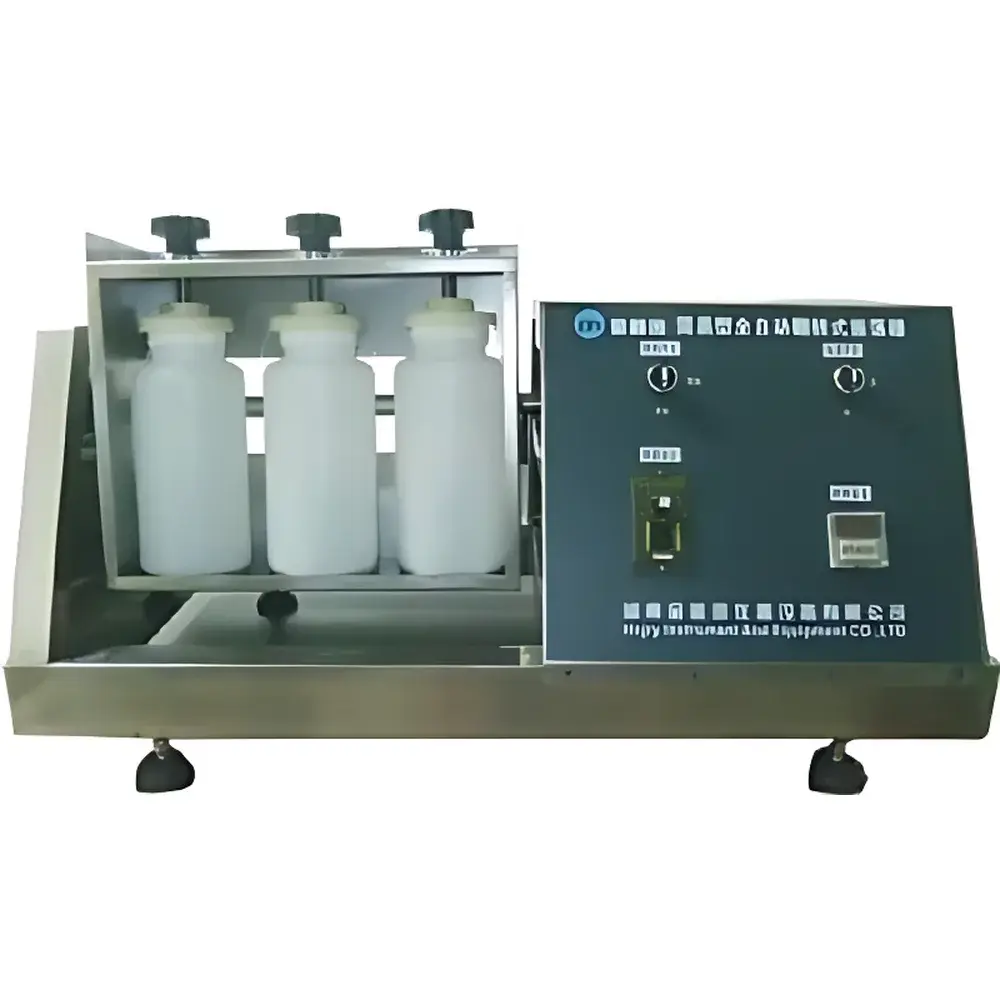
JRY JRY-JZ08 Tumbling Oscillator for Solid Waste Toxicity Leaching
| Brand | JRY |
|---|---|
| Origin | Hunan, China |
| Manufacturer | JRY |
| Country of Origin | China |
| Model | JRY-JZ08 |
| Sample Bottle Capacity | 8 × 2 L |
| Bottle Type | Wide-mouth 2 L (glass, PE, PTFE, or zero-headspace extraction vessels) |
| Rotation Mode | Unidirectional / Bidirectional |
| Speed Range | 0–40 rpm (adjustable) |
| Temperature Control Range | Ambient to 60 °C |
| Temperature Accuracy | ±1 °C |
| Timing Range | 0–72 h (adjustable) |
| Motor Power | 120 W |
| Rated Voltage | 220 V AC |
| Dimensions & Weight | As specified for JRY-JZ08 |
| Compliance | HJ 299–2007, HJ 300–2007 |
Overview
The JRY JRY-JZ08 Tumbling Oscillator is a precision-engineered laboratory instrument designed specifically for regulatory-compliant toxicity characteristic leaching procedures (TCLP) and synthetic precipitation leaching procedure (SPLP)-equivalent extractions in solid waste analysis. It implements the tumbling (rotational inversion) principle defined in Chinese environmental standards HJ 299–2007 (“Methods for Leaching Toxicity of Solid Waste – Sulfuric-Nitric Acid Method”) and HJ 300–2007 (“Methods for Leaching Toxicity of Solid Waste – Acetic Acid Buffer Extraction Method”). Unlike orbital shakers or end-over-end rotators used in general-purpose sample homogenization, this device delivers controlled, low-shear, gravity-driven tumbling motion—ensuring reproducible contact between solid-phase waste matrices and leaching agents under standardized angular displacement, rotation frequency, and dwell time. Its architecture supports method traceability, mechanical stability over extended operation cycles (up to 72 h), and thermal consistency critical for pH-dependent leachate chemistry.
Key Features
- Stainless steel monocoque chassis with corrosion-resistant finish—designed for long-term durability in acidic, humid, and solvent-exposed laboratory environments.
- Digital speed control (0–40 rpm) with real-time RPM display and programmable directionality: unidirectional, bidirectional, or alternating reversal sequences to simulate varied leaching dynamics.
- Integrated PID temperature regulation system (ambient to 60 °C, ±1 °C accuracy) enabling temperature-controlled leaching per method requirements—particularly essential for acetic acid buffer extractions where reaction kinetics are thermally sensitive.
- Modular bottle cradle accommodating eight standard 2 L wide-mouth containers—including borosilicate glass, high-density polyethylene (HDPE), PTFE-lined, and zero-headspace extraction (ZHE) vessels—ensuring compatibility with US EPA Method 1311, ASTM D5233, and ISO 14870-derived protocols.
- Low-noise, brushless AC motor (120 W) engineered for continuous duty cycling; validated for uninterrupted 72-hour operation without thermal derating or positional drift.
- Independent timer with hour-based resolution (0–72 h) and auto-shutdown functionality—supporting GLP-aligned experiment logging and audit-ready operational records.
Sample Compatibility & Compliance
The JRY-JZ08 meets the mechanical and operational specifications mandated by HJ 299–2007 and HJ 300–2007 for solid waste leaching testing. Its tumbling geometry ensures uniform 360° inversion at fixed intervals, replicating the physical agitation profile required to assess leachable concentrations of heavy metals (e.g., Pb, Cd, Cr, Hg), cyanide, and semi-volatile organic compounds (SVOCs) from heterogeneous matrices such as municipal sludge, incinerator ash, contaminated soils, and industrial filter cakes. The instrument’s design permits direct integration into accredited environmental testing laboratories operating under CNAS (China National Accreditation Service) or ISO/IEC 17025 frameworks. While not certified to EU EN 12457 or US EPA SW-846 Method 1311 out-of-the-box, its performance envelope aligns with core mechanical parameters (rotation rate, dwell time, vessel orientation, temperature stability) referenced in those standards.
Software & Data Management
The JRY-JZ08 operates via embedded microcontroller logic with no proprietary software dependency—ensuring method transparency and eliminating vendor lock-in. All operational parameters (speed, direction sequence, temperature setpoint, elapsed time) are displayed on an LED interface and retained in non-volatile memory across power cycles. For laboratories requiring electronic recordkeeping compliant with FDA 21 CFR Part 11 or ISO 17025 Clause 7.5.2, external data loggers may be interfaced via analog voltage outputs (0–5 V) corresponding to real-time temperature and RPM signals. Audit trails, user access logs, and electronic signatures are implemented at the laboratory information management system (LIMS) level—not within the oscillator itself—maintaining separation of instrumentation control and data governance responsibilities.
Applications
- Toxicity characteristic leaching procedure (TCLP) screening for landfill disposal classification per GB 5085.3–2007 and related provincial regulatory thresholds.
- Leachate generation for subsequent ICP-MS, AAS, or IC analysis of metal speciation and anion mobility.
- Research into contaminant release kinetics from stabilized/solidified waste forms under variable pH and redox conditions.
- Method validation studies comparing tumbling vs. rotating drum vs. end-over-end extraction efficiency for heterogeneous particulate matrices.
- Quality assurance workflows in municipal solid waste treatment facilities, hazardous waste recycling plants, and soil remediation contractors.
- Academic instruction in environmental engineering curricula covering regulatory sampling, extractive chemistry, and risk-based exposure modeling.
FAQ
Is the JRY-JZ08 compatible with US EPA Method 1311?
Yes—the mechanical tumbling action, 2 L vessel capacity, temperature control range, and timing resolution meet the fundamental equipment criteria outlined in Method 1311, though users must verify alignment with local accreditation body requirements.
Can it accommodate custom bottle geometries beyond 2 L wide-mouth containers?
No—the cradle is mechanically optimized for standardized 2 L wide-mouth profiles; deviation risks imbalance, vibration amplification, and non-uniform leaching kinetics.
Does the unit include calibration documentation traceable to national metrology institutes?
Factory calibration certificates for temperature and rotational speed are provided; NIST-traceable recalibration services are available through authorized JRY service centers in mainland China.
What maintenance intervals are recommended for sustained GLP compliance?
Motor lubrication and bearing inspection every 1,000 operational hours; full verification of temperature uniformity and rotational accuracy annually or after 500 cycles—whichever occurs first.
Is remote monitoring or Ethernet connectivity supported?
No native network interface is integrated; however, analog signal outputs enable third-party SCADA or PLC integration for centralized lab monitoring systems.







