
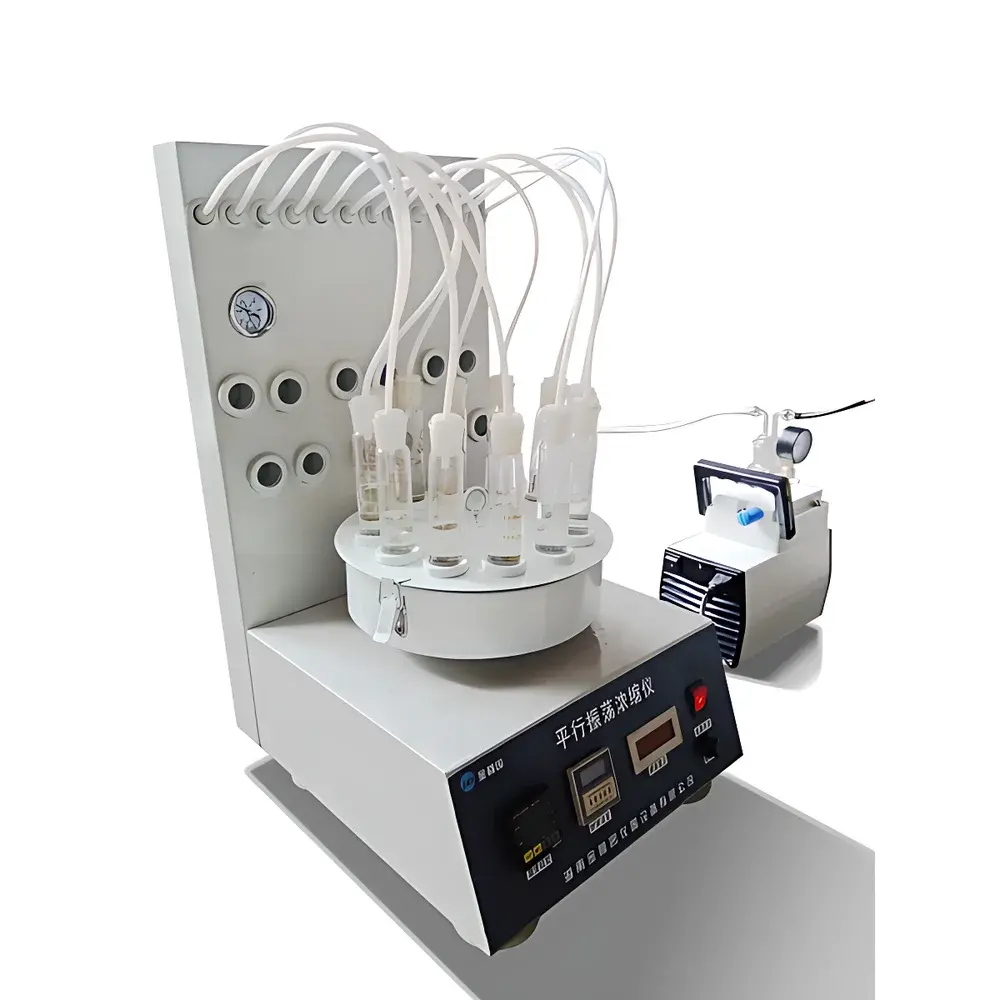
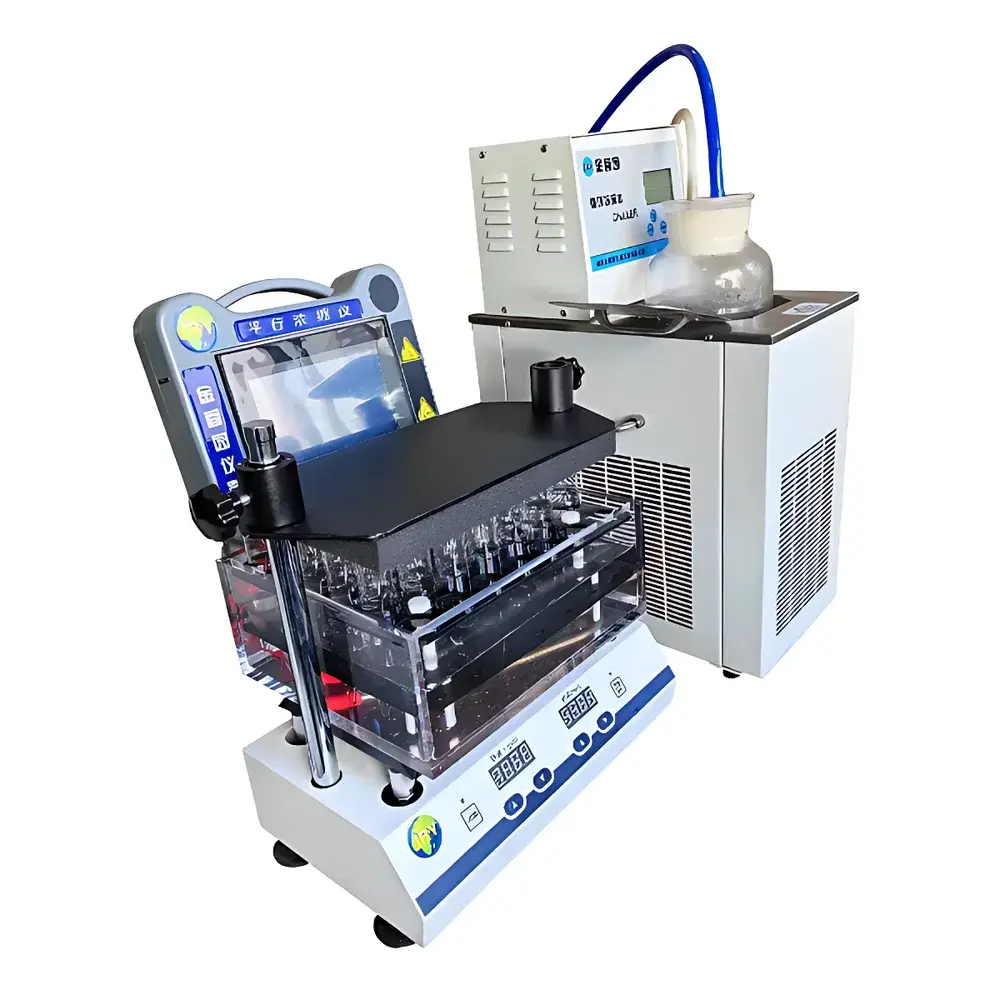
JRY JRY-NS-12 Parallel Evaporator
| Brand | JRY |
|---|---|
| Origin | Hunan, China |
| Manufacturer Type | Direct Manufacturer |
| Product Category | Domestic |
| Model | JRY-NS-12 |
| Instrument Type | Automated Quantitative Concentrator |
| Temperature Range | Ambient to 95 °C |
| Temperature Control Accuracy | ±0.1 °C |
| Maximum Sample Capacity | 200 mL per channel |
| Vacuum Level | <0.02 mbar |
| Oscillation Speed | 0–1200 rpm |
| Timer Range | 00:01 to 99:59 (hh:mm) |
| Power Rating | 1500 W |
| Voltage | 220 V AC |
| Independent Channel Architecture | 12 channels |
| Solvent Recovery | Integrated Cold Trap with Condensate Collection |
Overview
The JRY JRY-NS-12 Parallel Evaporator is an engineered solution for high-throughput, quantitative solvent removal in analytical and biological laboratories. It operates on a triple-mode principle—simultaneous water bath heating, controlled vacuum application, and programmable orbital oscillation—to accelerate evaporation while preserving thermally labile analytes. Unlike rotary evaporators relying solely on rotational motion and single-vessel operation, this system processes up to 12 samples in parallel under identical, independently regulated conditions. Its core architecture eliminates thermal gradient inconsistencies and cross-contamination risks inherent in batch-processing alternatives. Designed for trace-level analysis workflows—including environmental monitoring, food safety testing, pharmaceutical QC, clinical diagnostics, and molecular biology—the instrument supports low-temperature concentration of DNA/RNA extracts, protein solutions, and small-molecule standards without degradation or analyte loss.
Key Features
- Triple-action concentration mechanism: precise water bath heating (ambient to 95 °C), ultra-low vacuum (<0.02 mbar), and adjustable orbital shaking (0–1200 rpm) synergistically enhance mass transfer while suppressing bumping and foaming.
- Independent 12-channel design ensures full process isolation—each sample path features dedicated vacuum control, temperature sensing, and endpoint detection, eliminating carryover and enabling heterogeneous sample matrices in one run.
- Automated endpoint recognition: integrated level-sensing logic triggers audible alert and automatic pump shutdown upon reaching user-defined residual volume or time threshold.
- Integrated solvent recovery system: a built-in cold trap condenses vapors into a sealed collection reservoir, preventing atmospheric release and complying with laboratory ventilation and VOC emission guidelines.
- Dry-run protection: real-time water level monitoring prevents heater activation when bath volume falls below operational minimum, extending thermal block longevity and ensuring operator safety.
- Flexible sample format compatibility: accommodates round-bottom flasks (4×500 mL, 6×250 mL, 12×100 mL), digestion tubes (8×250 mL, 10×150 mL), and standard microplates—enabling seamless transition across extraction, cleanup, and pre-concentration steps.
Sample Compatibility & Compliance
The JRY-NS-12 is validated for use with aqueous, organic, and mixed-phase solvents commonly employed in EPA Method 1613/1668C, ISO 17025-accredited residue labs, and USP chromatographic sample prep. Its sub-0.02 mbar vacuum performance enables efficient removal of high-boiling solvents (e.g., DMSO, DMF, ethylene glycol) at reduced temperatures—critical for nucleic acid integrity in ISO/IEC 17025-compliant genomics workflows. The absence of nitrogen purge eliminates gas consumption costs and associated pressure regulation complexity, while the closed-loop condensate recovery satisfies OSHA 29 CFR 1910.1200 (HCS) and local environmental health requirements for volatile organic compound containment. All wetted surfaces are constructed from chemically resistant stainless steel and borosilicate glass, supporting cleaning validation per FDA 21 CFR Part 11–aligned SOPs.
Software & Data Management
The instrument operates via an embedded touchscreen interface with non-volatile parameter storage (≥100 method profiles). Each run logs timestamped metadata—including setpoint temperature, actual bath temperature, vacuum pressure trend, oscillation speed, elapsed time, and endpoint status—for audit-ready export via USB. While no cloud connectivity or remote control is provided, the local data archive supports GLP-compliant record retention and manual integration into LIMS environments via CSV export. All critical alarms (dry bath, overtemperature, vacuum failure, lid open) generate persistent event flags with time-stamped resolution history—facilitating root cause analysis during internal QA reviews or regulatory inspections.
Applications
- Environmental laboratories: concentration of pesticide residues, PCBs, dioxins, and PAHs from large-volume water extracts prior to GC-MS/MS or LC-MS/MS analysis.
- Food and beverage testing: parallel reduction of acetonitrile/water extracts from QuEChERS-prepared samples for mycotoxin and veterinary drug residue quantification.
- Clinical and public health labs: gentle desalting and volume reduction of serum, urine, or CSF specimens containing low-abundance biomarkers without denaturation.
- Molecular biology core facilities: preparation of high-yield, low-salt DNA/RNA eluates from silica-column or magnetic-bead purification kits—preserving enzymatic activity for downstream PCR, sequencing, or hybridization.
- Pharmaceutical R&D: accelerated solvent exchange in early-stage formulation development, including buffer exchange of monoclonal antibody intermediates.
FAQ
Does the JRY-NS-12 require external nitrogen or compressed air for operation?
No. It utilizes a built-in vacuum pump capable of sustaining <0.02 mbar without auxiliary gas sources.
Can I run different solvents simultaneously across the 12 channels?
Yes—each channel operates independently; however, solvent compatibility with the cold trap material (stainless steel + PTFE seals) must be verified prior to use.
What maintenance intervals are recommended for long-term reliability?
Vacuum pump oil replacement every 6 months (or after 1000 operating hours), cold trap cleaning after each solvent class change, and annual calibration verification of temperature and vacuum sensors.
Is the system compatible with 21 CFR Part 11 requirements?
It supports foundational elements—including user-accessible audit trails, electronic signatures via password-protected method editing, and immutable run logs—but lacks centralized identity management or electronic signature certification out-of-the-box.
What is the maximum allowable total volume per run?
200 mL per channel × 12 channels = 2.4 L total input volume; however, optimal performance is achieved at ≤150 mL/channel for viscous or foaming matrices.



