
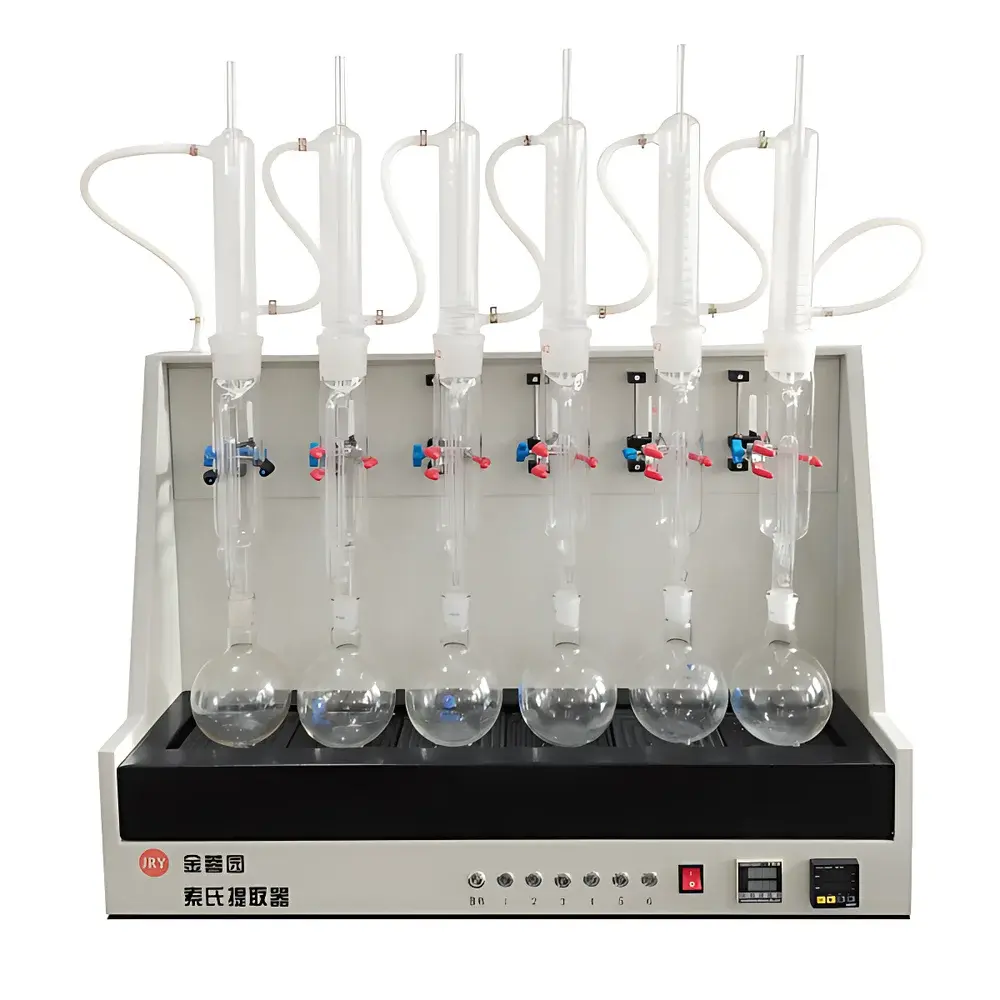
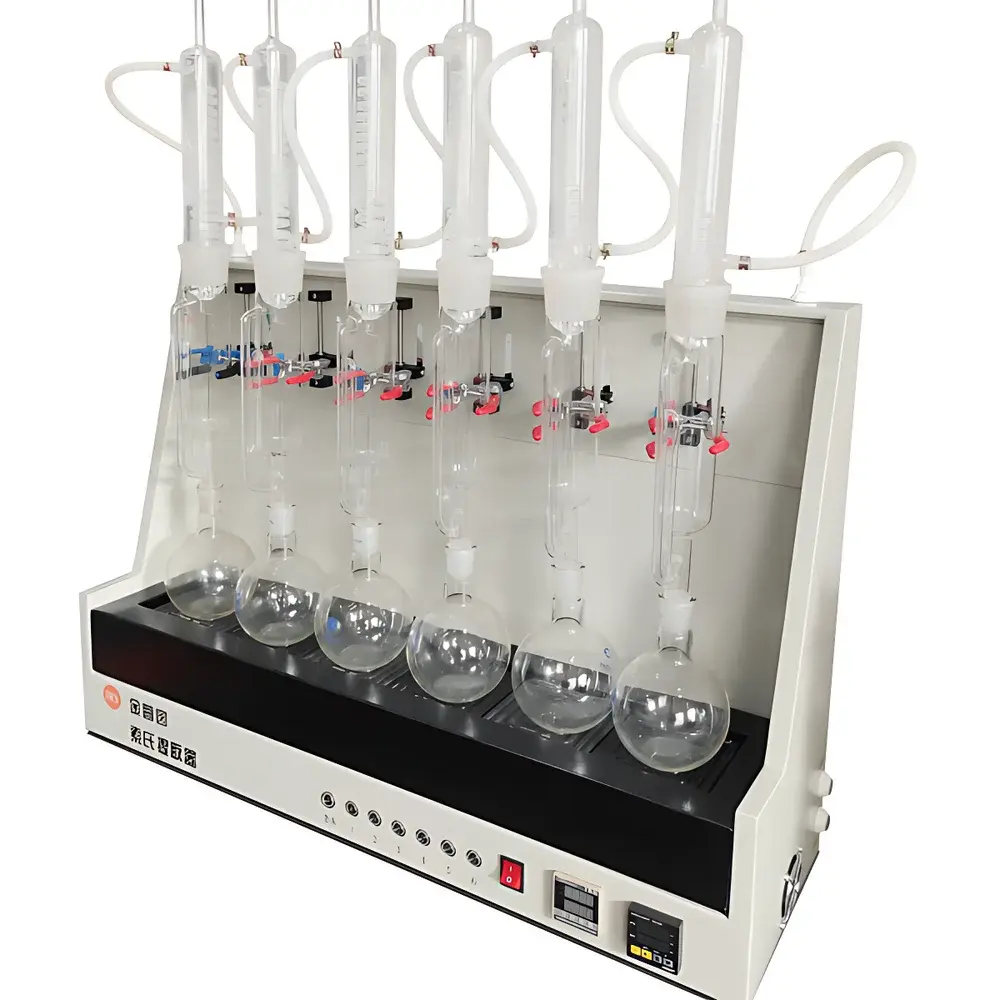
JRY JRY-SS Soxhlet Extractor
| Brand | JRY |
|---|---|
| Origin | Hunan, China |
| Manufacturer Type | Direct Manufacturer |
| Product Category | Domestic |
| Model | JRY-SS |
| Extraction Chamber Capacity | 6 positions |
| Receiver Flask Volume | 500 mL per position |
| Temperature Range | Ambient to 300 °C |
| Temperature Control Accuracy | ±0.1 °C |
| Number of Channels | 6 |
Overview
The JRY JRY-SS Soxhlet Extractor is a precision-engineered benchtop instrument designed for quantitative fat and lipid extraction based on the classical Soxhlet principle—continuous solvent reflux and cyclic percolation through solid samples. It operates by repeatedly washing ground or homogenized samples with hot solvent vapor condensate, enabling exhaustive extraction of non-polar analytes such as total lipids, crude fat, waxes, and hydrophobic contaminants. The system integrates three thermally coordinated functional modules: programmable heating zones for solvent boiling and reflux initiation, automated solvent recovery via integrated condensation pathways, and a factory-calibrated recirculating water cooling unit (standard) ensuring consistent condensate formation across all six channels. Its architecture supports both standardized methods (e.g., AOAC 920.39, ISO 6496, GB/T 5009.6) and method development workflows where independent thermal control per channel allows parallel optimization of extraction conditions—critical for heterogeneous sample matrices including animal feed, cereal grains, oilseeds, soil, and environmental solids.
Key Features
- Six independent extraction channels with individual PID-controlled heating elements, enabling simultaneous multi-condition experiments or high-throughput replicates under identical parameters.
- Precision temperature regulation from ambient to 300 °C with ±0.1 °C stability—optimized for low-boiling solvents (e.g., petroleum ether, diethyl ether) and high-boiling alternatives (e.g., chloroform, toluene).
- Integrated solvent recovery circuit featuring a sealed reflux path, gravity-driven siphon activation, and automatic return to the extraction thimble—minimizing solvent loss and operator intervention.
- Dual-display interface showing setpoint temperature, real-time channel temperature, programmed extraction duration, and elapsed heating time—supporting GLP-compliant documentation.
- Programmable extraction timer with audible end-of-cycle alarm and automatic heater shutdown—preventing overheating and ensuring repeatability across shifts.
- Standard inclusion of a recirculating water chiller (rated for continuous operation at ≤15 °C outlet temperature), eliminating dependency on external tap water and improving lab safety and sustainability.
Sample Compatibility & Compliance
The JRY-SS accommodates standard 25–35 mm diameter cellulose or glass fiber thimbles, supporting sample masses from 0.5 g to 20 g per position. It is validated for use with common organic solvents compliant with ASTM D129, ISO 11348, and USP <467> residual solvent limits. All wetted parts—including extraction chambers, receiver flasks (500 mL borosilicate glass), and condenser jackets—are chemically inert and autoclavable. The instrument meets CE marking requirements for laboratory electrical safety (EN 61010-1) and electromagnetic compatibility (EN 61326-1). Its operational protocol aligns with AOAC Official Method 920.39 for crude fat determination and supports audit-ready data generation when paired with optional USB logging firmware.
Software & Data Management
While the base JRY-SS operates via intuitive front-panel controls, an optional firmware upgrade enables USB data export of time-stamped temperature and timer logs in CSV format. This facilitates traceability in regulated environments requiring 21 CFR Part 11–compliant records (when used with validated third-party LIMS integration). All parameter settings—including target temperature, hold time, and channel enable/disable states—are retained after power cycling. No cloud connectivity or proprietary software installation is required, preserving data sovereignty and simplifying IT validation in GMP/GLP laboratories.
Applications
- Quantitative crude fat analysis in animal feed, dairy products, and meat according to AOAC and ISO standards.
- Lipid profiling in oilseed crops (soybean, rapeseed, sunflower) during breeding and quality assurance.
- Extraction of polycyclic aromatic hydrocarbons (PAHs) and total petroleum hydrocarbons (TPH) from contaminated soils and sediments per EPA Method 3541.
- Recovery of natural pigments (e.g., carotenoids, chlorophylls) from botanical matrices for nutraceutical R&D.
- Method validation studies requiring inter-channel reproducibility assessment under variable thermal gradients.
FAQ
What solvents are compatible with the JRY-SS extractor?
Petroleum ether (bp 40–60 °C), diethyl ether (bp 34.6 °C), chloroform (bp 61 °C), and toluene (bp 110 °C) are routinely used. Solvent selection must consider boiling point relative to the instrument’s 300 °C max heating capacity and compatibility with glass components.
Can the JRY-SS be used for non-fat extractions?
Yes—it is applicable to any analyte soluble in organic solvents and stable below 300 °C, including alkaloids, pesticides, plasticizers, and bioactive lipophilic compounds.
Is calibration certification included?
Factory calibration certificates for temperature sensors (traceable to NIST standards) are available upon request and may be added to purchase orders for regulated labs.
How is solvent recovery efficiency measured?
Under standard operating conditions with petroleum ether, solvent recovery exceeds 92% per cycle as verified by gravimetric balance comparison between initial charge and post-extraction volume.
What maintenance is required?
Routine cleaning of thimble holders and receiver flasks; annual verification of temperature sensor drift using a calibrated reference thermometer; inspection of silicone gaskets for compression set.



