
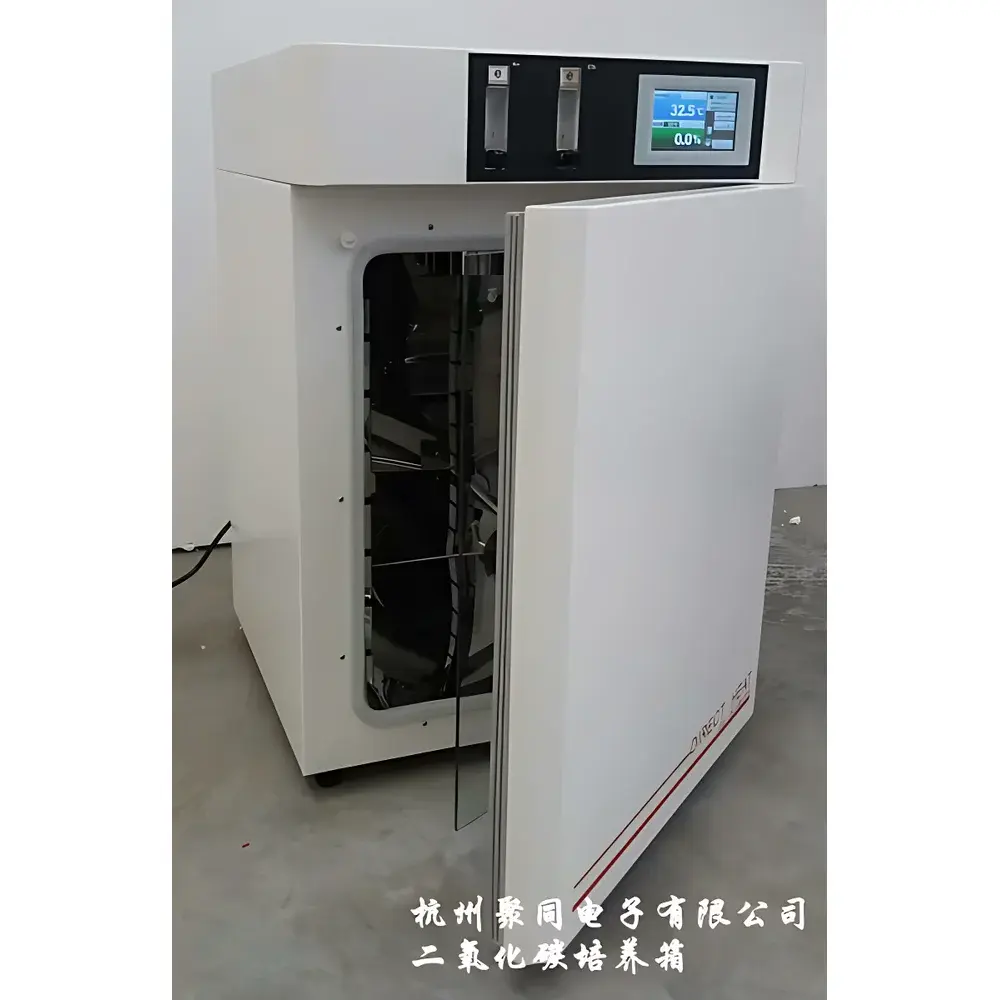
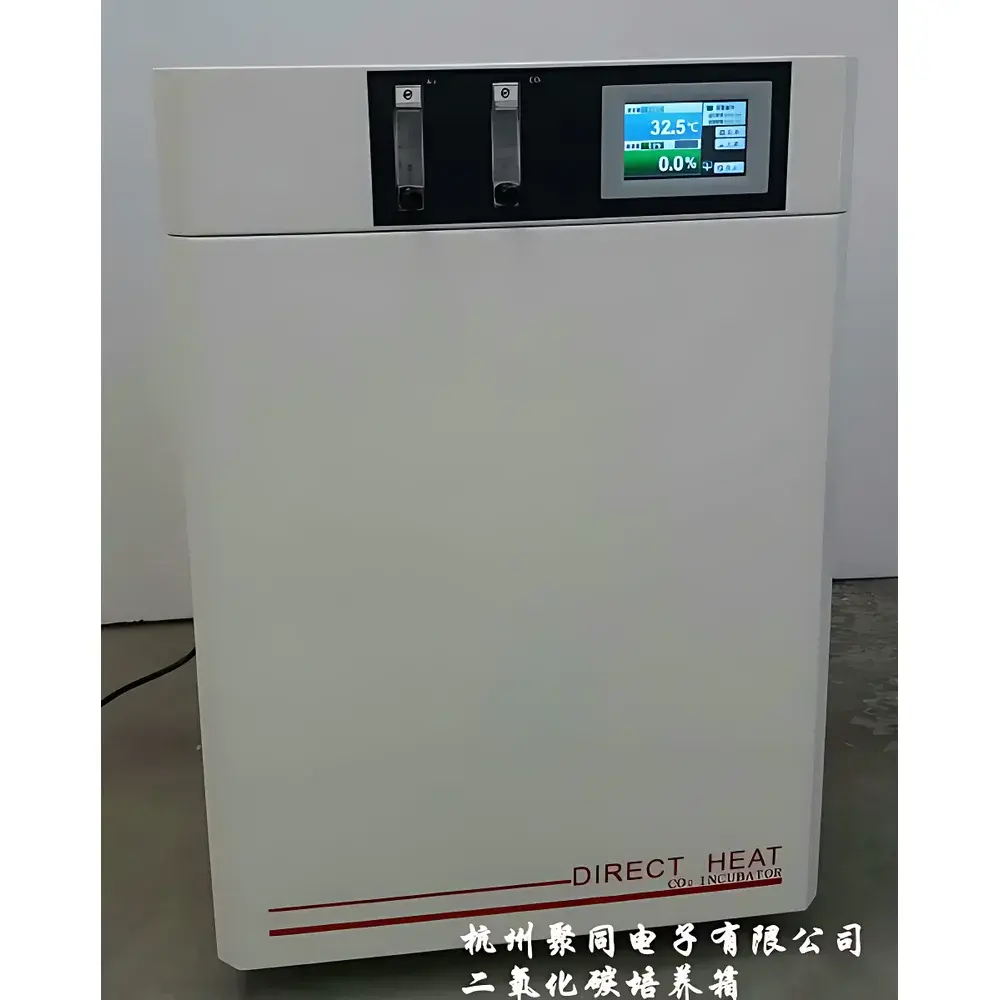
JTONE HH.CP-TW 160L CO₂ Incubator with Air-Jacketed Temperature Control and Integrated CO₂ Regulation
| Brand | JTONE |
|---|---|
| Origin | Anhui, China |
| Model | HH.CP-TW |
| Capacity | 160 L |
| Temperature Range | RT+5°C to 50°C |
| Temperature Uniformity | ±0.3°C |
| Refrigerant | Eco-friendly non-CFC |
| Construction | Cold-rolled steel exterior with electrostatic powder coating |
| Airflow System | Vertical laminar airflow with forced convection circulation |
| CO₂ Control | Dual-stage infrared (IR) sensor-based regulation (5% setpoint typical) |
| Humidity Control | Passive water-jacket-assisted humidification (95% RH typical at 37°C) |
| Safety Features | Independent over-temperature cutoff, UV sterilization lamp, door-temperature compensation, microbial inlet filter (0.2 µm), optional CO₂ pressure regulator |
| Compliance | Designed to support GLP-compliant cell culture workflows |
| Software Interface | LCD microprocessor controller with real-time display of temperature, CO₂ concentration, and elapsed time |
Overview
The JTONE HH.CP-TW 160L CO₂ Incubator is an air-jacketed, microprocessor-controlled environmental chamber engineered for reliable, long-term mammalian cell and tissue culture under physiologically relevant conditions. Unlike standard dry-air incubators, this system maintains tightly regulated CO₂ concentration (typically 5% v/v), temperature (commonly 37°C), and relative humidity (≥95% RH), replicating key parameters of the in vivo extracellular environment. Its operation relies on dual-sensor feedback control: a high-stability platinum resistance thermometer (PT100) for temperature monitoring and a non-dispersive infrared (NDIR) CO₂ sensor for gas-phase concentration measurement. The chamber employs vertical laminar airflow combined with a forced-convection circulation system to minimize thermal stratification and ensure spatial uniformity across all shelf levels—critical for reproducible monolayer expansion, stem cell differentiation assays, and co-culture experiments.
Key Features
- Air-jacketed thermal architecture with eco-friendly refrigerant ensures rapid temperature recovery (<15 min after 30-sec door opening) and low energy consumption during continuous operation.
- Mirror-finish 304 stainless steel interior with rounded corners and removable shelves enables efficient cleaning and reduces microbial retention points—supporting routine decontamination protocols including vaporized hydrogen peroxide (VHP) cycles.
- Integrated UV-C germicidal lamp (254 nm) operates on programmable timer or manual activation, providing periodic surface sterilization without compromising chamber integrity.
- Door-temperature compensation algorithm prevents condensation on the inner observation window, eliminating visual obstruction during live monitoring of cultures.
- Microbial-grade inlet filter (0.2 µm PTFE membrane) treats incoming CO₂ and ambient air, mitigating aerosol-borne contamination risks during gas replenishment.
- Independent dual-limit over-temperature protection circuitry interrupts heating if chamber temperature exceeds user-defined thresholds—compliant with IEC 61010-1 safety requirements for laboratory equipment.
Sample Compatibility & Compliance
The HH.CP-TW accommodates standard T-flasks (up to T225), multi-well plates (6–96-well), Petri dishes, roller bottles, and bioreactor-compatible vessels up to 160 mm diameter. Its chamber geometry supports simultaneous use of multiple vessel types without airflow interference. The unit is designed to meet foundational requirements for Good Laboratory Practice (GLP) and early-stage Good Manufacturing Practice (GMP) environments, including audit-ready operational logs (via optional RS232/USB data export), traceable calibration procedures, and mechanical interlocks for safety-critical functions. While not certified to FDA 21 CFR Part 11 out-of-the-box, its controller architecture supports integration with validated electronic lab notebook (ELN) systems when paired with appropriate middleware.
Software & Data Management
The embedded microcontroller features a 4.3-inch TFT LCD interface with intuitive menu navigation, real-time parameter visualization (temperature, CO₂ %, elapsed time), and configurable alarm thresholds. All operational events—including door openings, temperature excursions, CO₂ fluctuations, and UV lamp cycles—are timestamped and stored in non-volatile memory for ≥30 days. Data export is supported via USB flash drive (CSV format) or serial communication (RS232) for archival in LIMS or quality management systems. Calibration routines—including temperature offset adjustment and CO₂ zero/span calibration—follow standardized protocols aligned with ASTM E1293-22 (Standard Practice for Calibrating Environmental Chambers) and are documented in the included technical manual.
Applications
This incubator is routinely deployed in academic research laboratories for primary neuron isolation, induced pluripotent stem cell (iPSC) maintenance, and 3D organoid development. In biopharmaceutical QC settings, it supports viability testing of master cell banks per USP <1043>, stability studies of therapeutic proteins under stress conditions, and endotoxin-free media validation. Clinical labs utilize it for hematopoietic progenitor expansion prior to flow cytometry analysis and for maintaining patient-derived xenograft (PDX) explants during drug sensitivity screening. Its passive humidity retention design—enhanced by a stainless steel water pan and insulated chamber walls—makes it suitable for extended-duration assays (>72 h) without requiring active humidification hardware.
FAQ
What CO₂ gas purity is recommended for optimal sensor performance?
Use medical-grade CO₂ (≥99.99% purity, ISO 8573-1 Class 2 compressed air specifications) to prevent IR sensor drift caused by hydrocarbon or moisture contaminants.
Can the incubator operate without CO₂ supply for non-CO₂-dependent cultures?
Yes—the system defaults to ambient air mode with temperature-only regulation; CO₂ control remains inactive until gas supply is connected and enabled via menu.
Is external humidity monitoring required for validation?
While the chamber achieves ≥95% RH passively at 37°C, users performing ISO/IEC 17025-accredited work should verify humidity distribution using NIST-traceable hygrometers placed at defined grid points.
How often should the CO₂ sensor be recalibrated?
Perform zero calibration weekly using fresh ambient air; full span calibration with certified 5% CO₂/N₂ standard gas is recommended quarterly or after sensor replacement.
Does the unit support remote monitoring via Ethernet or Wi-Fi?
No native network interface is included; however, third-party IoT gateways with Modbus RTU-to-TCP conversion can integrate with building management systems (BMS) for centralized status reporting.




