
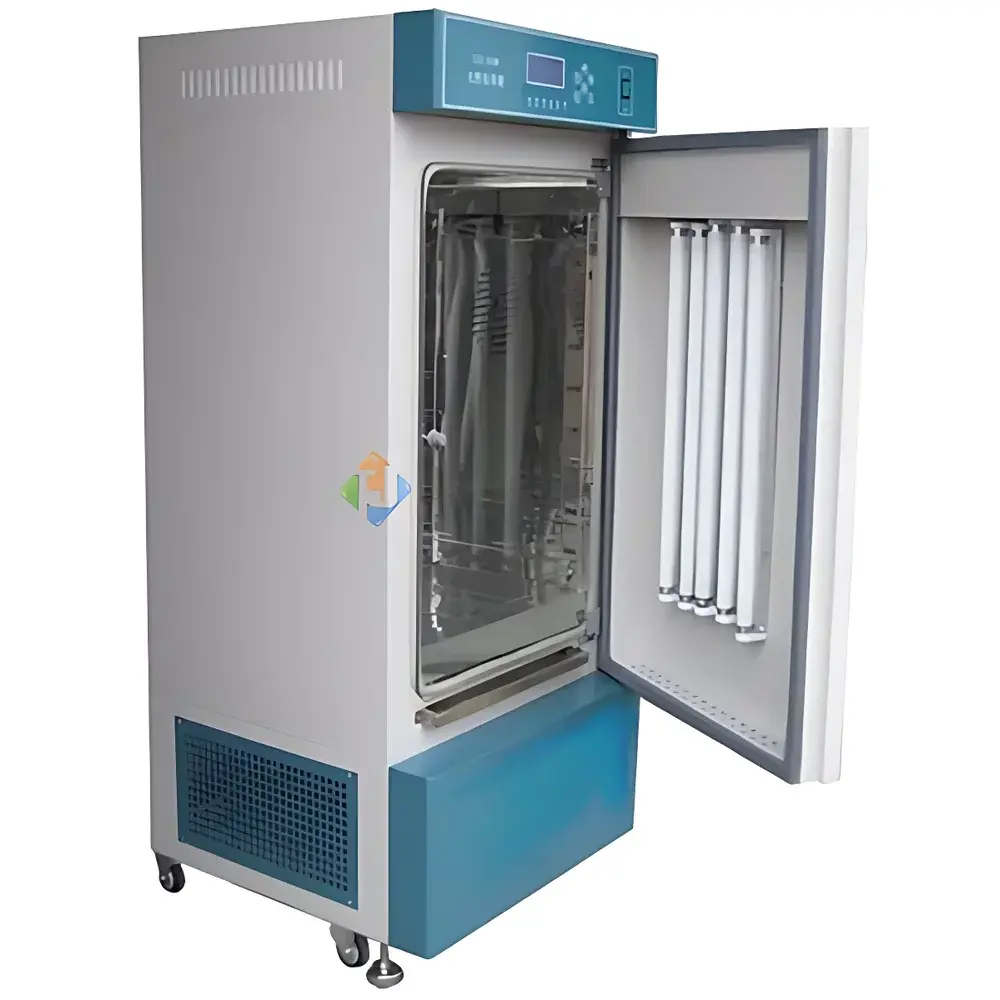
JTONE HWS-600 Temperature and Humidity Controlled Incubator
| Brand | JTONE |
|---|---|
| Origin | Zhejiang, China |
| Model | HWS-600 |
| Capacity | 600 L |
| Temperature Range (with Humidification) | 0–50 °C |
| Temperature Uniformity | ±0.8 °C |
| Humidity Range | 30–95 %RH |
| Humidity Control Accuracy | ±2 %RH |
| Construction | Dual-door, triple-pane insulated glass, stainless steel interior chamber with lockable access |
| Compressor | Original Tecumseh (France) hermetic refrigeration unit with delayed start and high/low pressure protection |
| Humidification System | Ultrasonic humidifier with high-reproducibility humidity generation |
| Air Circulation | Forced convection via corrosion-resistant stainless steel ductwork |
| Safety Features | Over-temperature protection, sensor fault detection, automatic shutdown |
Overview
The JTONE HWS-600 Temperature and Humidity Controlled Incubator is an engineered environmental simulation platform designed for long-term, stable cultivation of biological samples under precisely regulated thermal and hygroscopic conditions. Based on the principle of active thermoelectric and refrigeration-based temperature control combined with ultrasonic humidification, the system maintains tight setpoint adherence across its full 600 L working volume. Its dual-door architecture with triple-pane insulated glazing minimizes thermal bridging and external ambient interference—critical for applications requiring uninterrupted stability over extended periods (e.g., cell monolayer expansion, microbial growth kinetics, or seed germination studies). The unit complies with fundamental design expectations outlined in ISO 15197:2013 (for environmental chamber performance verification) and aligns with general laboratory infrastructure requirements per CLSI EP25-A guidelines for incubator qualification.
Key Features
- Ultrasonic humidification system delivering rapid, uniform moisture distribution without condensation risk or mineral deposition—enabling reproducible RH ramping and hold profiles.
- Dual-door configuration with magnetic gasket seals and triple-pane low-emissivity glass reduces heat loss by >40% compared to single-door alternatives, improving energy efficiency and thermal stability.
- Original Tecumseh (France) hermetically sealed compressor with integrated delayed-start logic and dual-stage pressure monitoring ensures refrigeration system longevity and operational safety under variable load conditions.
- Stainless steel forced-air circulation ductwork optimized for laminar flow distribution—validated to achieve ≤±0.8 °C temperature uniformity at 37 °C across all shelf levels (per ASTM E2755-17 Annex A1).
- Microprocessor-based PID controller with optional auto-tuning (ATU mode), real-time deviation compensation, and user-accessible calibration offset adjustment (SC parameter) for traceable temperature display correction.
- Comprehensive safety architecture including independent over-temperature cutoff (adjustable up to 60 °C), RTD sensor failure detection, and automatic power-down upon critical fault detection.
Sample Compatibility & Compliance
The HWS-600 accommodates standard microbiological and cell culture formats—including stacked Petri dishes (up to 150 mm diameter), T-flasks (up to 225 cm²), multi-well plates (6–96-well), roller bottles, and custom bioreactor vessels—without airflow obstruction. Interior dimensions (W×D×H: 850 × 620 × 1180 mm) allow vertical stacking of three full-height shelves (each rated for 25 kg static load). All wetted surfaces are electropolished AISI 304 stainless steel, compliant with USP <661.1> material compatibility standards for non-pyrogenic environments. While not certified to IEC 61010-1 or FDA 21 CFR Part 11 out-of-the-box, the instrument supports GLP/GMP-aligned operation when deployed with documented IQ/OQ protocols and external audit-trail logging via RS485 Modbus RTU interface.
Software & Data Management
The embedded controller provides local data logging (internal memory stores ≥30 days of 1-minute interval temperature/humidity readings) with timestamped event tagging (door opens, alarm triggers, setpoint changes). Optional RS485 serial output enables integration into centralized LabVantage or Siemens Desigo CCMS platforms using standard Modbus RTU register mapping. For standalone validation, a USB export port allows CSV dump of logged datasets for post-processing in MATLAB, Python (pandas), or JMP. All calibration and alarm thresholds are password-protected (two-tier access: operator vs. administrator), satisfying basic traceability requirements under ISO/IEC 17025 Clause 7.7 for equipment management.
Applications
- Mammalian cell culture maintenance (e.g., HEK293, CHO-K1) at 37 °C / 5% CO₂-ready configurations (when paired with optional gas mixing module).
- Fungal and bacterial growth profiling across humidity gradients (e.g., Aspergillus spp. sporulation at 25 °C / 85% RH).
- Pharmaceutical stability testing per ICH Q1A(R2) intermediate condition protocols (30 °C ±2 °C / 65% RH ±5% RH).
- Agricultural seed viability assays requiring synchronized hydration cycles (e.g., rice embryo germination at 28 °C / 90% RH).
- Material science studies involving hygroscopic polymer aging under controlled thermo-hygrometric stress.
FAQ
What is the recommended calibration frequency for the HWS-600?
Annual verification against NIST-traceable reference sensors is advised; internal probe calibration offsets (SC parameter) may be adjusted following ISO/IEC 17025-compliant procedures.
Can the unit operate continuously at 50 °C and 95% RH?
Yes—thermal and humidification subsystems are rated for continuous duty at maximum setpoints, though sustained operation above 45 °C/90% RH may reduce compressor service life; consult the maintenance log for cumulative runtime tracking.
Is remote monitoring supported natively?
No built-in Ethernet or Wi-Fi; however, RS485 Modbus RTU enables third-party SCADA integration with appropriate gateway hardware.
How is door-opening impact mitigated during operation?
Dual-door design isolates the inner chamber from ambient drafts; recovery time to ±0.5 °C after 30-second door opening is ≤12 minutes at 37 °C/50% RH (tested per ASTM E2755-17 Section 8.3).
Does the incubator meet any international safety certifications?
It conforms to GB 4793.1–2007 (Chinese equivalent of IEC 61010-1), but CE or UL listing requires factory-installed modifications and regional certification body validation.






