
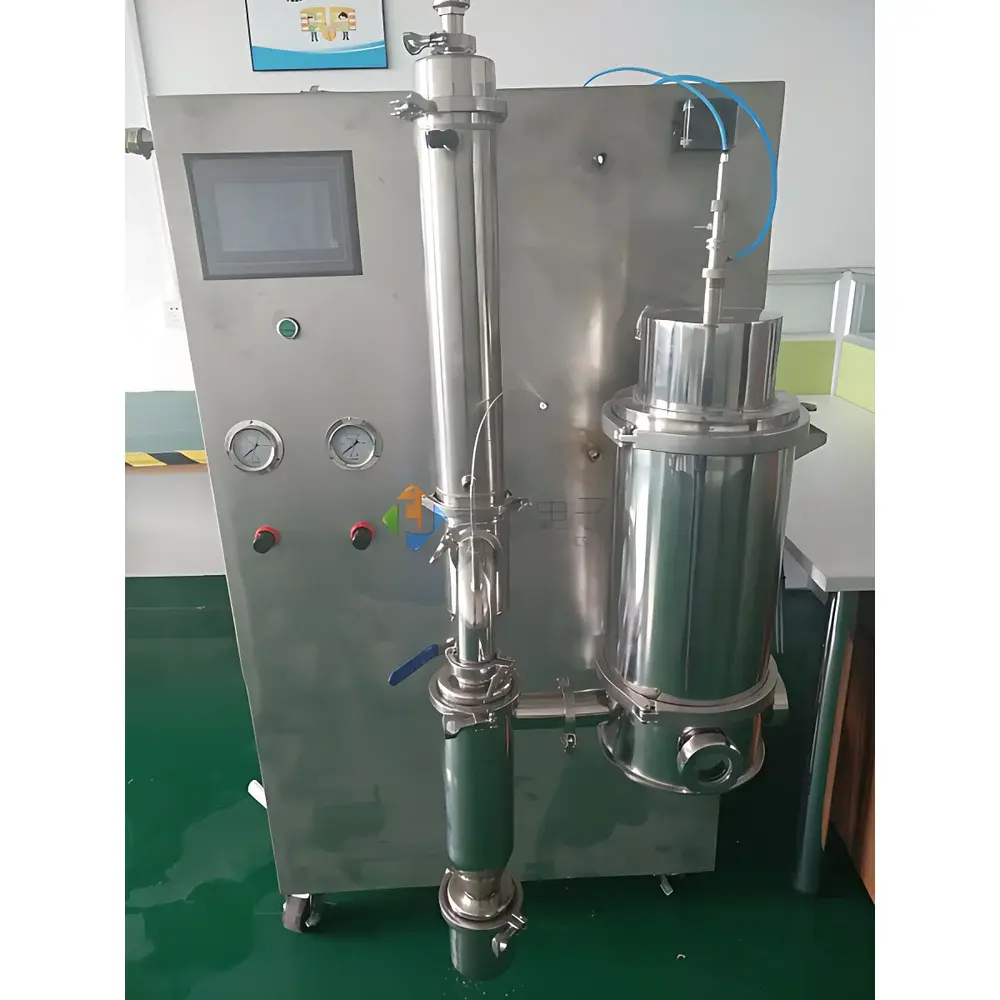
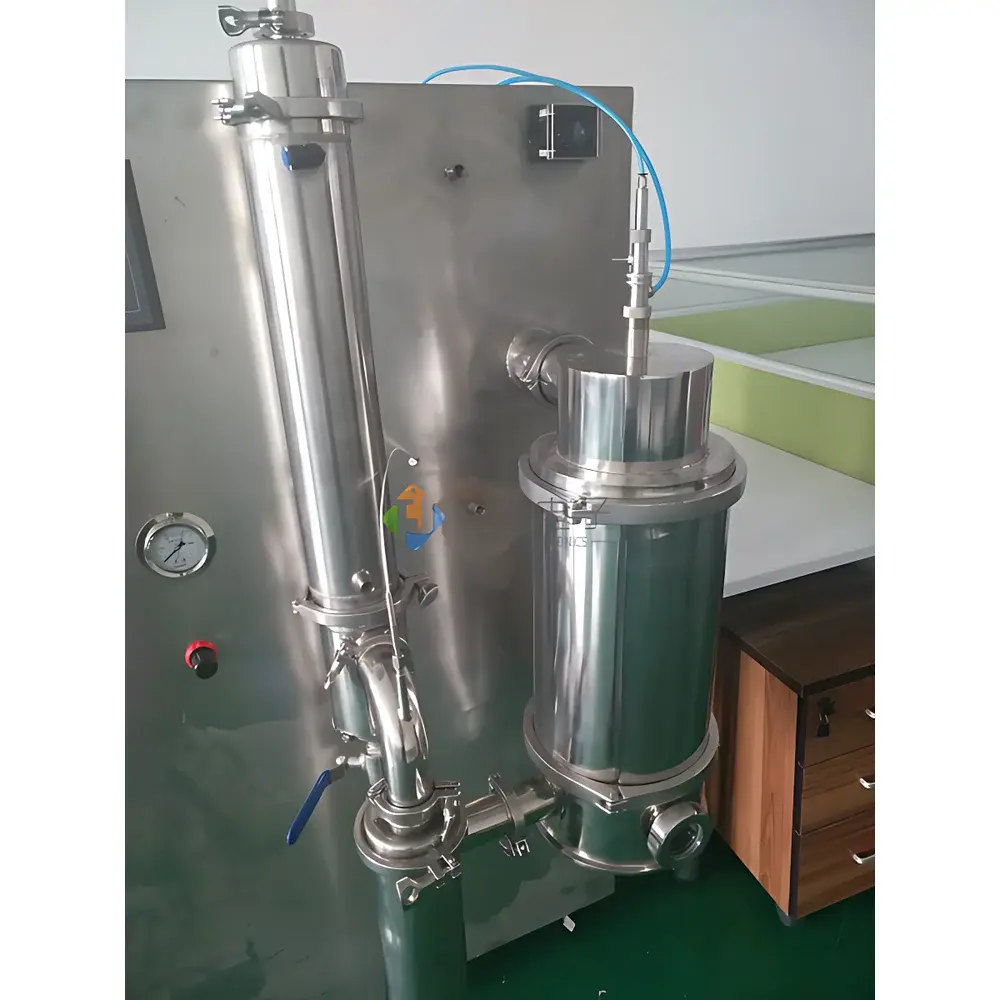
JTONE JT-6000Y Laboratory-Scale Low-Temperature Vacuum Spray Dryer
| Brand | JTONE |
|---|---|
| Origin | Jiangsu, China |
| Manufacturer Type | Authorized Distributor |
| Product Category | Domestic |
| Model | JT-6000Y |
| Sample Types | Emulsions, Suspensions |
| Max Throughput | 2000 mL/h |
| Temperature Range | 50–80 °C |
| Particle Size Tunability | Yes |
| Nozzle Orifice Options | 0.7 mm, 1.0 mm, 1.5 mm, 2.0 mm |
| Vacuum Range | –0.05 to –0.06 MPa |
| Heating Control Accuracy | ±1 °C (PID) |
| Power Supply | 5.8 kW / 380 V |
| Dimensions (L×W×H) | 850 × 1000 × 1650 mm |
Overview
The JTONE JT-6000Y Laboratory-Scale Low-Temperature Vacuum Spray Dryer is an engineered solution for the gentle, rapid conversion of heat-sensitive liquid feeds—such as pharmaceutical emulsions, biopolymer suspensions, probiotic broths, and functional food extracts—into free-flowing, amorphous or crystalline powders under controlled sub-atmospheric conditions. Unlike conventional atmospheric spray dryers that rely on inlet air temperatures exceeding 150 °C, the JT-6000Y operates within a sealed vacuum chamber where boiling point depression enables effective solvent evaporation at process temperatures strictly maintained between 50 °C and 80 °C. This principle leverages thermodynamic phase behavior under reduced pressure to preserve labile molecular structures—including enzyme conformation, peptide integrity, volatile aroma compounds, and encapsulated actives—without thermal degradation. The system integrates a concentric two-fluid nozzle architecture with interchangeable orifice diameters (0.7–2.0 mm), enabling precise control over droplet size distribution and, consequently, final particle morphology, density, and reconstitution kinetics. Designed for benchtop deployment in GLP-compliant research laboratories, it bridges the gap between exploratory formulation development and scalable process parameter mapping.
Key Features
- Full-color LCD touchscreen interface with intuitive Chinese-English bilingual navigation; supports both automatic PID temperature regulation and manual override modes with built-in parameter memory for repeatable experimental protocols.
- Integrated oil-free scroll air compressor ensures clean, pulse-free atomizing gas supply—critical for consistent droplet formation and compliance with ISO 8573-1 Class 0 air purity standards for pharmaceutical applications.
- Vacuum-assisted drying chamber maintains stable operating pressure between –0.05 and –0.06 MPa, reducing thermal stress and minimizing oxidative pathways during drying—particularly advantageous for omega-3 oils, anthocyanins, and live bacterial cultures.
- Adjustable concentric nozzle assembly allows vertical positioning optimization and interchangeable orifices (0.7, 1.0, 1.5, 2.0 mm) to tailor Sauter mean diameter (SMD) and span of the initial droplet distribution—directly influencing powder bulk density, flowability, and dissolution rate.
- Automated needle-type nozzle cleaner (‘clearing pin’) activates at user-defined intervals to prevent nozzle clogging during prolonged runs with high-viscosity or particulate-laden feeds—enhancing operational uptime and data continuity.
- Peristaltic feed pump enables precise volumetric delivery across a wide range (50–2000 mL/h), supporting both low-volume screening (e.g., 50 mL antibody formulations) and higher-throughput feasibility studies.
Sample Compatibility & Compliance
The JT-6000Y accommodates aqueous and organic-phase systems including protein-stabilized nanoemulsions, chitosan-based colloidal suspensions, polyphenol-rich plant extracts, and polymer-drug conjugates. Its vacuum environment mitigates Maillard reactions and hydrolytic cleavage commonly observed above 60 °C, making it suitable for USP <797> and <1117>-aligned aseptic process development. While not certified for GMP manufacturing, its design aligns with key elements of FDA 21 CFR Part 11 regarding audit-trail-capable parameter logging (via optional USB data export), closed-system operation, and material-contact surfaces fabricated from electropolished 316L stainless steel—meeting ASTM F86 surface finish requirements. All electrical components conform to IEC 61000-4 electromagnetic compatibility standards.
Software & Data Management
The embedded controller records real-time values for chamber temperature, vacuum level, feed rate, and inlet/outlet air differential—all timestamped and exportable as CSV files for post-run statistical analysis (e.g., ANOVA of particle size vs. nozzle size). Though no proprietary cloud platform is included, raw datasets integrate seamlessly with third-party tools such as MATLAB, JMP, or Python-based DOE frameworks. For regulated environments, optional RS-232/USB interfaces support connection to LIMS or ELN systems, enabling traceable linkage between batch ID, drying parameters, and analytical outcomes (e.g., residual moisture by Karl Fischer titration per USP <921>).
Applications
- Pharmaceutical R&D: Lyophilization-alternative drying of monoclonal antibodies, mRNA-LNP complexes, and inhalable dry powder aerosols.
- Food Science: Encapsulation of probiotics, vitamins, and flavor oils into maltodextrin or gum arabic matrices without Maillard browning.
- Materials Chemistry: Synthesis of uniform metal-organic framework (MOF) microspheres and ceramic precursors with controlled stoichiometry.
- Natural Products: Stabilization of thermolabile phytochemicals (e.g., curcumin, resveratrol) while retaining antioxidant capacity measured by ORAC assay.
- Academic Teaching: Hands-on instruction in mass transfer, fluid dynamics, and thermal processing principles aligned with ABET-accredited chemical engineering curricula.
FAQ
Can the JT-6000Y be used for organic solvent-based feeds?
Yes—provided the vacuum system and chamber seals are rated for the vapor pressure and chemical compatibility of solvents such as ethanol, acetone, or ethyl acetate. Consult the safety datasheet for maximum allowable concentration limits.
Is particle size distribution (PSD) directly measurable on this unit?
No—the JT-6000Y does not include integrated laser diffraction or imaging. PSD analysis requires offline measurement via Malvern Mastersizer, Sympatec HELOS, or scanning electron microscopy (SEM) of collected powder.
What maintenance intervals are recommended for the vacuum pump?
Oil-sealed rotary vane pumps require oil changes every 500 operating hours; oil-free diaphragm alternatives are available upon request for reduced maintenance burden.
Does the system comply with CE or UL certification?
The base configuration meets CE marking requirements per Machinery Directive 2006/42/EC and EMC Directive 2014/30/EU. UL listing is available under custom order with additional factory testing.
How is residual moisture content affected by vacuum level and temperature setpoint?
Lower absolute pressure (< –0.055 MPa) combined with 60–70 °C drying temperature typically achieves ≤2.5% w/w residual moisture in carbohydrate-based matrices, as verified by gravimetric loss-on-drying (LOD) per USP <731>.



