
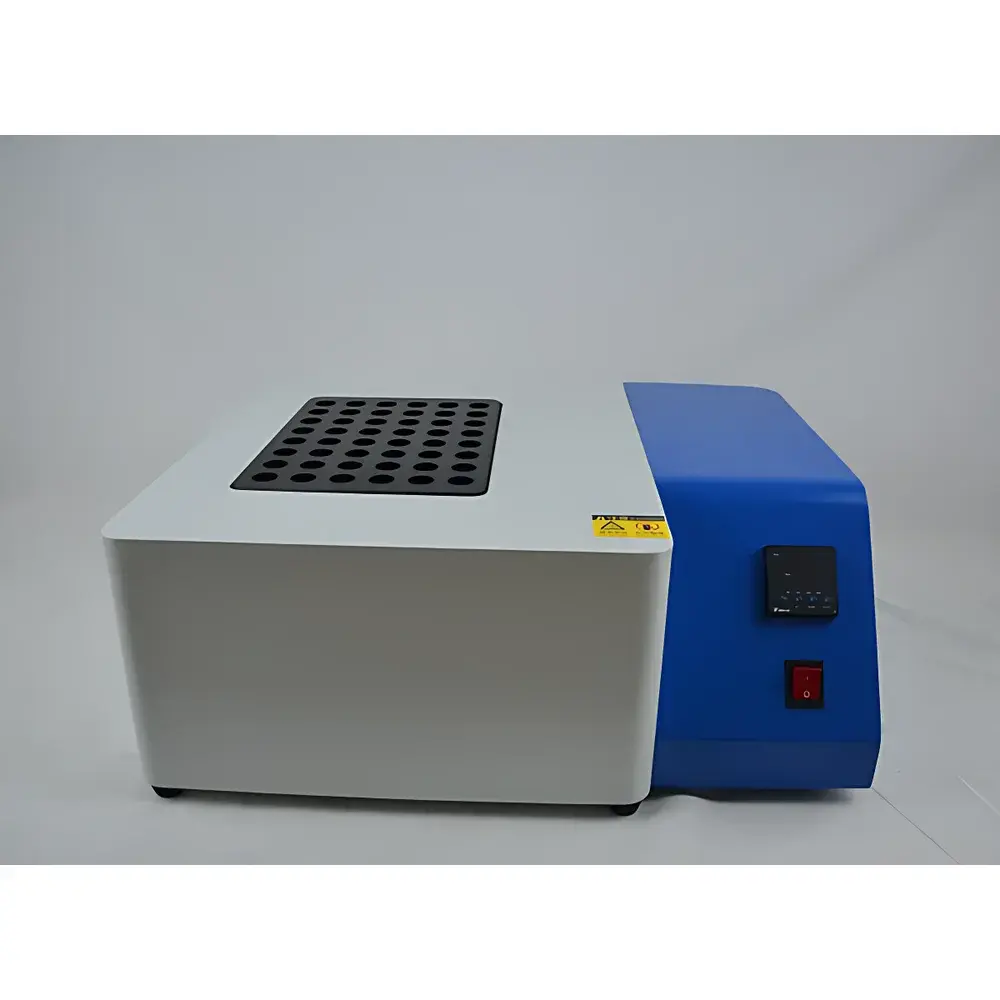
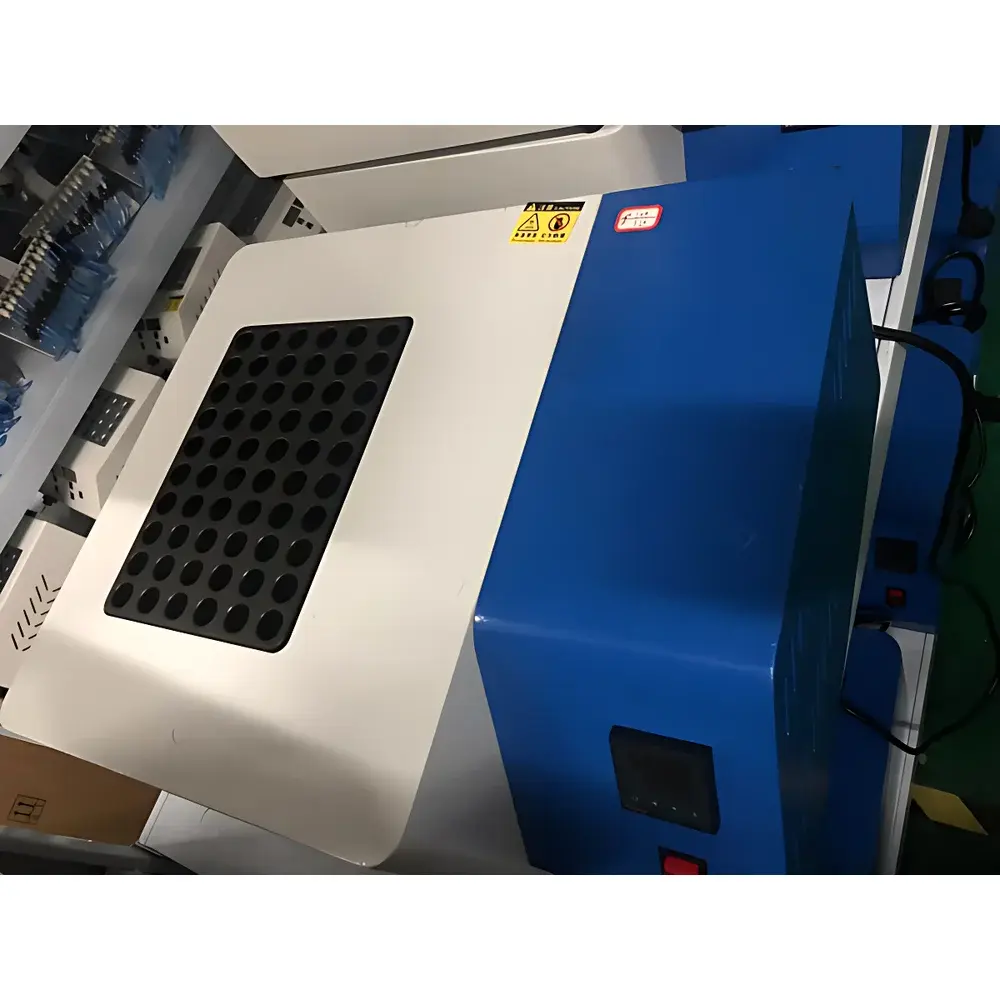
JTONE JTSM-60 Graphite Block Digestion System
| Brand | JTONE |
|---|---|
| Origin | Zhejiang, China |
| Manufacturer Type | Authorized Distributor |
| Origin Category | Domestic |
| Model | JTSM-60 |
| Pricing | Upon Request |
| Digestion Method | Rapid Digestion |
| Heating Module | Dual Graphite Blocks |
| Batch Capacity | 60 samples |
| Temperature Range | Ambient to 400 °C |
| Temperature Accuracy | ±0.1 °C |
| Digestion Vessel Capacity | 1 mL per well |
| Timer Accuracy | ±1 s |
| Heating Material | Isostatically Pressed High-Purity Graphite |
| Surface Coating | PTFE-Impregnated Graphite |
| Control Algorithm | PID with Auto-Tuning |
| Safety Features | Overtemperature, Overcurrent, Overvoltage, and Thermal Runaway Protection |
| Optional Accessory | Acid Gas Neutralization Unit (Condensation + Alkaline Scrubbing + Desiccant Drying) |
Overview
The JTONE JTSM-60 Graphite Block Digestion System is a precision-engineered instrument designed for high-throughput, reproducible sample digestion in environmental, wastewater, and regulatory compliance laboratories. It operates on the principle of conductive heating via isostatically pressed, ultra-fine graphite blocks — a material selected for its exceptional thermal conductivity, chemical inertness, and dimensional stability under repeated thermal cycling. Unlike ceramic or metal heating blocks, graphite provides uniform heat distribution across all 60 digestion wells, minimizing inter-well temperature deviation to ≤±1.5 °C at steady state — a critical factor for method reproducibility in COD, total phosphorus, heavy metals (e.g., As, Cd, Pb, Hg), and nutrient analysis per ISO 6344, EPA Method 3015A, and ASTM D129–17. The system supports rapid digestion protocols compliant with ISO 8467 (COD by dichromate oxidation) and enables precise ramp-and-hold thermal programming across up to 10 user-defined steps, with independent control of ramp rate and dwell time.
Key Features
- Dual independent graphite heating blocks engineered for parallel processing of up to 60 samples (1 mL capacity per well), significantly reducing batch turnaround time in high-volume water quality labs.
- PID-based temperature control with auto-tuning capability ensures stable setpoint maintenance from ambient to 400 °C, with accuracy of ±0.1 °C and intra-block uniformity ≤±2.0 °C (per well).
- PTFE-impregnated graphite surface and corrosion-resistant hardware (including fluoropolymer-coated fasteners and epoxy-powder-coated chassis) provide long-term resistance to concentrated HNO₃, H₂SO₄, HF, and aqua regia — essential for trace-metal digestion workflows.
- Double-layer suspended inner chamber design enhances passive airflow and thermal isolation, preventing chassis overheating during extended 8–12 h digestion cycles typical for refractory matrices.
- Integrated safety architecture includes real-time overtemperature cutoff, current/voltage monitoring, thermal runaway detection, and audible/visual alarm activation upon deviation >2 °C from setpoint.
- Optional acid gas neutralization module (available as add-on) features condensate trapping, NaOH-scrubbed alkaline neutralization, and silica gel drying — enabling safe operation without external fume hood dependency for routine COD or TN digestion.
Sample Compatibility & Compliance
The JTSM-60 accommodates standard 16 mm × 100 mm borosilicate glass digestion tubes and compatible quartz or PFA vials. Its 18 mm well diameter and 90 mm depth support full immersion of vessels used in EPA 3015A, ISO 11908 (total nitrogen), and GB/T 11892–1989 (CODCr). All thermal profiles are fully programmable and audit-trail ready — supporting GLP/GMP-aligned data integrity when paired with optional PC-based logging software. The instrument meets IEC 61010-1:2010 safety requirements for laboratory equipment and complies with electromagnetic compatibility standards EN 61326-1:2013.
Software & Data Management
While the base unit features an intuitive membrane keypad and LED display for manual operation, optional USB-connected PC software enables method library management, thermal profile export/import, real-time temperature graphing, and timestamped event logging (start/stop, alarms, setpoint changes). All logged data adhere to ALCOA+ principles (Attributable, Legible, Contemporaneous, Original, Accurate, Complete, Consistent, Enduring, Available) and may be configured to meet FDA 21 CFR Part 11 requirements when deployed with electronic signature and role-based access controls.
Applications
- Routine COD determination in municipal and industrial wastewater per ISO 6060 and APHA Standard Methods 5220B.
- Digestion of soil, sludge, and sediment samples prior to ICP-OES/MS analysis of regulated metals (Cd, Cr, Ni, Zn) under EPA Method 3050B and ISO 11466.
- Total phosphorus and Kjeldahl nitrogen digestion in surface water and effluent matrices per ISO 6878 and ISO 5663.
- Preparation of certified reference materials (CRMs) and proficiency testing samples requiring strict inter-laboratory comparability.
- Method development for difficult-to-digest organic matrices (e.g., humic substances, biochar, polymer-laden effluents) using multi-step ramp-and-hold protocols.
FAQ
What is the maximum recommended digestion temperature for routine COD analysis?
For dichromate-based COD methods (ISO 6060, EPA 410.4), the optimal digestion temperature is 150 °C for 2 hours. The JTSM-60 maintains this setpoint with ≤±0.1 °C deviation and ensures <±1.0 °C inter-well variance.
Can the JTSM-60 accommodate custom vessel sizes?
Yes — well diameter (standard 18 mm) and depth (90 mm) can be modified per customer specification; engineering documentation and thermal validation reports are provided for customized configurations.
Is the acid gas neutralization module required for regulatory compliance?
Not universally mandated, but strongly recommended for ISO/IEC 17025-accredited labs performing >50 digestions/week; it eliminates reliance on facility fume hoods and reduces cross-contamination risk from volatile acid vapors.
How does the dual-block design improve analytical reproducibility?
Independent thermal control of two 30-well blocks allows staggered digestion runs, calibration verification between blocks, and redundancy — ensuring continuity if one block undergoes maintenance without halting throughput.
What documentation is supplied for IQ/OQ/PQ validation?
Factory-installed calibration certificates (NIST-traceable RTD sensors), temperature uniformity mapping reports (per ASTM E220), and a complete validation protocol template aligned with EU Annex 15 and USP <1058> are included with each unit.
Related Products







