
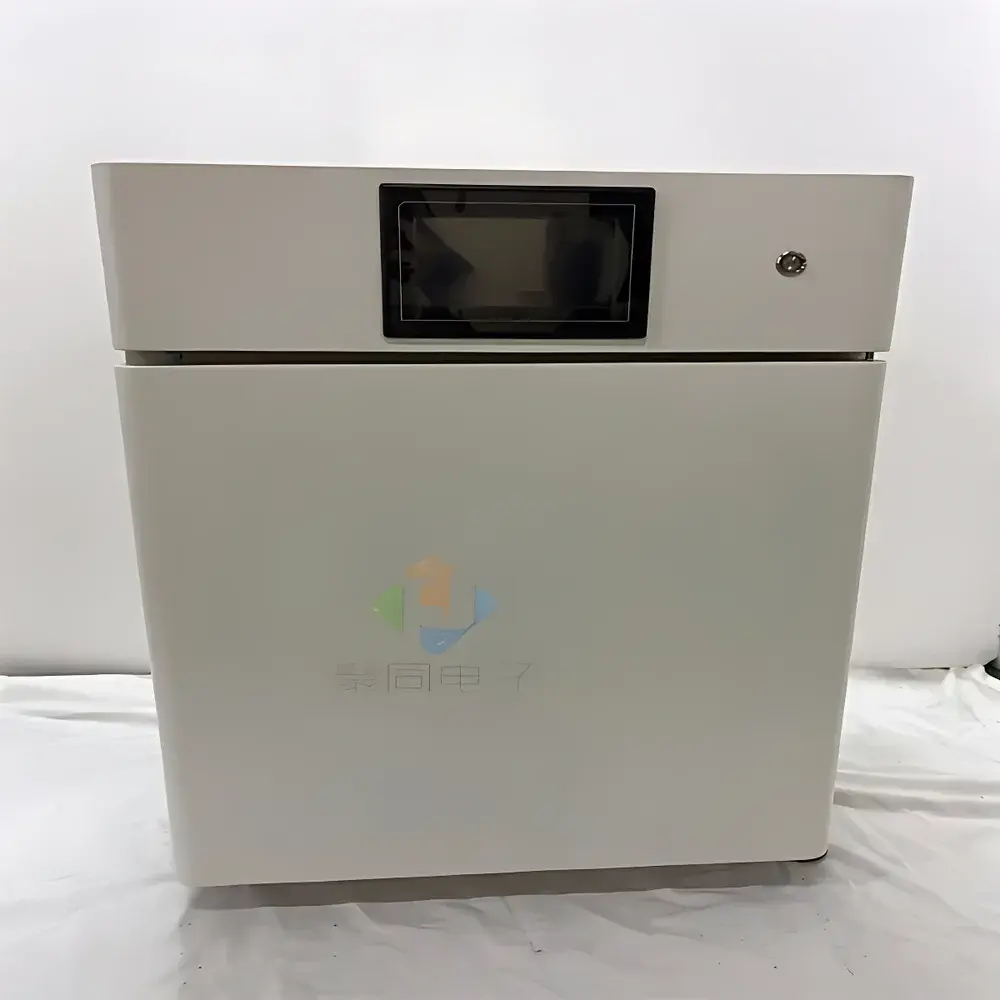
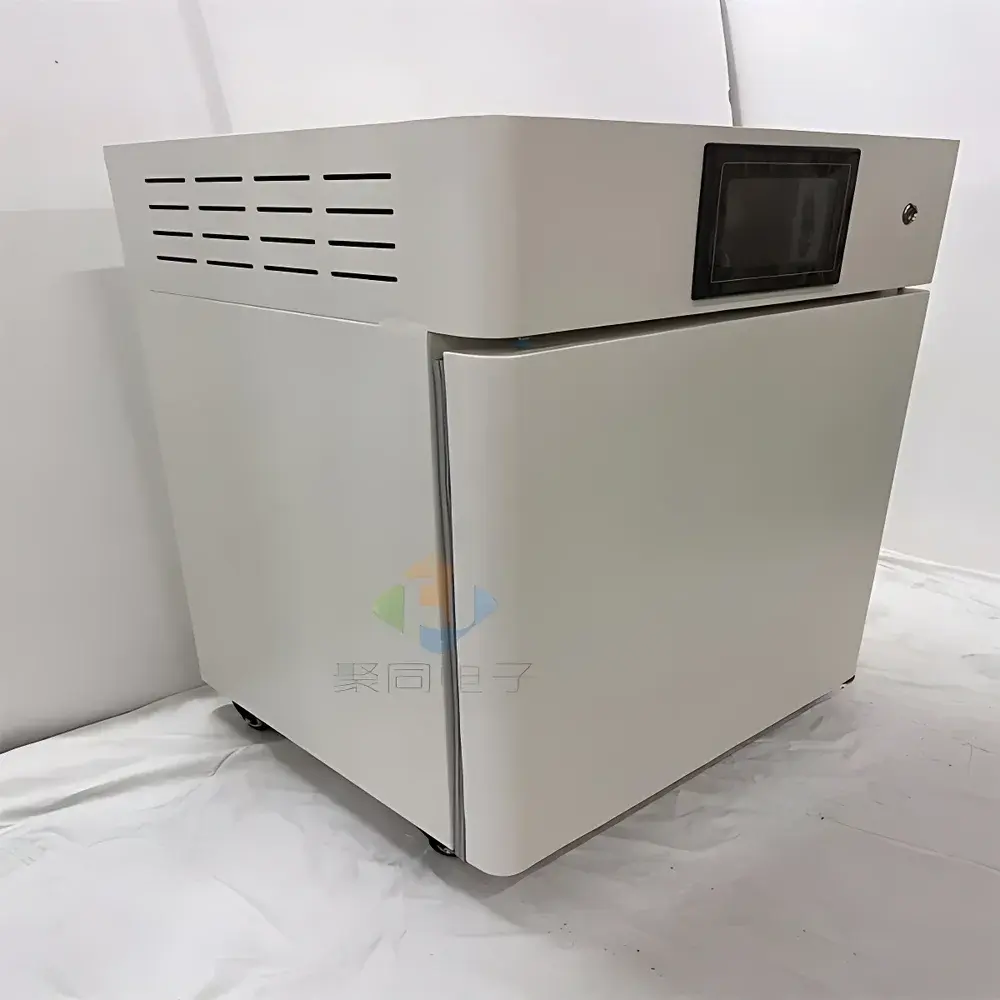
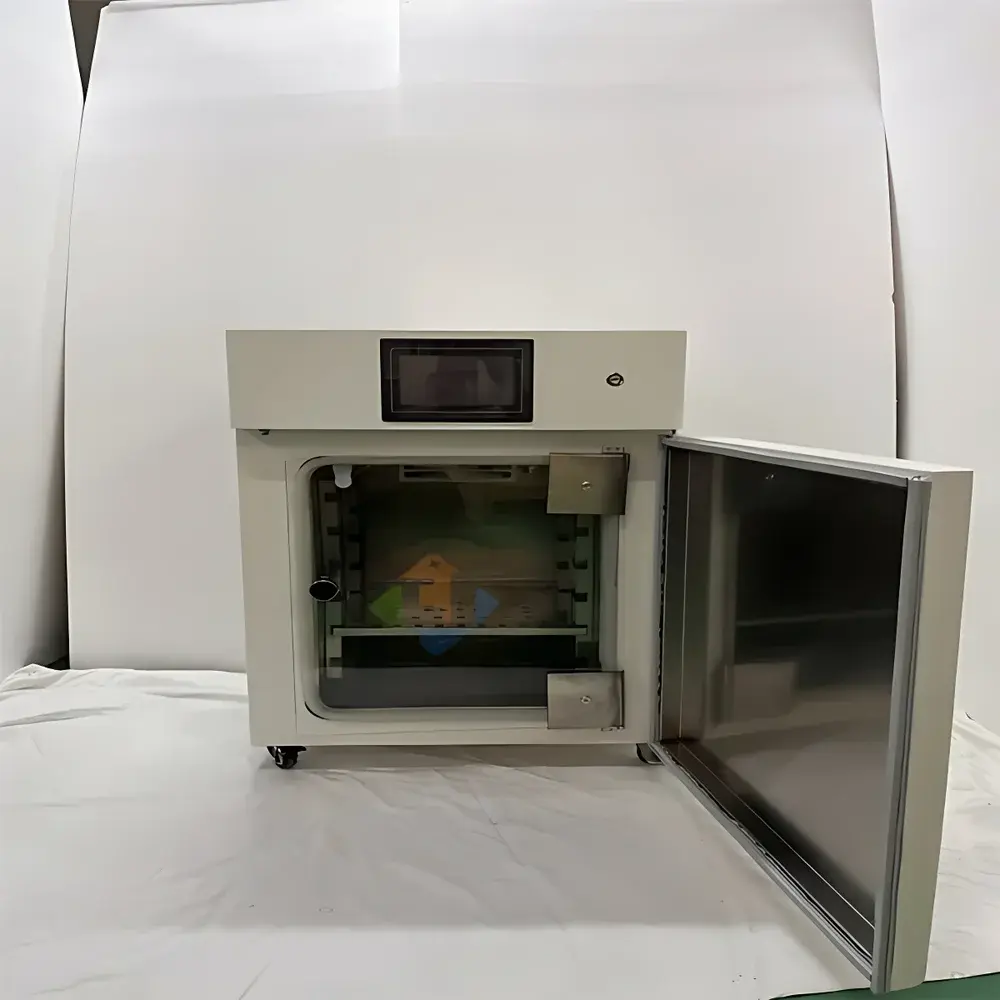
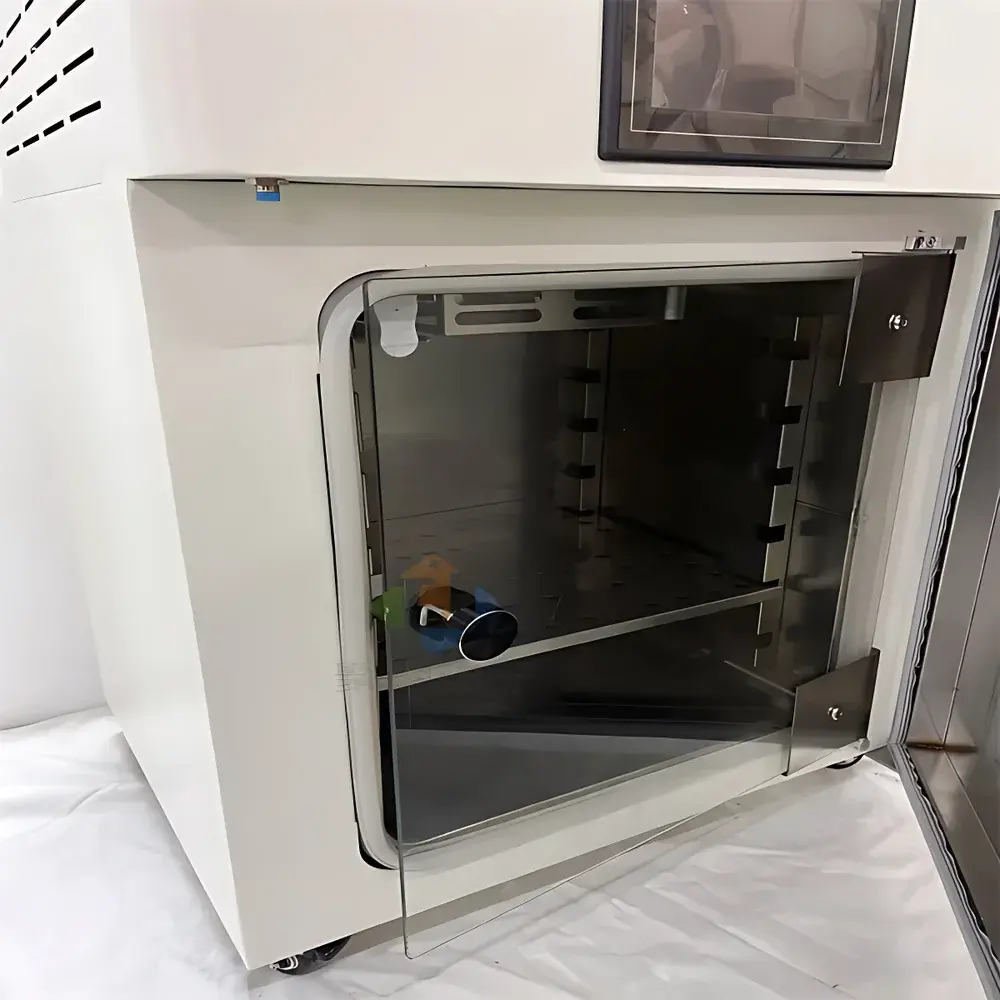
JTONE JTSQ-50A Tri-Gas Incubator (50 L, CO₂/O₂/N₂ Controlled)
| Brand | JTONE |
|---|---|
| Origin | Zhejiang, China |
| Model | JTSQ-50A |
| Capacity | 50 L |
| Temperature Control Range | RT+5°C to 60°C |
| Temperature Uniformity | ±0.3°C |
| Humidity Range | 35% ±5% RH (natural evaporation) |
| CO₂ Control Range | 0–20.0% (IR sensor, ±0.2% accuracy) |
| O₂ Control Range | 1.0–19.0% (hypoxic) or 23.0–50.0% (hyperoxic), up to 90.0% optional |
| O₂ Sensor | Imported zirconia |
| CO₂ Sensor | Imported NDIR infrared |
| Temperature Sensor | PT100 |
| Control System | PLC-based with 4.3″ capacitive touchscreen |
| Sterilization | UV lamp (optional 90°C moist-heat or 180°C dry-heat) |
| Heating Method | Air-jacketed |
| Internal Dimensions (W×D×H) | 340 × 340 × 450 mm |
| Standard Shelving | 2 stainless steel shelves |
| Power Consumption | 250 VA (±10%) |
Overview
The JTONE JTSQ-50A Tri-Gas Incubator is a compact, precision-engineered cell culture environment system designed for controlled hypoxic, normoxic, and hyperoxic research applications. Unlike standard CO₂ incubators, this 50 L unit actively regulates three independent gas phases—carbon dioxide (CO₂), oxygen (O₂), and nitrogen (N₂)—enabling reproducible simulation of physiologically relevant oxygen tensions (e.g., 1–5% O₂ for stem cell or tumor microenvironment studies). It operates on a dual-gas injection strategy: for hypoxic setpoints (<19.0% O₂), high-purity N₂ displaces ambient air prior to CO₂ introduction; for hyperoxic conditions (>22.3% O₂), medical-grade O₂ is introduced first, followed by CO₂ dosing—ensuring minimal cross-interference between gas control loops. Temperature regulation employs an air-jacketed architecture with PT100-sensed, PID-controlled heating across three thermal zones (chamber, door, and air plenum), delivering stable thermal performance (±0.3°C uniformity) even during frequent door access. The chamber’s forced-air circulation—guided by symmetrical baffle channels and a low-turbulence axial fan—mimics natural convection, accelerating recovery of setpoint conditions after intervention.
Key Features
- Air-jacketed thermal design with triple-zone PT100 sensing (chamber, door, and air path) minimizes thermal drift from ambient fluctuations and ensures rapid temperature stabilization (±0.2°C typical deviation).
- NDIR-based CO₂ monitoring (Finnish-sourced infrared sensor) provides non-consumptive, drift-free measurement over extended operation with <0.2% absolute accuracy and <10 min ramp time to 5.0% setpoint.
- Zirconia-based O₂ sensing (UK-imported electrochemical cell) delivers linear response across full 1.0–90.0% range, validated per ISO 8573-1 for trace-gas metrology compliance in biological environments.
- PLC-driven control logic implements fail-safe interlocks: automatic valve shutoff upon door opening, electronic solenoid protection (30-min timeout if CO₂ flow fails to activate), and multi-stage alarm escalation (audible/visual + relay output) for out-of-spec temperature, CO₂, or O₂.
- UV germicidal irradiation (254 nm) integrated into the ceiling assembly provides routine surface decontamination; optional validation-ready moist-heat (90°C/30 min) or dry-heat (180°C/2 h) sterilization cycles support GLP/GMP-aligned workflows.
- Natural evaporation humidification achieves 95–98% RH without water reservoirs or ultrasonic components—eliminating condensation risk and microbial carryover while maintaining ISO 14644-1 Class 5 cleanroom-compatible internal sterility.
Sample Compatibility & Compliance
The JTSQ-50A accommodates standard T-25, T-75, and 6-/12-well plates, Petri dishes, and roller bottles within its 340 × 340 × 450 mm stainless-steel chamber (electropolished AISI 304). Its gas control architecture meets critical requirements for primary cell expansion, organoid differentiation, and anaerobic pathogen cultivation—applications demanding strict adherence to ASTM E1920 (standard guide for hypoxic chamber qualification) and USP <1043> (cell therapy environmental controls). The system supports audit-ready operation under FDA 21 CFR Part 11 when paired with JTONE’s optional data logging module (timestamped, user-access-controlled, tamper-evident event records). All gas lines incorporate 0.2 µm hydrophobic particulate filters compliant with ISO 8573-2 Class 2 purity standards, preventing microbial ingress during N₂/O₂/CO₂ supply.
Software & Data Management
Operation is managed via a 4.3″ industrial-grade capacitive touchscreen running embedded Linux firmware. The HMI displays real-time overlay graphs of temperature, CO₂, O₂, and humidity trends with adjustable time scales (1 min to 72 h). Parameter configuration—including ramp/soak profiles, alarm thresholds, and sterilization cycle presets—is password-protected with role-based access (Operator, Technician, Administrator). Raw sensor logs export via USB 2.0 in CSV format with ISO 8601 timestamps; optional Ethernet connectivity enables integration into LabVantage or Thermo Fisher SampleManager LIMS via Modbus TCP. All control actions (gas valve actuation, heater cycling, UV activation) are recorded with digital signatures, satisfying ALCOA+ principles for data integrity in regulated bioprocessing environments.
Applications
- Stem cell maintenance under physiological hypoxia (1–5% O₂) to preserve pluripotency and reduce oxidative stress-induced senescence.
- Tumor spheroid and patient-derived xenograft (PDX) culture where gradient O₂ tension modulates HIF-1α signaling and chemoresistance phenotypes.
- Microaerophilic bacterial culture (e.g., Helicobacter pylori, Campylobacter jejuni) requiring precise 5–10% O₂ with concurrent 10% CO₂ supplementation.
- Embryonic development studies simulating placental O₂ gradients (e.g., 2–8% O₂) in conjunction with controlled pH via CO₂/bicarbonate buffering.
- Biomanufacturing process development for monoclonal antibody production, where transient O₂ modulation enhances glycosylation consistency and titer yield.
FAQ
What gas purity specifications are required for optimal JTSQ-50A performance?
Medical-grade CO₂ (≥99.995%), N₂ (≥99.999%), and O₂ (≥99.5%) are recommended. Inlet pressure must be regulated to 0.2–0.3 MPa with dew point ≤−40°C to prevent sensor fouling and condensation.
Can the incubator maintain simultaneous CO₂ and O₂ setpoints during frequent door openings?
Yes. The adaptive gas replenishment algorithm prioritizes O₂ correction before CO₂ dosing post-intervention, achieving full recovery of both gases within ≤8 minutes (tested at 5% O₂ / 5% CO₂ setpoints).
Is third-party IQ/OQ/PQ documentation available?
Standard factory-issued IQ/OQ protocols are provided. PQ templates aligned with ISO 13485 and EU Annex 11 are available upon request for GMP-regulated installations.
How is humidity stability verified without active humidification?
Humidity uniformity (±2% RH across chamber volume) is validated using calibrated Vaisala HMP7 series probes per ISO 14644-3 Annex B, confirming consistent natural evaporation kinetics across all shelf positions.
Does the system support remote monitoring via network?
Yes—via optional RS485-to-Ethernet gateway enabling SNMP traps, SNMP polling, and secure HTTPS API access for integration into centralized facility management systems.



