
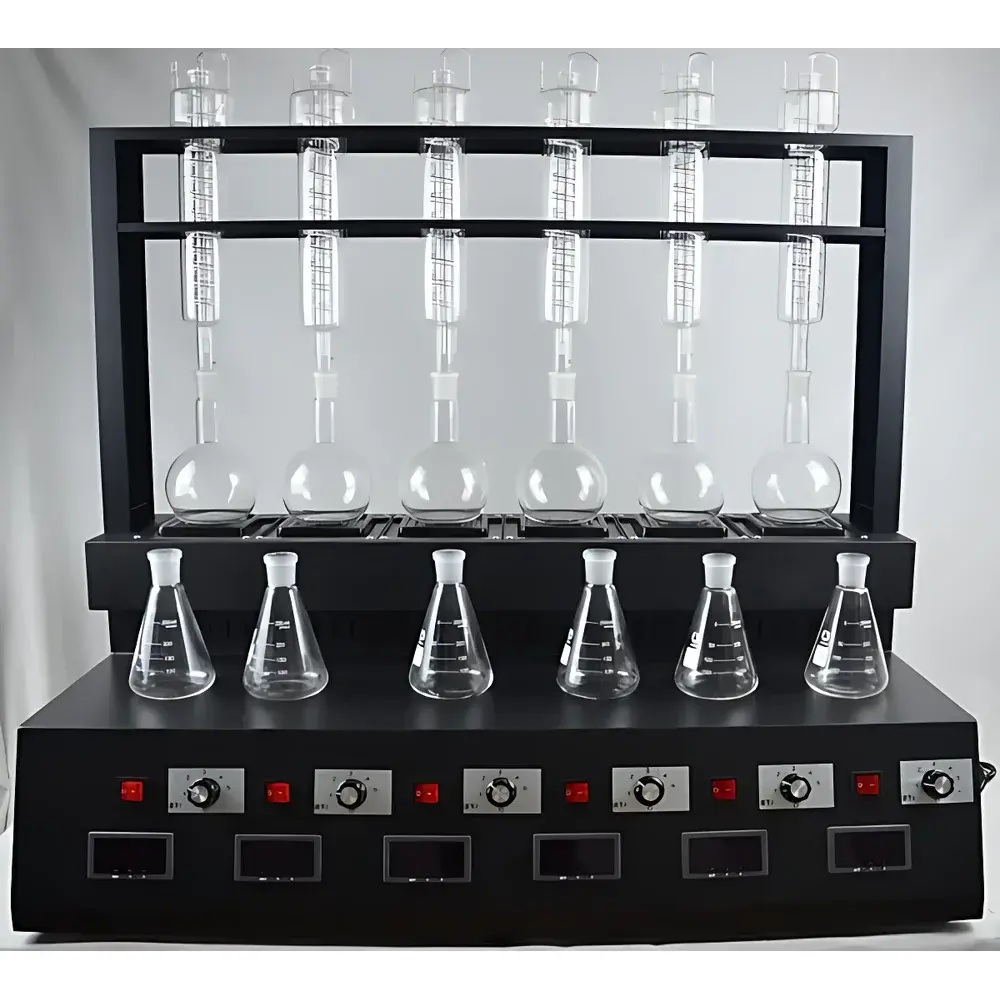
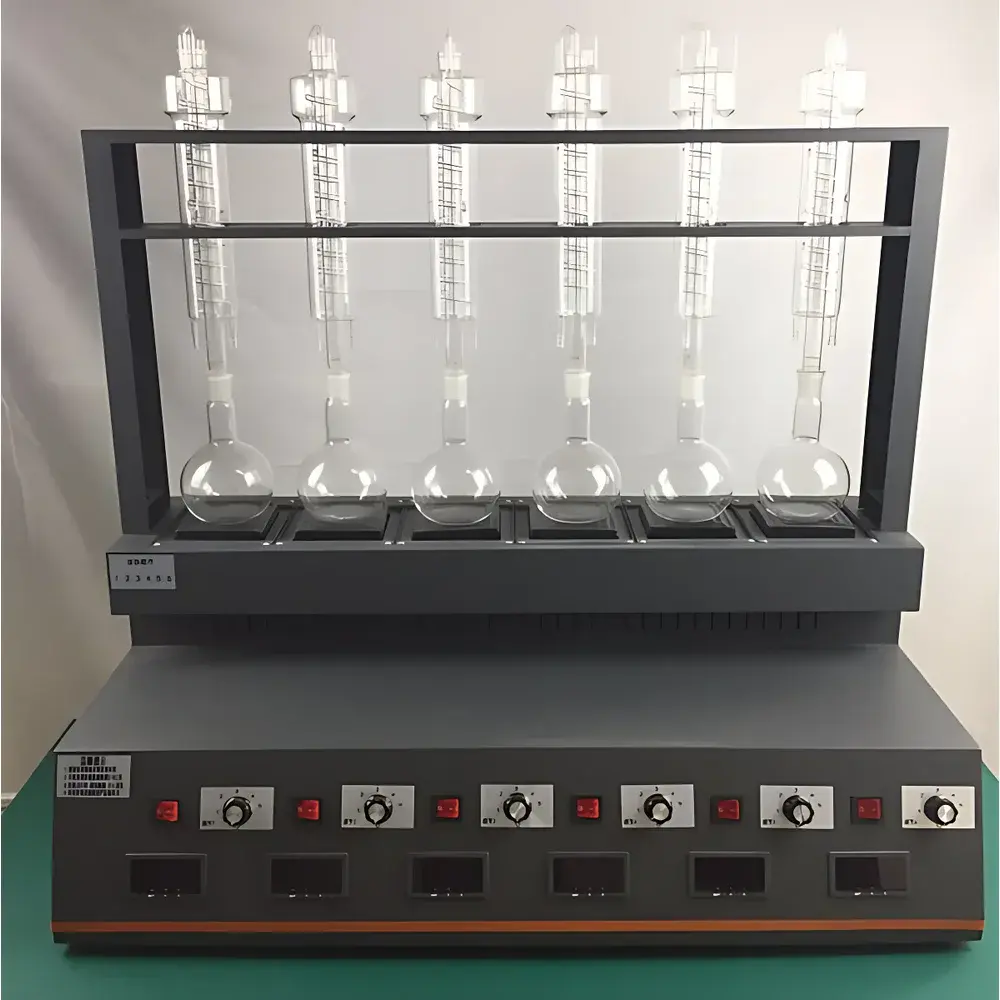
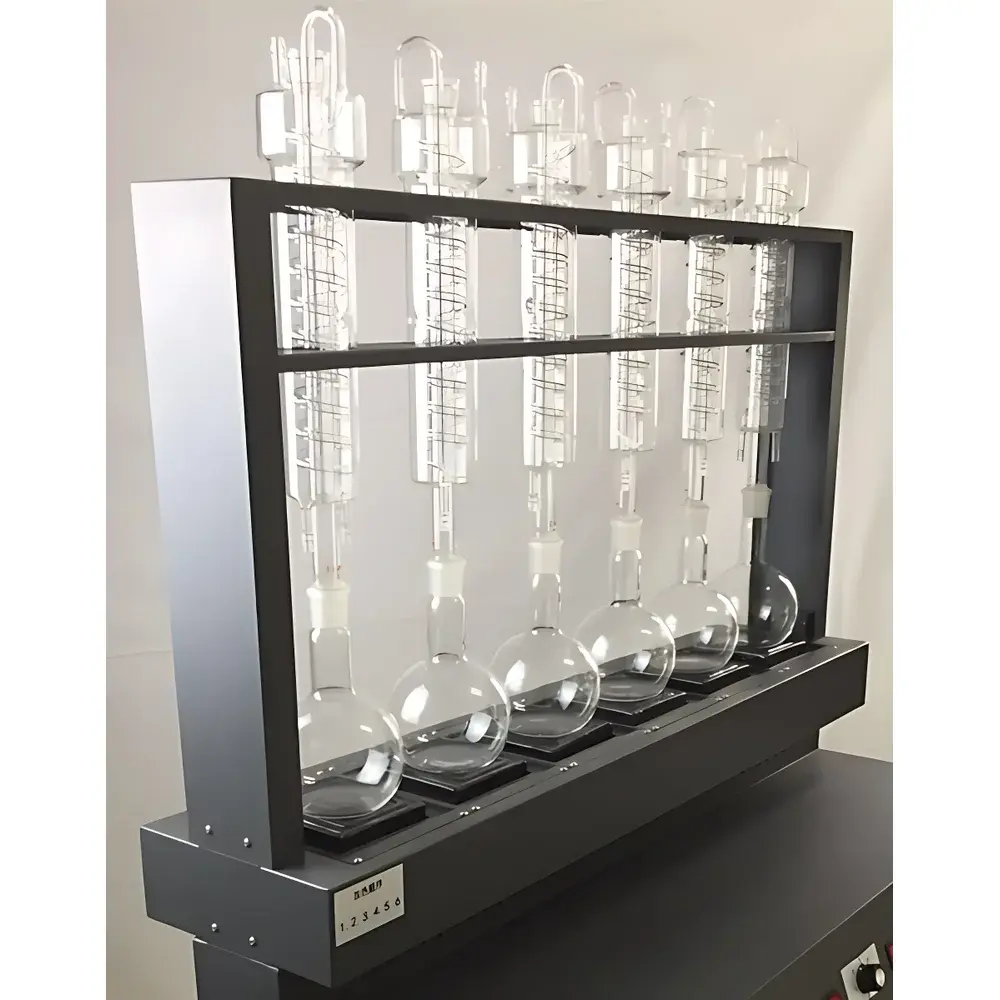
JTONE JTZL-6C Integrated Distillation System with Far-Infrared Ceramic Heating and Intelligent Endpoint Control
| Brand | JTONE |
|---|---|
| Origin | Zhejiang, China |
| Model | JTZL-6C |
| Heating Method | 6-channel Far-Infrared Ceramic Heater (≤800 W per channel) |
| Distillation Capacity | 6 samples simultaneously |
| Distillation Rate | 12 mL/min |
| Temperature Range | Ambient to 320 °C |
| Endpoint Control | Dual-mode (gravimetric ±2 mL accuracy or timer 0–999 min) |
| Cooling System | Built-in air-cooled recirculating water unit |
| Display | 7-inch capacitive touch LCD |
| Single-Channel Temperature Control | Yes |
| Anti-Suck-Back | Electromagnetic vacuum valve |
| Power Supply | 220 V / 50 Hz |
| Flask Compatibility | Six 500 mL or 250 mL round-bottom flasks |
| Warm-up Time | 5–20 min |
Overview
The JTONE JTZL-6C Integrated Distillation System is an engineered solution for standardized, high-reproducibility sample preparation in analytical laboratories requiring precise, automated distillation of volatile analytes. Based on the principle of controlled thermal vaporization followed by condensation and quantitative collection, this system implements far-infrared ceramic heating technology to deliver uniform, contactless energy transfer—eliminating hot spots, flame hazards, and thermal overshoot common with conventional resistive coil heaters. Each of the six independent heating zones features real-time temperature monitoring via calibrated platinum resistance sensors (PT100), enabling per-channel thermal regulation across the full operational range (ambient to 320 °C). The system integrates three core functional modules into a single compact platform: programmable heating control, closed-loop air-cooled recirculating condensation, and intelligent endpoint detection—either by mass loss (±2 mL resolution via high-stability load cell) or elapsed time (0–999 min). Designed for compliance-driven environments, it supports unattended operation while maintaining traceability through digital parameter logging and user-accessible operation history.
Key Features
- Six independently controllable far-infrared ceramic heating units, each rated ≤800 W, with gold-layered thermal insulation to minimize downward heat loss and improve energy efficiency.
- 7-inch industrial-grade capacitive touch display with intuitive menu navigation; no stylus or fingernail required—designed for glove-compatible operation in lab settings.
- Dual-mode endpoint detection: gravimetric mode (with tare function and ±2 mL volumetric equivalence) or timer-based termination—configurable per channel.
- Integrated air-cooled recirculating water system eliminates dependency on external tap water or chiller units; optional external coolant interface available for low-temperature condensation requirements (e.g., <10 °C).
- Automated anti-suck-back protection via solenoid-controlled vacuum isolation valve, activated during pressure decay or power interruption.
- Micro-boil modulation algorithm dynamically adjusts power output to suppress bumping and ensure stable distillate flow at 12 mL/min nominal rate.
- Modular mechanical architecture: standardized flask mounts (500 mL × 6 or 250 mL × 6), quick-release condenser coupling, and tool-free access to all service points.
Sample Compatibility & Compliance
The JTZL-6C is validated for use in EPA Method 4500-NH₃ D (ammonia distillation), ISO 6439 (cyanide), ISO 6438 (phenols), AOAC 971.27 (SO₂ in food), and standard methods for formaldehyde and ethanol quantification. Its design adheres to general safety principles outlined in IEC 61010-1 for laboratory electrical equipment, including IP20 ingress protection, double-insulated heater elements, and grounded chassis construction. While not certified to GLP or 21 CFR Part 11 out-of-the-box, the system supports audit-ready operation when paired with external electronic lab notebook (ELN) integration: all setpoints, runtime logs, endpoint triggers, and user IDs are timestamped and exportable as CSV. It meets typical institutional requirements for environmental, food safety, and public health testing workflows—including those governed by CNAS (China National Accreditation Service) and equivalent regional accreditation bodies.
Software & Data Management
Operation is fully managed through embedded firmware without reliance on PC software. All parameters—including target temperature, endpoint mass/time, heating ramp profile, and cooling activation threshold—are stored in non-volatile memory with version-stamped change history. The interface supports multi-level user authentication (operator, supervisor, administrator) with configurable permission sets. Data export occurs via USB-A port to FAT32-formatted drives; files include .csv records containing channel ID, start/stop timestamps, actual vs. setpoint temperature curves, mass delta per minute, and endpoint trigger type. No cloud connectivity or remote access capabilities are included—ensuring data sovereignty and alignment with internal IT security policies common in regulated laboratories.
Applications
This system serves routine and method-specific distillation needs across multiple sectors:
- Environmental analysis: Ammonia nitrogen (NH₃-N), total cyanide, phenolic compounds, and Kjeldahl nitrogen in wastewater, surface water, and soil extracts.
- Food & beverage testing: Sulfur dioxide (SO₂) in wines and dried fruits; free and total formaldehyde in seafood; alcohol content in fermented products.
- Public health & epidemiology: Volatile organic compound (VOC) preconcentration prior to GC analysis; iodine value determination in fats and oils.
- Academic & industrial R&D: Solvent recovery, essential oil extraction optimization, and reaction mixture workup under controlled reflux conditions.
Its modular scalability allows deployment in both high-throughput QA/QC labs and small-scale research facilities where reproducibility, operator safety, and method adherence are prioritized over raw throughput.
FAQ
Is the JTZL-6C compliant with USP <467> or EPA Method 502.2 for volatile halogenated hydrocarbons?
No—the system is optimized for aqueous-phase distillation of polar volatiles (e.g., NH₃, HCN, phenol); it does not support purge-and-trap or headspace configurations required for non-polar VOCs.
Can the built-in cooling system maintain condenser temperatures below 10 °C?
The standard air-cooled recirculator maintains 15–25 °C under typical ambient conditions; for sub-10 °C operation, an external chiller must be connected via the auxiliary coolant port.
What calibration documentation is provided with shipment?
Each unit ships with a factory calibration certificate for temperature sensors (traceable to NIST standards) and load cell linearity verification; periodic recalibration intervals are recommended every 12 months or after 500 operational cycles.
Does the system support LIMS integration?
Direct LIMS interfacing is not native; however, exported CSV logs can be parsed and ingested via standard middleware or custom API gateways.
Are replacement flasks and condensers available as spare parts?
Yes—standard 500 mL borosilicate glass flasks (ISO 1042), Liebig-type condensers (300 mm length), and silicone tubing kits are stocked and orderable under JTONE part numbers JF-500, JC-L300, and JT-TB20 respectively.
Related Products



