
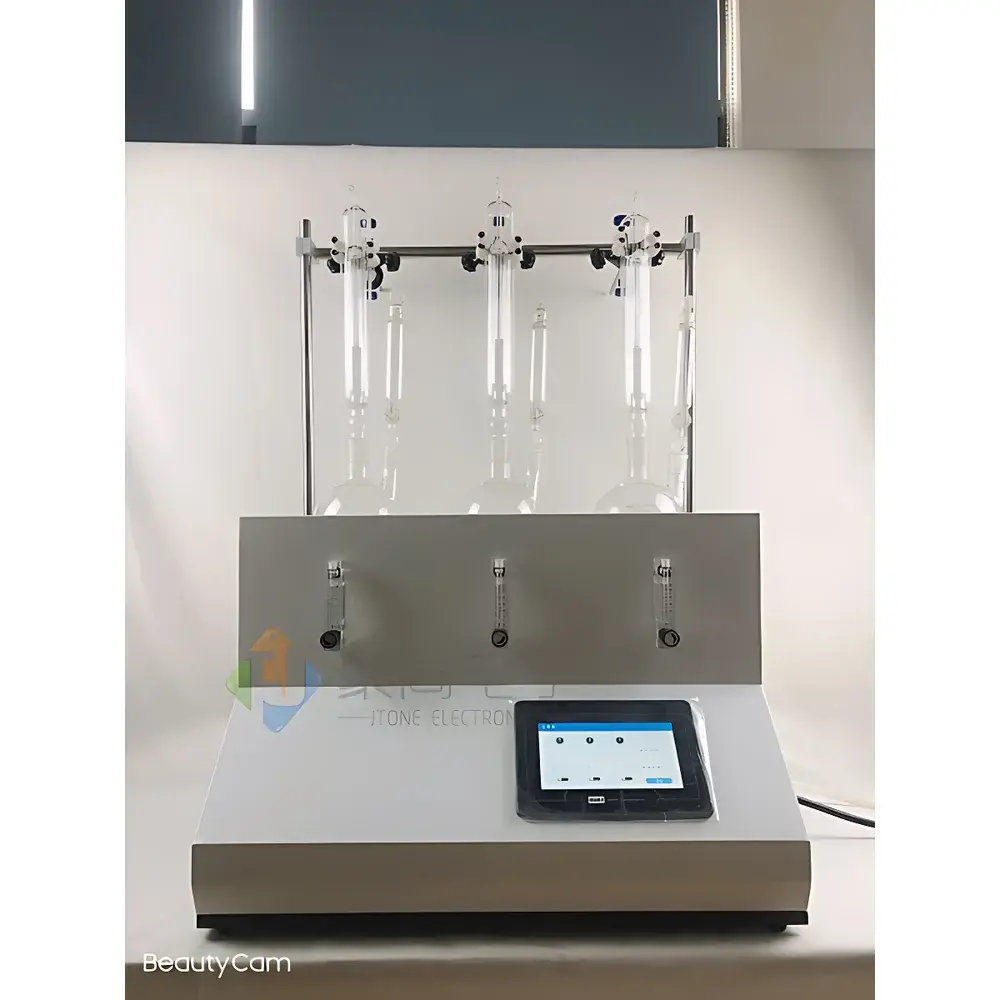
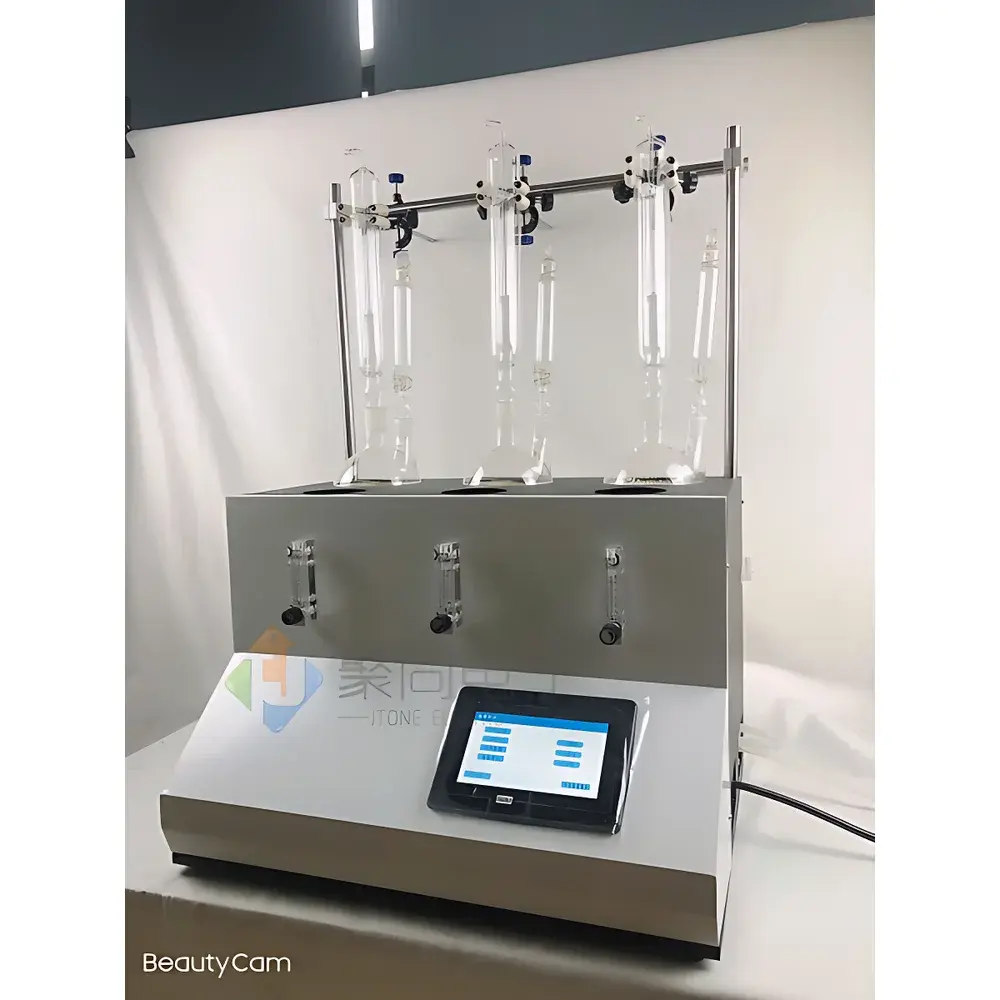
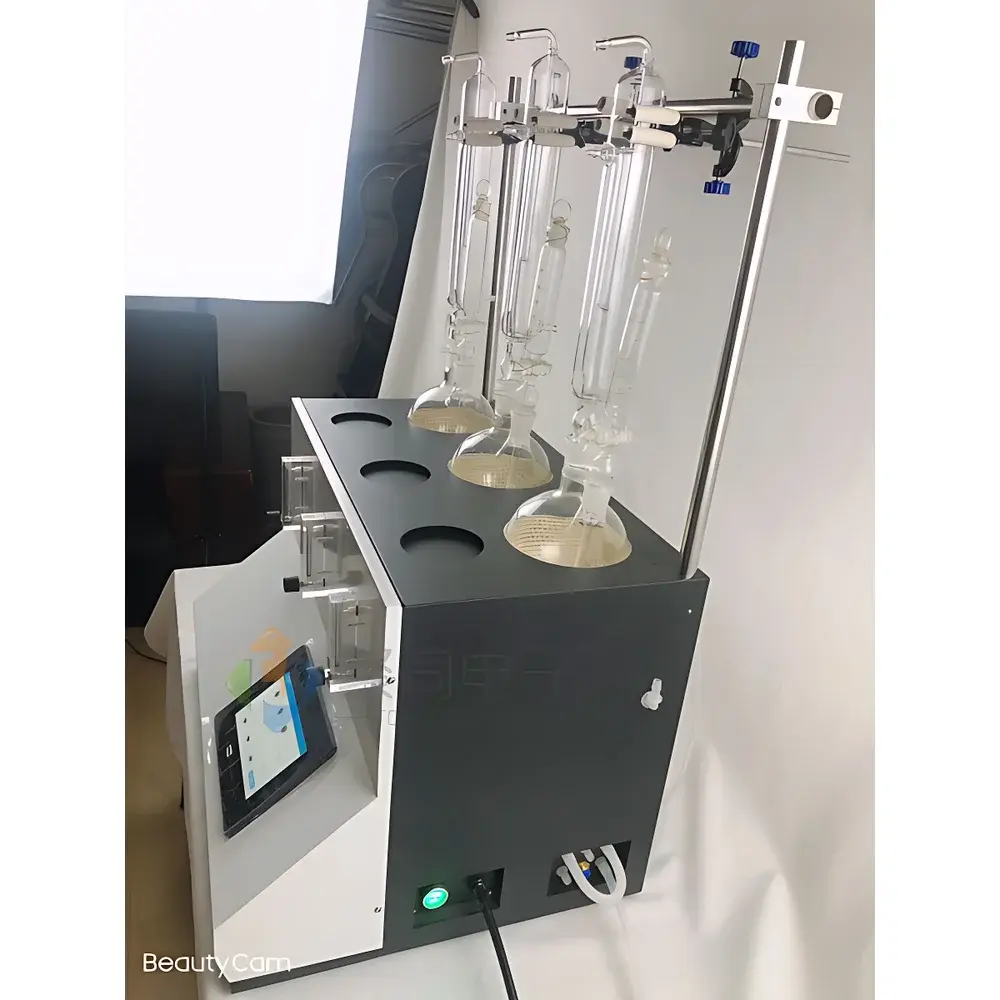
JTONE SO2-3000 Sulfur Dioxide Residue Distillation Analyzer
| Brand | JTONE |
|---|---|
| Origin | Beijing, China |
| Model | SO2-3000 |
| Detection Target | Sulfur Dioxide (SO₂) |
| Detection Range | Ammonia Nitrogen, Volatile Phenols |
| Detection Principle | Acid Distillation–Iodometric Titration (Standard Pharmacopoeia Method) |
| Distillation Units | 3 |
| Heating Temperature Control Range | Up to 200 °C |
| Heating Method | Sealed Infrared Ceramic Heater |
| Cooling System | External Recirculating Chiller (Optional Internal Chiller) |
| Nitrogen Flow Control | Individual Precision Mass Flow Meters per Channel |
| Power Rating | 1850 W |
| Voltage/Frequency | 220 V / 50 Hz |
| Dimensions (L×W×H) | 800 × 520 × 850 mm |
| Safety Features | Leakage Protection, Dry-Run Prevention |
| Standard Flask Configuration | 1000 mL Distillation Flasks × 3, 100 mL Conical Receivers × 3 |
| Display | LCD Touchscreen Interface |
| Compliance | Designed for Chinese Pharmacopoeia (ChP) 2020 Edition Method II (SO₂ Residue Determination), Compatible with USP <231>, EP 2.4.24, and ISO 5840:2016 (SO₂ in Herbal Materials) |
Overview
The JTONE SO2-3000 Sulfur Dioxide Residue Distillation Analyzer is a dedicated laboratory instrument engineered for the quantitative determination of residual sulfur dioxide (SO₂) in herbal medicinal materials, processed traditional Chinese medicines (TCM), and related botanical products. It implements the official acid distillation–iodometric titration method specified in the Chinese Pharmacopoeia (ChP) 2020 Edition, Volume I, Section 2301, as well as aligned protocols from the United States Pharmacopeia (USP <231>) and European Pharmacopoeia (EP 2.4.24). The system integrates four functionally coordinated modules—programmable heating, controlled steam distillation, precision nitrogen purging, and regulated coolant circulation—to ensure reproducible volatilization, quantitative transfer, and stable condensation of SO₂ gas prior to downstream titrimetric or spectrophotometric analysis. Its design emphasizes method fidelity, operator safety, and compliance-ready operation in GLP-regulated QC laboratories.
Key Features
- Triple-channel parallel distillation architecture enables simultaneous processing of three samples, improving throughput without cross-contamination.
- Sealed infrared ceramic heating elements provide uniform thermal distribution, eliminate open-flame hazards, reduce power consumption, and prevent spill-induced electrical faults.
- Independent digital temperature control per heating zone (0–200 °C) with micro-boiling algorithm ensures precise reflux initiation and consistent distillation kinetics across all units.
- Integrated touchscreen HMI supports intuitive parameter setting, real-time status monitoring, and programmable countdown timers with audible alerts and automatic heater shutdown.
- Dedicated nitrogen flow management system features individual mass flow meters (0–5 L/min range, ±1% FS accuracy) for each distillation channel, enabling calibrated inert gas sparging during distillation to enhance SO₂ recovery efficiency.
- Flexible cooling configuration: compatible with external recirculating chillers (recommended for stable ≤10 °C condensate temperature) or optional built-in chiller module—eliminates dependency on municipal tap water and improves lab space utilization.
Sample Compatibility & Compliance
The SO2-3000 is validated for use with solid herbal matrices—including crude herbs, sliced decoction pieces, powdered extracts, and concentrated pastes—as defined in ChP monographs. Sample preparation follows standardized homogenization and acidification (phosphoric acid addition) prior to loading into 1000 mL borosilicate glass distillation flasks. The system’s geometry and thermal profile are optimized to minimize SO₂ adsorption losses and volatile co-distillate interference. It supports full audit trail generation when paired with compliant LIMS or ELN platforms and meets foundational requirements for FDA 21 CFR Part 11 readiness (user authentication, electronic signatures, and change-controlled configuration logs) when deployed with validated software extensions. Routine performance verification aligns with ISO/IEC 17025:2017 clause 5.9 (method validation) and ICH Q2(R2) guidance for analytical procedure robustness.
Software & Data Management
The embedded firmware provides local data logging of time-stamped temperature profiles, nitrogen flow rates, and distillation duration per channel. Export formats include CSV and PDF reports with configurable metadata fields (operator ID, sample ID, batch number, date/time stamp). For integrated quality systems, the device supports RS-232 and USB-to-serial communication protocols to interface with third-party laboratory information management systems (LIMS) or chromatography data systems (CDS). Optional software add-ons enable automated calibration curve import, result calculation per ChP equations, and electronic signature capture compliant with ALCOA+ principles (Attributable, Legible, Contemporaneous, Original, Accurate).
Applications
- Quantitative SO₂ residue testing in raw herbal materials prior to GMP-compliant manufacturing.
- Stability study support for SO₂-containing formulations under accelerated and long-term storage conditions.
- Method transfer and verification between QC labs operating under different pharmacopoeial frameworks (ChP, USP, EP).
- Complementary analysis of ammonia nitrogen and volatile phenols in environmental or food safety screening workflows—leveraging shared distillation infrastructure.
- Educational use in pharmaceutical sciences programs for hands-on training in pharmacopoeial distillation techniques and redox titration fundamentals.
FAQ
What pharmacopoeial methods does the SO2-3000 directly support?
It is configured to execute ChP 2020 Method II (acid distillation–iodometric titration) and is operationally compatible with USP <231> and EP 2.4.24 procedures through adjustable heating ramping, nitrogen flow, and condensate temperature settings.
Can the system be used for non-pharmaceutical samples such as food or soil?
Yes—its distillation architecture conforms to AOAC Official Method 990.11 and ISO 5840:2016 for SO₂ in foodstuffs and herbal commodities; however, matrix-specific validation per ISO 17025 is required prior to reporting certified results.
Is the nitrogen flow rate calibrated traceably to national standards?
Each mass flow meter is factory-calibrated against NIST-traceable references; calibration certificates are provided with delivery and re-certification is recommended annually or after 500 operational hours.
Does the instrument meet electrical safety and EMC requirements for CE marking?
The SO2-3000 complies with IEC 61010-1:2010 (Safety Requirements for Electrical Equipment for Measurement, Control, and Laboratory Use) and IEC 61326-1:2013 (EMC for Laboratory Equipment); CE documentation is available upon request.
How is method reproducibility ensured across multiple operators?
Standardized SOP templates, password-protected parameter locking, and operator ID logging minimize procedural variability; inter-operator RSD for SO₂ recovery (n=6) remains ≤3.2% at 50 mg/kg spike level under routine use conditions.





