
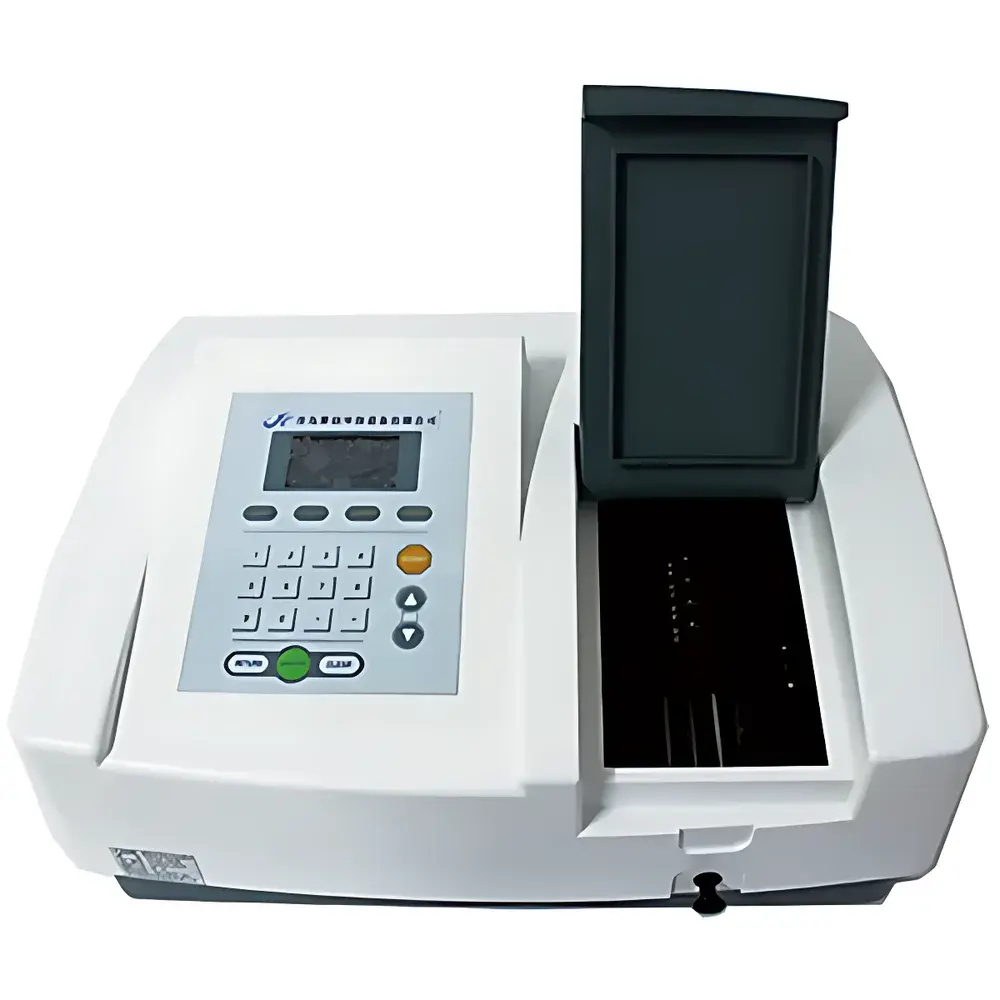
JU CHUANG ENVIRONMENTAL UV-759CRT Scanning Ultraviolet-Visible Spectrophotometer
| Brand | JU CHUANG ENVIRONMENTAL |
|---|---|
| Origin | Shandong, China |
| Manufacturer Type | Authorized Distributor |
| Instrument Type | Domestic |
| Model | UV-759CRT |
| Optical Design | Single-beam |
| Detector | CMOS array |
| Wavelength Range | 190–1100 nm |
| Wavelength Accuracy | ±0.3 nm |
| Wavelength Repeatability | 0.1 nm |
| Spectral Bandwidth | 1.8 nm |
| Stray Light | ≤0.05% T at 220 nm and 360 nm |
| Photometric Accuracy | ±0.003% T |
| Photometric Repeatability | 0.001% T |
| Absorbance Range | –0.30 to 3.00 A |
| Transmittance Range | 0.0–200.0% T |
| Concentration Range | 0–1999 units |
| Baseline Flatness | ±0.001 A |
| Stability | ±0.0005 A/h at 500 nm |
| Interface | USB (RS-232 emulation) |
| Display | 128×64 graphic LCD |
| Data Storage | 200 calibration curves + 200 measurement sets |
| Software Support | UV-759CRT dedicated analysis software |
Overview
The JU CHUANG ENVIRONMENTAL UV-759CRT is a scanning ultraviolet-visible (UV-Vis) spectrophotometer engineered for precision routine analysis and research-grade applications in academic, industrial, and quality control laboratories. Based on a refined Czerny-Turner monochromator optical architecture, the instrument employs asymmetric beam splitting—a design innovation that delivers stability characteristics approaching those of dual-beam systems while retaining the high photon throughput and signal-to-noise ratio inherent to optimized single-beam configurations. Operating across a broad spectral range from 190 nm to 1100 nm, the UV-759CRT enables quantitative and qualitative analysis of organic compounds, transition metal complexes, biological macromolecules, and nanomaterials through absorbance, transmittance, and concentration measurements. Its 1.8 nm spectral bandwidth ensures adequate resolution for most standard analytical protocols—including those specified in ASTM E275, ISO 6223, and USP <857>—while maintaining robust photometric linearity and low stray light performance (<0.05% T at critical wavelengths of 220 nm and 360 nm).
Key Features
- High-fidelity Czerny-Turner optical path with thermally stabilized grating mount and precision slit assembly, ensuring long-term wavelength reproducibility (±0.1 nm) and baseline flatness (±0.001 A).
- CMOS-based linear array detector providing rapid spectral acquisition, enhanced dynamic range, and improved resistance to photobleaching compared to traditional photomultiplier tubes.
- Integrated 128×64 graphic LCD display enabling real-time spectral visualization, direct parameter input, and on-board data review without external PC dependency.
- On-instrument storage capacity for up to 200 user-defined calibration curves and 200 individual measurement datasets, supporting GLP-compliant workflow traceability.
- Automatic wavelength calibration routine with internal reference peak detection, reducing operator-induced drift and minimizing recalibration frequency.
- Wide sample compartment accommodating standard cuvettes from 5 mm to 100 mm pathlength, compatible with quartz, fused silica, and high-transmission polymer cells.
- USB interface compliant with virtual COM port (RS-232 emulation), enabling seamless integration into laboratory networks and compatibility with third-party LIMS or ELN platforms.
Sample Compatibility & Compliance
The UV-759CRT supports liquid-phase analysis using conventional matched cuvettes (10 mm default), micro-volume adapters (down to 50 µL), and flow-through cells for continuous monitoring applications. It meets essential performance criteria outlined in international standards for spectrophotometric instrumentation, including wavelength accuracy per ISO 8577-2 and photometric linearity per ASTM E169. While not certified for regulated GMP environments out-of-the-box, its firmware supports audit-trail-enabling features—including timestamped measurement logs and user-accessible calibration history—that align with foundational requirements of FDA 21 CFR Part 11 when deployed with validated software and procedural controls.
Software & Data Management
The dedicated UV-759CRT analysis software provides full spectral acquisition, kinetic scan mode, multi-wavelength quantitation, and derivative spectroscopy functions. Raw absorbance and transmittance data are exportable in CSV and ASCII formats for post-processing in MATLAB, Origin, or Python-based analytical pipelines. The software includes built-in tools for Beer-Lambert law validation, limit-of-detection estimation, and uncertainty propagation modeling based on instrument-specific noise profiles. All stored curves and results retain metadata such as date/time stamp, operator ID (if configured), and instrument serial number—facilitating traceability in QA/QC documentation.
Applications
This spectrophotometer is routinely deployed in environmental water quality testing (e.g., nitrate, phosphate, COD determination), pharmaceutical excipient verification, food additive quantification (e.g., synthetic dyes, preservatives), enzymatic activity assays (NADH/NADPH kinetics), and nanoparticle characterization (surface plasmon resonance band analysis). Its extended near-IR capability (up to 1100 nm) also supports polymer degradation studies and semiconductor thin-film thickness estimation via interference fringe analysis.
FAQ
Is the UV-759CRT compliant with FDA 21 CFR Part 11?
The hardware and firmware support core elements—such as electronic signatures, audit trails, and secure data storage—but formal compliance requires site-specific validation, documented SOPs, and qualified software deployment.
What cuvette materials are recommended for UV measurements below 220 nm?
Fused silica or high-purity quartz cuvettes with UV-grade optical surfaces are required; standard borosilicate glass exhibits significant absorption below 350 nm.
Can the instrument perform time-resolved kinetic scans?
Yes—the onboard software supports fixed-wavelength kinetic acquisition at user-defined intervals (100 ms to 60 s resolution) with automatic curve fitting and rate constant calculation.
Does the system include NIST-traceable calibration standards?
No—certified holmium oxide and neutral density filters must be procured separately for periodic wavelength and photometric verification per ISO/IEC 17025 guidelines.
Is remote operation supported over Ethernet or Wi-Fi?
Not natively; connectivity is limited to USB host interface. Network operation requires an external USB-to-Ethernet server and custom driver configuration.





