
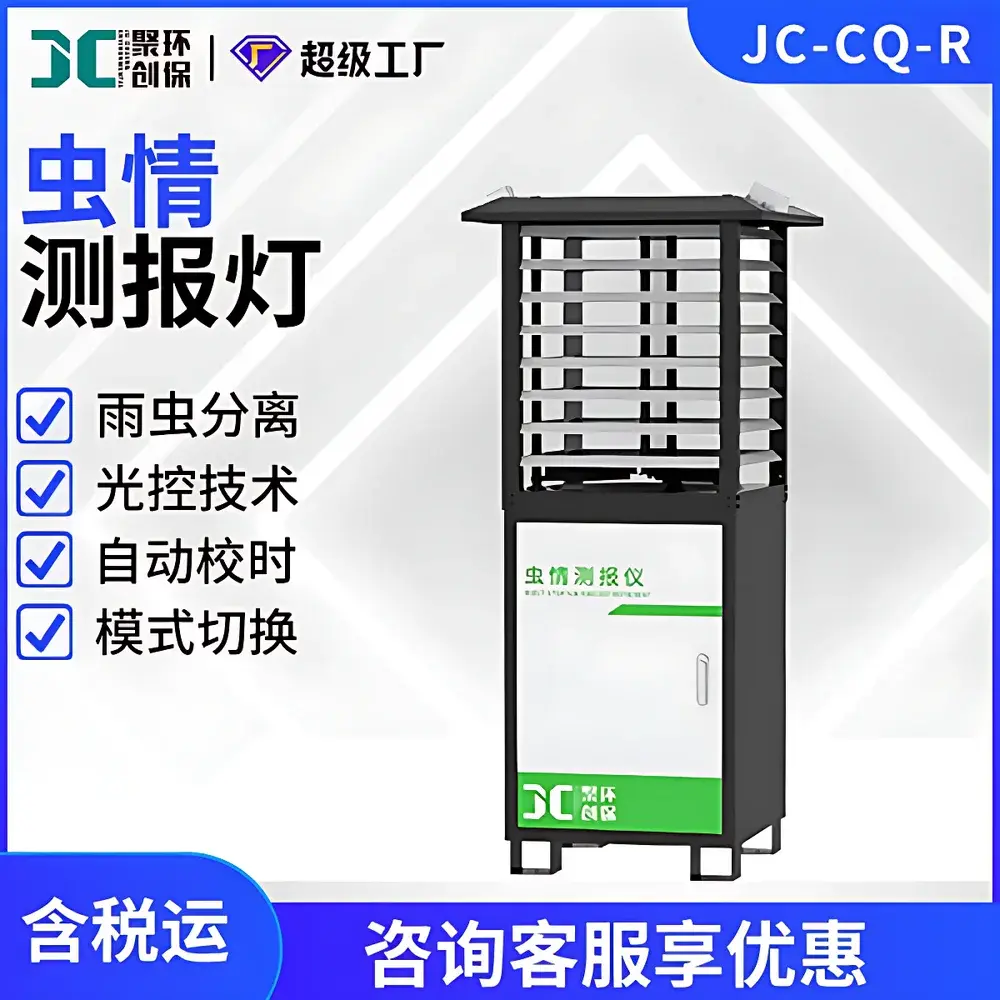
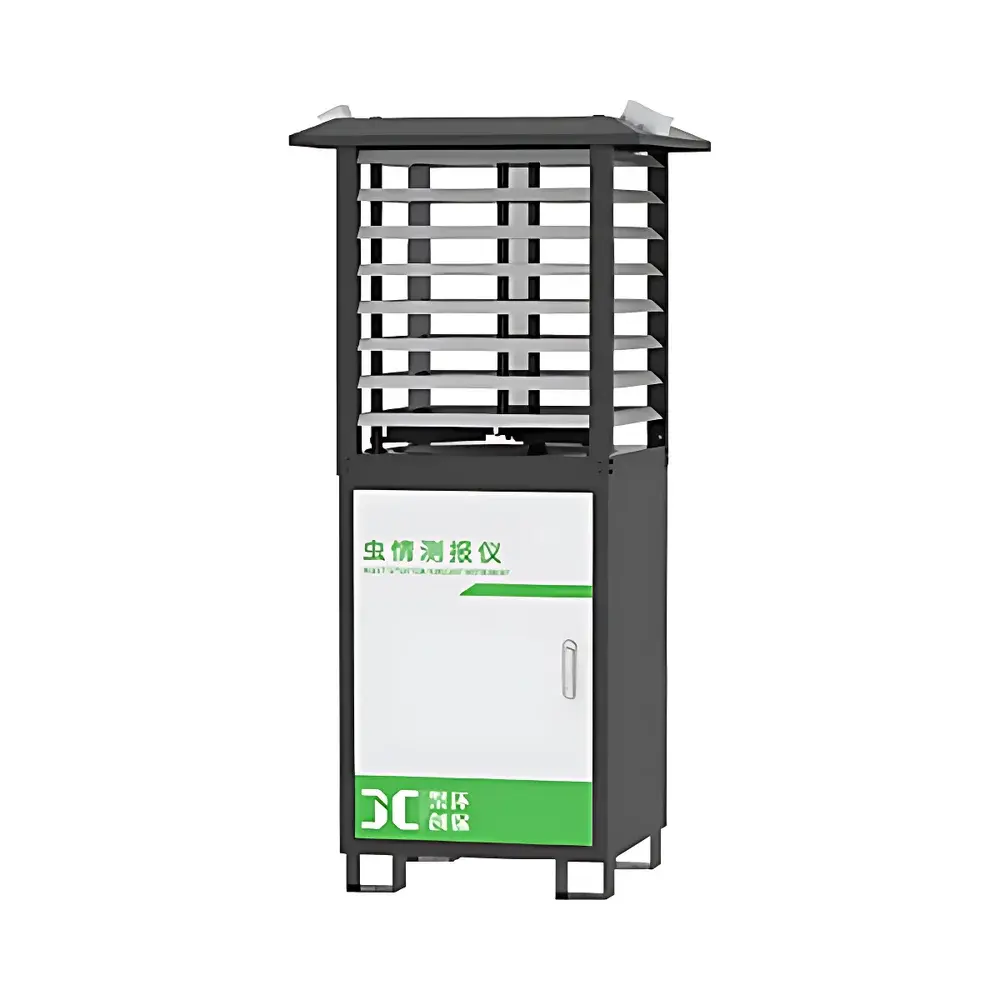
Ju Chuang JC-CQ-R Series Intelligent Photographic Pest Monitoring Trap
| Brand | Ju Chuang Environmental |
|---|---|
| Origin | Shandong, China |
| Manufacturer Type | OEM/ODM Manufacturer |
| Country of Origin | China |
| Model | JC-CQ-R |
| Instrument Type | Pest Surveillance System |
| Power Consumption | ≤200 W (operational), ≤25 W (standby) |
| Power Supply | 220 VAC ±10% / 50 Hz or Solar-Powered Configuration Available |
| Dimensions (H×W×D) | 2117.7 mm × 769 mm × 779 mm (including base) |
| Display | 10.1-inch Android-based capacitive touchscreen interface |
Overview
The Ju Chuang JC-CQ-R Series Intelligent Photographic Pest Monitoring Trap is an automated, image-based entomological surveillance instrument engineered for continuous, unattended monitoring of agricultural insect populations in open-field and greenhouse environments. Designed in strict compliance with GB/T 24689.1–2009 “Technical Requirements for Photographic Pest Monitoring Devices”, the system integrates optical attraction, high-efficiency insect mortality, mechanical transport, high-resolution imaging, environmental sensing, and IoT-enabled data transmission into a single robust architecture. Its core operational principle relies on phototactic response induction using ultraviolet (UV-A) illumination at 365 nm, followed by physical capture, thermal inactivation via dual-layer far-infrared chambers, controlled dispersion on a vibration-assisted conveyor belt, and standardized digital imaging under consistent lighting conditions. The resulting image dataset—geotagged, time-stamped, and metadata-enriched—is transmitted to a centralized cloud platform where AI-powered species classification, temporal abundance trending, and phenological modeling support evidence-based pest management decisions.
Key Features
- UV-A optical lure system: 20 W blacklight tube (peak wavelength 365 nm; ignition time ≤5 s) with 120°-angled high-transparency glass impact plates (595 mm × 213 mm × 5 mm) for uniform insect knockdown.
- Dual-stage far-infrared killing chamber: Achieves ≥98% mortality rate and ≥95% specimen integrity retention; reaches 85°C ±5°C within 15 minutes of activation.
- Vibration-assisted dispersion mechanism: Ensures even distribution of insect specimens across the conveyor belt surface to eliminate overlap and occlusion—critical for downstream AI recognition accuracy.
- Modular imaging subsystem: USB-interfaced industrial camera supporting selectable resolutions (500 W, 800 W, 1200 W, or 2000 W pixels); calibrated illumination and fixed-focus optics optimized for morphological feature extraction.
- Multi-sensor environmental intelligence: Integrated rain/snow sensor (IP65-rated), ambient light sensor (immune to transient glare), and real-time temperature/humidity monitoring (0–70°C, 0–85% RH, non-condensing).
- Adaptive operational logic: Combines photoperiodic, hydrometric, and programmable time-based control to suspend operation during precipitation or daylight—reducing energy use and preserving specimen quality.
- Flexible power architecture: Supports grid-connected 220 VAC operation or optional solar photovoltaic + battery backup configuration for off-grid deployment in remote agro-ecological zones.
Sample Compatibility & Compliance
The JC-CQ-R series is validated for monitoring lepidopteran, coleopteran, dipteran, and hemipteran pests commonly associated with cereal, vegetable, fruit, and tea cultivation systems. Specimen compatibility extends to intact adult insects ranging from 2 mm to 25 mm in length, provided they exhibit sufficient UV phototaxis. Structural design includes anti-bird/anti-rodent baffle louvers to exclude non-target fauna and debris, ensuring optical clarity and minimizing false-positive identification events. The device conforms to GB/T 24689.1–2009 for photographic pest trap performance, electromagnetic compatibility (EMC), and electrical safety (insulation resistance ≥2.5 MΩ). All firmware and cloud software modules adhere to ISO/IEC 27001 principles for secure data handling and are architected to support future alignment with FAO’s International Standards for Phytosanitary Measures (ISPMs) and national digital agriculture reporting frameworks.
Software & Data Management
The embedded Android 10.1-inch touchscreen interface provides local configuration, real-time status visualization, component-level manual override, and offline photo caching with automatic resynchronization upon network recovery. Firmware updates are delivered over-the-air (OTA) with cryptographic signature verification. All image uploads include EXIF metadata (GPS coordinates, UTC timestamp, sensor readings) and are stored in encrypted AES-256 containers on the cloud platform. The AI identification engine operates on a continuously trained convolutional neural network (CNN) model, supporting >120 regionally relevant pest taxa with per-species confidence scoring and inter-observer agreement metrics (Cohen’s κ ≥0.87 in validation trials). Audit trails—including user actions, parameter changes, and image upload logs—are retained for ≥18 months to satisfy GLP-aligned traceability requirements in regulatory field trials.
Applications
- Regional pest forecasting networks: Deployed across sentinel sites to generate longitudinal incidence maps for migratory pests such as Spodoptera frugiperda and Nilaparvata lugens.
- Integrated Pest Management (IPM) decision support: Provides quantitative thresholds for intervention timing—e.g., triggering biocontrol agent release when Myzus persicae counts exceed 50 adults/trap/week.
- Phytopharmaceutical efficacy trials: Enables blinded, objective assessment of insecticide field performance through pre- and post-treatment specimen counts and diversity indices.
- Educational entomology platforms: Supplies standardized, georeferenced image datasets for university extension programs and citizen science initiatives.
- Climate–pest phenology correlation studies: Correlates trap catch dynamics with on-device microclimate logs to model developmental degree-day accumulation and emergence windows.
FAQ
Does the JC-CQ-R require constant internet connectivity to function?
No—the device operates autonomously in offline mode: all mechanical cycles, image capture, and local storage proceed normally without network access. Images and metadata sync automatically once connectivity resumes.
Can the system distinguish between live and dead insects in images?
The current AI model classifies species based on morphological features visible in static images; it does not assess viability. However, the far-infrared killing stage ensures >98% mortality prior to imaging, yielding consistent post-mortem specimens.
Is solar power configuration certified for long-term outdoor deployment?
Yes—optional solar kits include IP67-rated lithium iron phosphate (LiFePO₄) batteries, MPPT charge controllers, and corrosion-resistant mounting hardware rated for ≥10-year service life in humid subtropical and arid continental climates.
How frequently are AI model updates released, and how are they validated?
Model updates occur quarterly and undergo independent validation against reference collections curated by provincial agricultural academies, with precision/recall metrics published in each release note.
What level of cybersecurity protection is implemented for cloud data transmission?
All communications use TLS 1.3 encryption; device authentication employs X.509 certificates; and cloud storage complies with ISO/IEC 27001 Annex A controls for confidentiality, integrity, and availability.




