
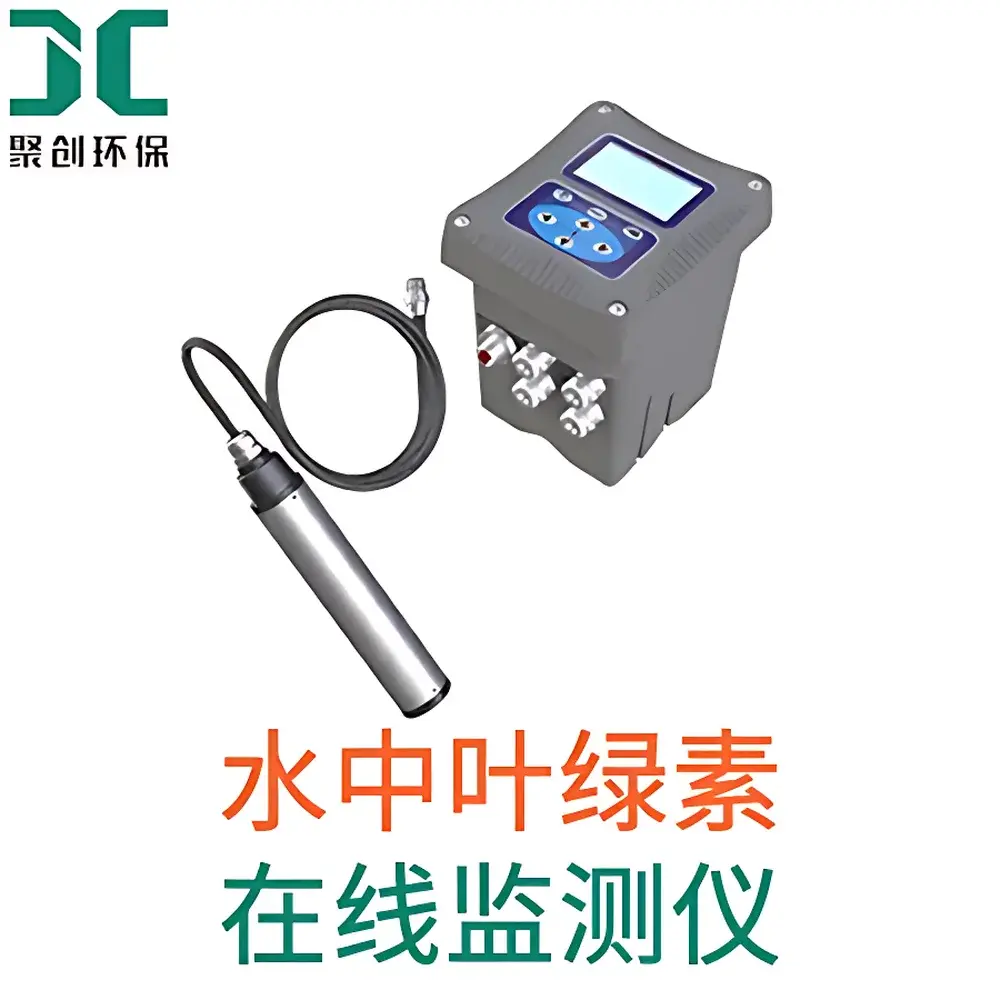
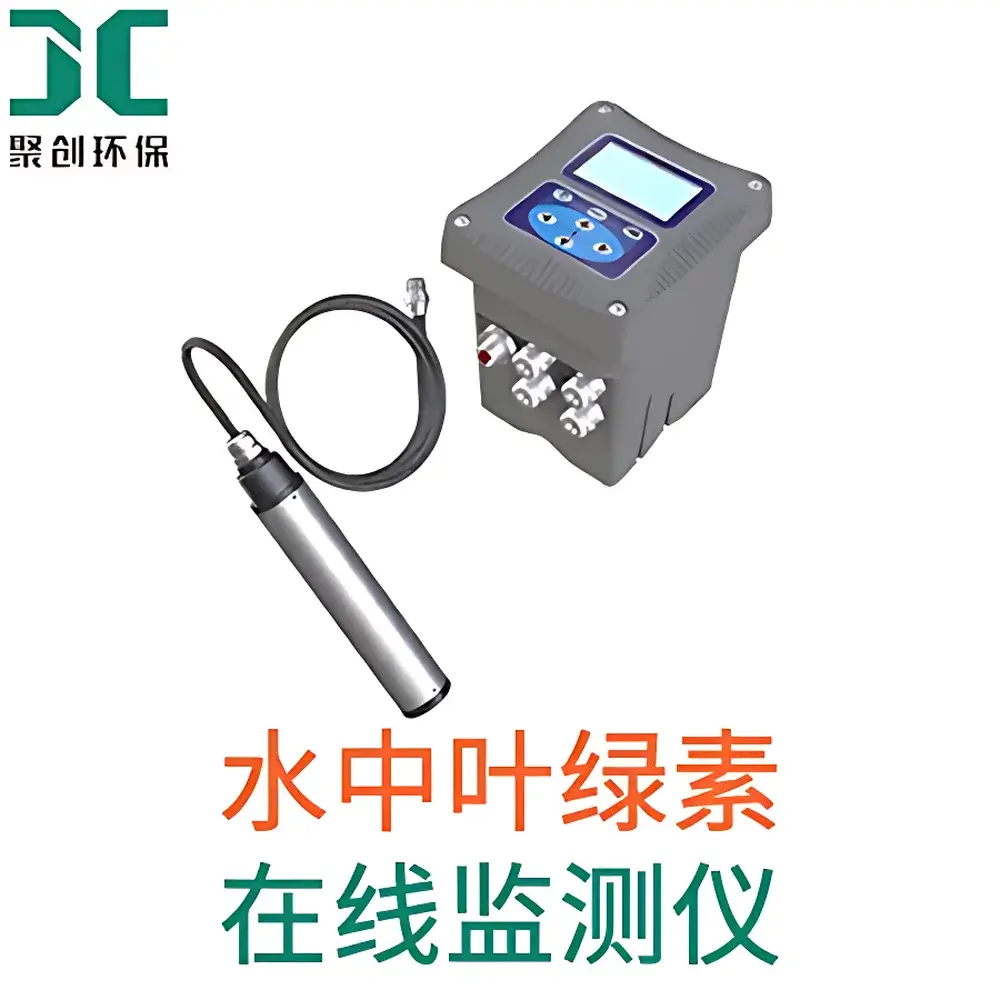
Ju Chuang JC-YLS3000 In-situ Chlorophyll-a Fluorescence Sensor System
| Brand | Ju Chuang Environmental |
|---|---|
| Origin | Shandong, China |
| Model | JC-YLS3000 |
| Measurement Range | 0–500 µg/L |
| Accuracy | ±5% of Rhodamine WT equivalent signal at 1 ppb |
| Pressure Rating | ≤0.4 MPa |
| Calibration | Offset & Slope |
| Turbidity Limit | <50 NTU |
| Sensor Material | SUS316L + PVC (Standard) / Ti-coated SUS316L + PVC (Marine Grade) |
| O-ring | FKM (Fluoroelastomer) |
| Cable | PVC-insulated, standard 10 m (extendable to 100 m) |
| Power Supply | 100–240 VAC, 50/60 Hz |
| Outputs | Three isolated 4–20 mA analog channels |
| Relay Outputs | Three programmable relays with user-defined setpoints and hysteresis |
| Communication | MODBUS RTU over RS-485 |
| Storage Temp. | –15 to +65 °C |
| Operating Temp. | 0 to +45 °C |
| Sensor Dimensions | Ø37 mm × 220 mm |
| Transmitter Dimensions | 145 × 125 × 162 mm (L×W×H) |
| Sensor Weight | 0.8 kg |
| Transmitter Weight | 1.35 kg |
| Enclosure Rating | Sensor IP68 / NEMA 6P |
Overview
The Ju Chuang JC-YLS3000 is an in-situ, submersible chlorophyll-a fluorescence sensor system engineered for continuous, real-time monitoring of phytoplankton biomass in natural and engineered water systems. It operates on the principle of excitation-emission fluorometry: a high-stability blue LED (typically ~470 nm) excites chlorophyll-a molecules dissolved or suspended in water; upon relaxation, chlorophyll-a emits red fluorescence (~685 nm), the intensity of which correlates linearly with its concentration within the validated range (0–500 µg/L). This optical method eliminates the need for sample extraction, chemical reagents, or laboratory-based spectrophotometric analysis—enabling autonomous, long-term deployment in raw water intakes, reservoirs, aquaculture ponds, coastal zones, and wastewater treatment influent streams. The system’s design adheres to fundamental photophysical constraints of chlorophyll fluorescence, including inner-filter effect mitigation and temperature-compensated signal processing, ensuring stable performance under variable ambient light and thermal conditions.
Key Features
- True in-situ measurement: Submersible sensor head rated IP68/NEMA 6P enables direct immersion in flowing or static water bodies without housing or flow cell requirements.
- Optically optimized excitation-detection geometry: Dual-wavelength optical path minimizes interference from colored dissolved organic matter (CDOM) and turbidity-induced scattering, supported by built-in temperature compensation (0–45 °C operational range).
- Dual-grade material configuration: Standard version features SUS316L stainless steel body with PVC housing; marine-grade variant employs titanium-coated SUS316L for enhanced corrosion resistance in brackish or seawater applications.
- Industrial-grade signal integrity: Three isolated 4–20 mA outputs support simultaneous integration with SCADA, DCS, or PLC systems; all analog channels are galvanically isolated and calibrated traceably to Rhodamine WT reference standards.
- Configurable relay logic: Three SPDT relays support alarm activation, pump control, or data logging triggers based on user-defined chlorophyll-a thresholds and hysteresis settings.
- Robust digital communication: MODBUS RTU protocol over RS-485 ensures interoperability with legacy and modern industrial networks; baud rates configurable from 9.6 to 115.2 kbps.
Sample Compatibility & Compliance
The JC-YLS3000 is validated for use in freshwater, estuarine, and low-salinity marine environments where turbidity remains below 50 NTU. Higher turbidity levels may attenuate excitation/emission photons and require site-specific empirical correction or complementary turbidity compensation via optional co-located sensor integration. The sensor does not measure pheophytin or other chlorophyll derivatives; its response is specific to native chlorophyll-a in photosynthetically active phytoplankton cells. While not certified to ISO 10264 or ASTM D3731, the system conforms to electromagnetic compatibility (EMC) requirements per IEC 61326-1 for industrial environments and meets RoHS Directive 2011/65/EU for hazardous substance restrictions. Its analog outputs comply with NAMUR NE43 standards for fault signaling.
Software & Data Management
The JC-YLS3000 operates as a field-deployable smart transducer without embedded firmware-based data logging. Configuration and diagnostics are performed via MODBUS register access using standard industrial configuration tools (e.g., ModScan, QModMaster) or vendor-neutral HMI platforms. All calibration parameters—including zero offset, gain slope, temperature coefficient, and relay setpoints—are stored non-volatile memory and survive power cycles. For regulatory environments requiring auditability, integration with time-synchronized SCADA systems enables full traceability of measurement events, relay state changes, and calibration history—supporting GLP-aligned operational records when paired with appropriate data historian infrastructure.
Applications
- Early-warning detection of cyanobacterial blooms in drinking water source protection zones, enabling proactive coagulant dosing or intake switching before toxin release.
- Process optimization in recirculating aquaculture systems (RAS), where chlorophyll-a trends correlate with nutrient loading, biofilter efficiency, and risk of off-flavor compound formation (e.g., geosmin).
- Long-term ecological monitoring of eutrophication dynamics in lakes, rivers, and coastal lagoons—particularly where manual grab sampling is logistically constrained or temporally undersampled.
- Performance validation of UV disinfection or ozonation units, as chlorophyll-a fluorescence decay kinetics provide proxy indicators of algal cell membrane integrity and viability loss.
- Regulatory compliance reporting for Class II–IV surface waters under national water quality frameworks requiring phytoplankton biomass trending.
FAQ
Does the JC-YLS3000 require periodic recalibration in the field?
Yes—while factory-calibrated against Rhodamine WT standards, drift due to biofouling, optical window soiling, or prolonged exposure to UV radiation necessitates routine verification every 30–90 days depending on deployment environment. A two-point (zero/span) calibration procedure is supported via MODBUS registers.
Can the sensor be deployed in seawater?
The marine-grade variant (Ti-coated SUS316L) is suitable for salinities up to 35 psu; however, chlorophyll-a fluorescence quantum yield decreases slightly in high-salinity media, and users should apply site-specific correction factors derived from concurrent lab fluorometry.
Is the 4–20 mA output intrinsically safe?
No—the analog outputs are non-IS rated; installation in hazardous locations requires external intrinsic safety barriers compliant with IEC 60079-11.
What is the maximum cable length between sensor and transmitter?
The standard PVC cable is rated for 10 m; extended lengths up to 100 m are achievable using shielded twisted-pair cable with proper grounding and voltage drop compensation—consult engineering documentation for loop resistance limits.
How does turbidity affect measurement accuracy?
At turbidities >50 NTU, scattering and absorption reduce effective photon path length and introduce nonlinearity; co-measurement with a turbidity sensor and application of multiparameter regression models is recommended for quantitative correction.



