
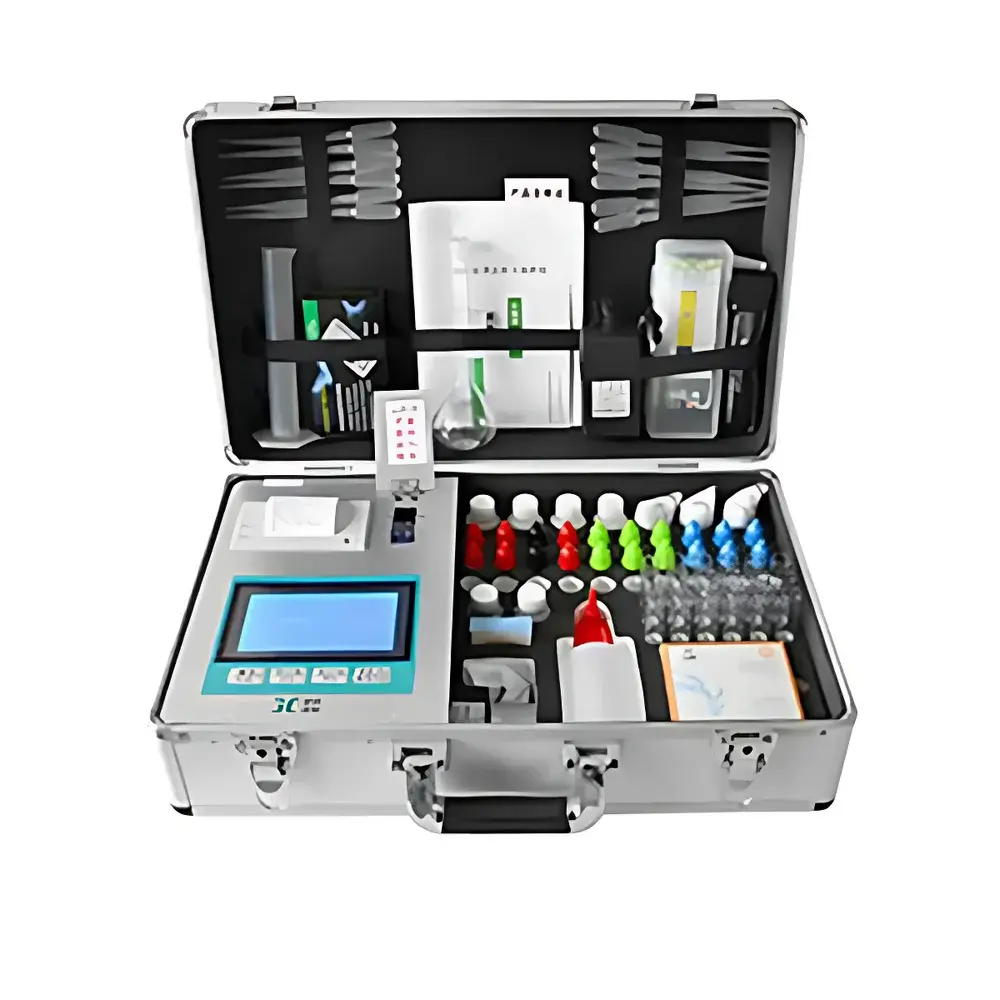
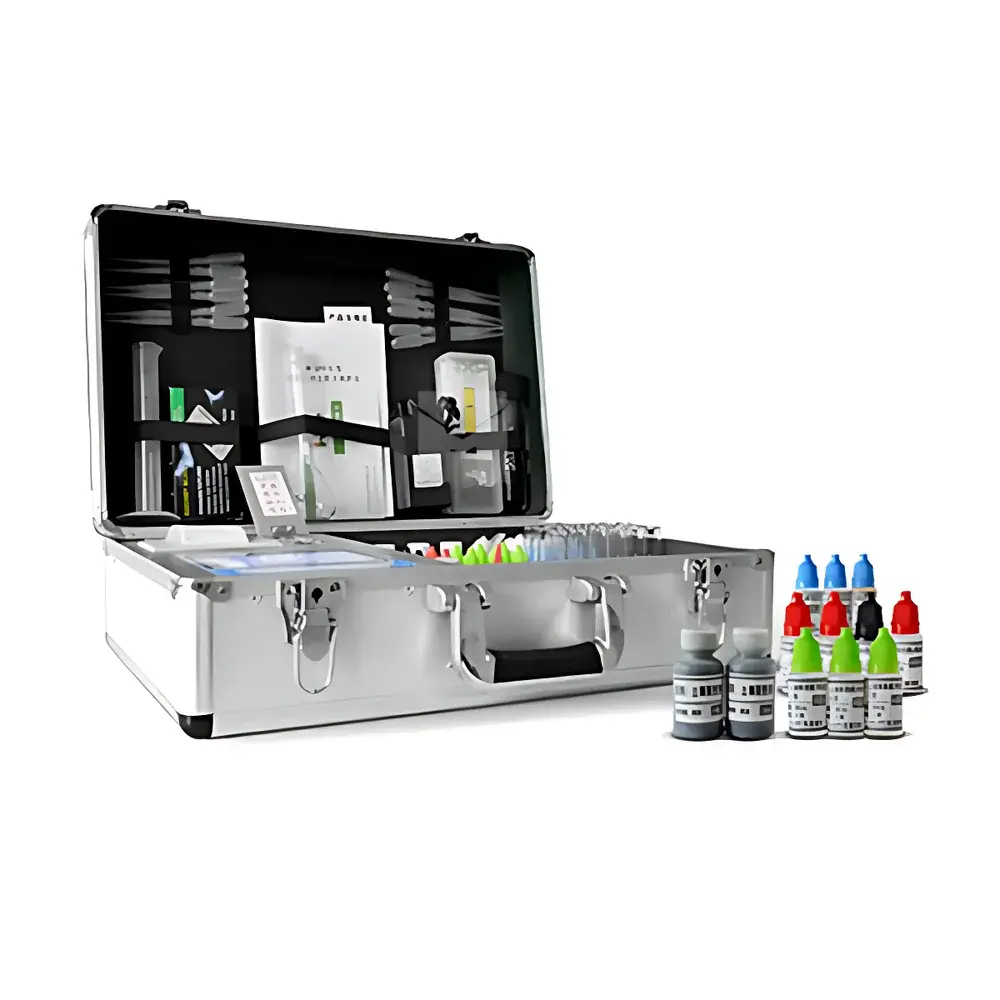
Ju Chuang JC-ZP01S Smart Soil Nutrient Analyzer with Integrated Fertilizer Recommendation System
| Brand | Ju Chuang Environmental |
|---|---|
| Origin | Shandong, China |
| Manufacturer Type | Authorized Distributor |
| Product Category | Domestic |
| Model | JC-ZP01S |
| Instrument Type | Multi-Nutrient Fertilizer & Soil Analyzer |
| Detection Range | N: 5–500 mg/kg, P: 2–200 mg/kg, K: 10–600 mg/kg |
| Detection Capability | Simultaneous quantification of nitrogen (N), phosphorus (P), and potassium (K) in soil and fertilizer samples |
| Display | 5.1-inch backlit LCD with Chinese character interface |
| Power Supply | AC 220 ± 22 V / DC 7.5 V (optional built-in rechargeable Li-ion battery) |
| Power Consumption | ≤6 W |
| Repeatability Error | ≤0.5% |
| Linearity Error | ≤3% |
| Optical Sensitivity | Red light ≥4.5 × 10⁻⁵, Blue light ≥3.17 × 10⁻³ |
| Wavelength Accuracy | Red: 620 ± 4 nm, Blue: 440 ± 4 nm |
| Data Storage | ≥1,000 test records with timestamp, sample ID, crop type, yield target, and recommended application rate |
| Output | Built-in thermal printer for on-site report generation (test parameters, date/time, crop-specific fertilizer recommendations, dosage in kg/ha) |
| Sample Throughput | Single soil NPK analysis ≤15 min |
| Operating Environment | Field-deployable portable design |
| Control System | Embedded microcomputer with touch-sensitive keypad interface |
| Compliance | Designed for routine agricultural laboratory and extension service use |
Overview
The Ju Chuang JC-ZP01S Smart Soil Nutrient Analyzer is a field-portable, microprocessor-controlled photometric instrument engineered for rapid, on-site quantification of key macronutrients—nitrogen (N), phosphorus (P), and potassium (K)—in both soil extracts and commercial fertilizers. It operates on the principle of visible-light absorbance spectroscopy, utilizing dual-wavelength optical detection (620 ± 4 nm red and 440 ± 4 nm blue) to measure colorimetric reactions generated by standardized reagent kits. Unlike benchtop spectrophotometers requiring calibration curves, the JC-ZP01S implements a zero-reference, direct-read methodology: pre-formulated, factory-calibrated reagents eliminate the need for user-prepared blanks or standards, thereby reducing procedural variability and operator dependency. Its integrated agronomic decision-support engine applies empirically derived nutrient response functions—aligned with regional cropping systems and yield targets—to convert raw concentration data into actionable, site-specific fertilizer prescriptions (e.g., N-P₂O₅-K₂O rates in kg/ha). The system is purpose-built for agricultural extension services, cooperative labs, input retailers, and precision farming cooperatives conducting decentralized soil testing programs under resource-constrained or mobile operational conditions.
Key Features
- Direct-read photometric analysis with no blanking or standardization steps—minimizes inter-operator error and accelerates workflow.
- Simultaneous multi-parameter capability: measures N, P, and K in a single extraction step using validated wet-chemistry protocols compliant with national soil testing guidelines (e.g., NY/T 1121 series).
- Expandable test menu includes pH, electrical conductivity (EC), organic matter, ammonium-N, available phosphorus (Olsen or Bray-1), and速效 potassium (NH₄OAc extraction), with optional add-ons for micronutrients (Fe, Zn, B, Mn) and total elemental content.
- Onboard thermal printer generates auditable field reports containing sample ID, test date/time, measured concentrations, crop type, target yield, and mathematically derived fertilizer formulation (including split-application guidance).
- Embedded database stores ≥1,000 test records with full metadata—enabling longitudinal trend analysis, seasonal comparison, and compliance-ready documentation for quality assurance audits.
- Field-rugged architecture: 5.1-inch backlit monochrome LCD ensures legibility under variable ambient lighting; low-power design (≤6 W) supports extended operation via internal Li-ion battery or universal AC/DC input (220 V ±10% or 7.5 V DC).
Sample Compatibility & Compliance
The JC-ZP01S is validated for use with air-dried, sieved (<2 mm) mineral and organic soils, composted amendments, and granular/liquid fertilizer formulations. Sample preparation follows standardized extraction procedures—including alkaline hydrolysis for N, Olsen or Mehlich-3 for P, and ammonium acetate for K—ensuring comparability with reference laboratory methods. While not certified to ISO/IEC 17025, its measurement repeatability (≤0.5%) and linearity (≤3%) meet the performance thresholds specified in GB/T 32739–2016 (Chinese National Standard for Soil Testing Instruments) and align with FAO-recommended tolerances for participatory soil fertility assessment. Data integrity is reinforced through immutable timestamping, non-editable print outputs, and structured storage—facilitating alignment with Good Agricultural Practice (GAP) documentation requirements and supporting traceability in GMP-adjacent agri-input supply chains.
Software & Data Management
The embedded firmware implements a deterministic, real-time operating environment with no external OS dependencies. All analytical algorithms—including matrix correction factors, dilution compensation, and crop-specific nutrient uptake coefficients—are hard-coded and unmodifiable by end users, ensuring methodological consistency across deployments. Test results are stored in a proprietary binary log format with CRC-16 checksum validation. Export functionality is limited to printed hardcopy; USB or Bluetooth connectivity is not provided, reflecting the device’s design philosophy of operational simplicity and data containment within regulated field environments. Audit trails include automatic logging of power-on events, test initiation timestamps, and print job records—sufficient for internal QA review and third-party verification during farm certification audits (e.g., GlobalG.A.P., Organic Certifiers).
Applications
- On-farm nutrient mapping: rapid screening of field sub-zones to guide variable-rate fertilizer application.
- Agricultural extension outreach: mobile soil clinics delivering same-day interpretation and prescription to smallholder farmers.
- Fertilizer quality control: verification of labeled NPK content in blended or specialty products prior to distribution.
- Soil health monitoring programs: longitudinal tracking of extractable nutrient trends across crop rotations or conservation tillage trials.
- Vocational training: hands-on instruction in fundamental soil chemistry principles and evidence-based nutrient management.
- Input retailer support: technical differentiation for agronomy service offerings beyond product sales.
FAQ
Does the JC-ZP01S require daily calibration or standard solutions?
No. It uses pre-quantified, sealed reagent vials with lot-specific calibration embedded in firmware—eliminating manual calibration and associated drift errors.
Can it analyze both soil and fertilizer samples without hardware modification?
Yes. Method selection is software-configured; dedicated assay protocols are loaded per sample matrix (soil extract vs. fertilizer digest) to optimize reaction kinetics and dynamic range.
Is the thermal printer compatible with continuous label stock or only roll paper?
It accepts standard 57-mm wide thermal paper rolls (core diameter ≤25 mm); custom labeling is not supported.
What is the expected lifetime of the optical sensor under field use?
The LED-photodiode detection module is rated for ≥100,000 measurements with stable output; no user-serviceable optical recalibration is provided.
Does the device comply with FDA 21 CFR Part 11 or EU Annex 11 for electronic records?
No. It lacks electronic signature capability, audit trail export, or role-based access control—intended for operational rather than regulated pharmaceutical or clinical use.







