
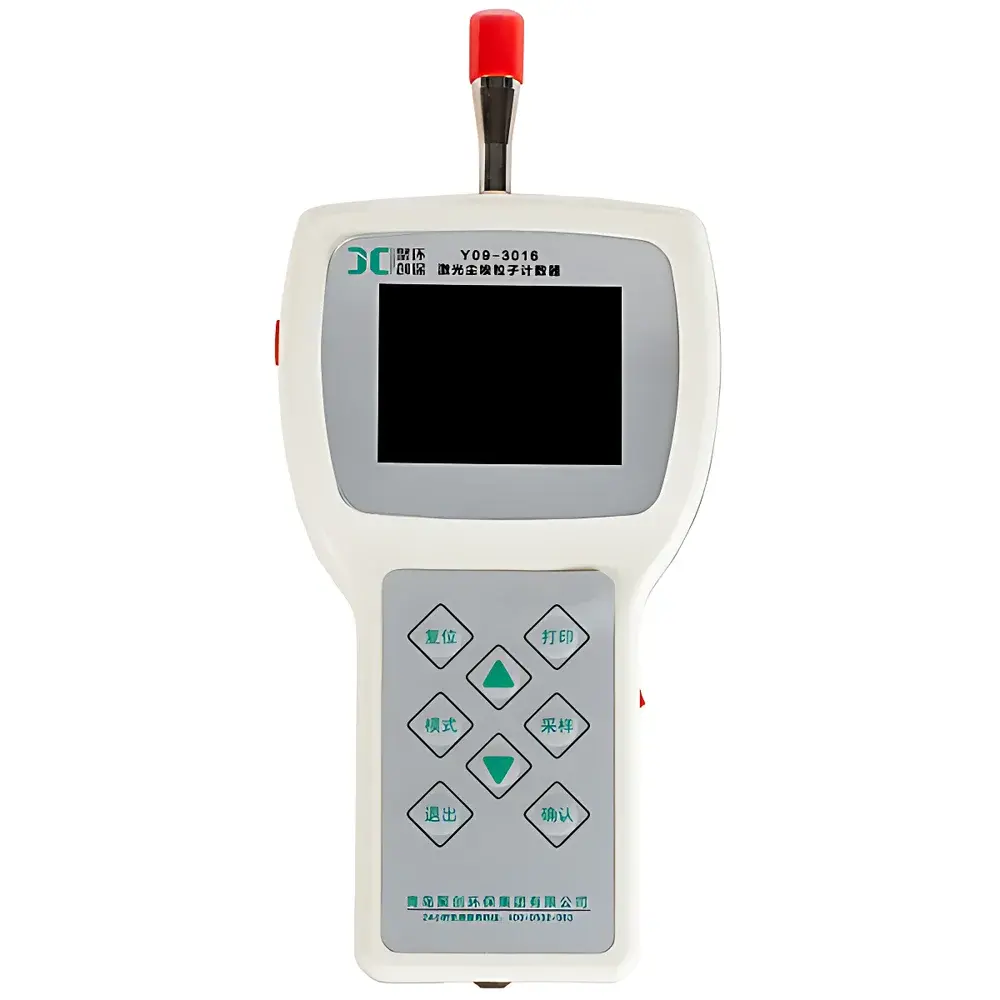
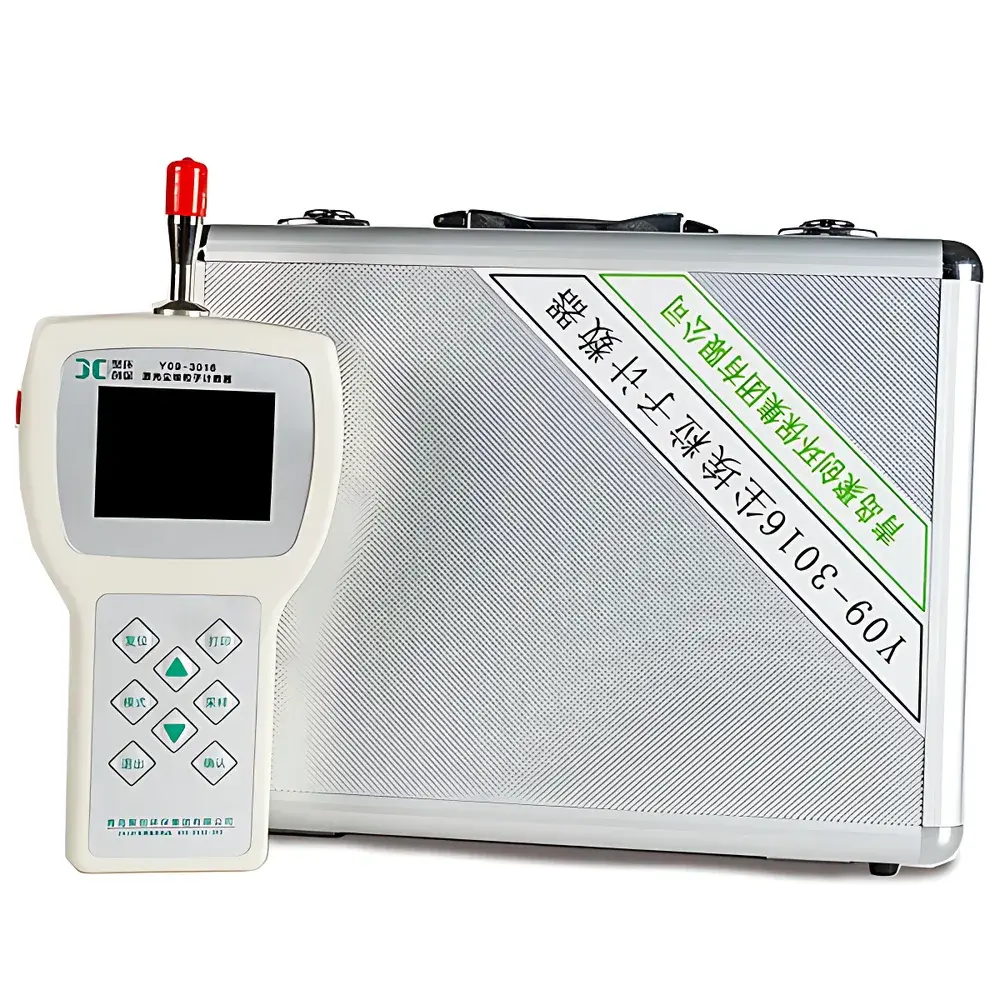
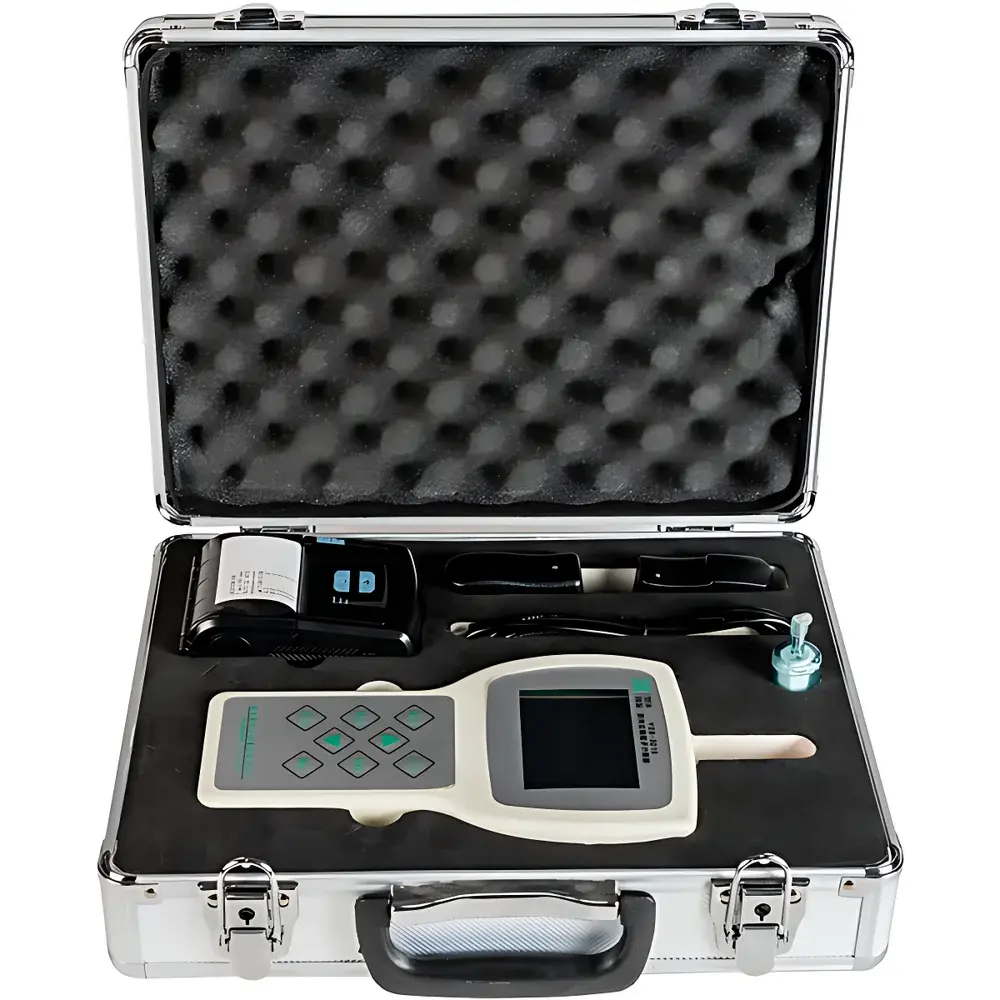
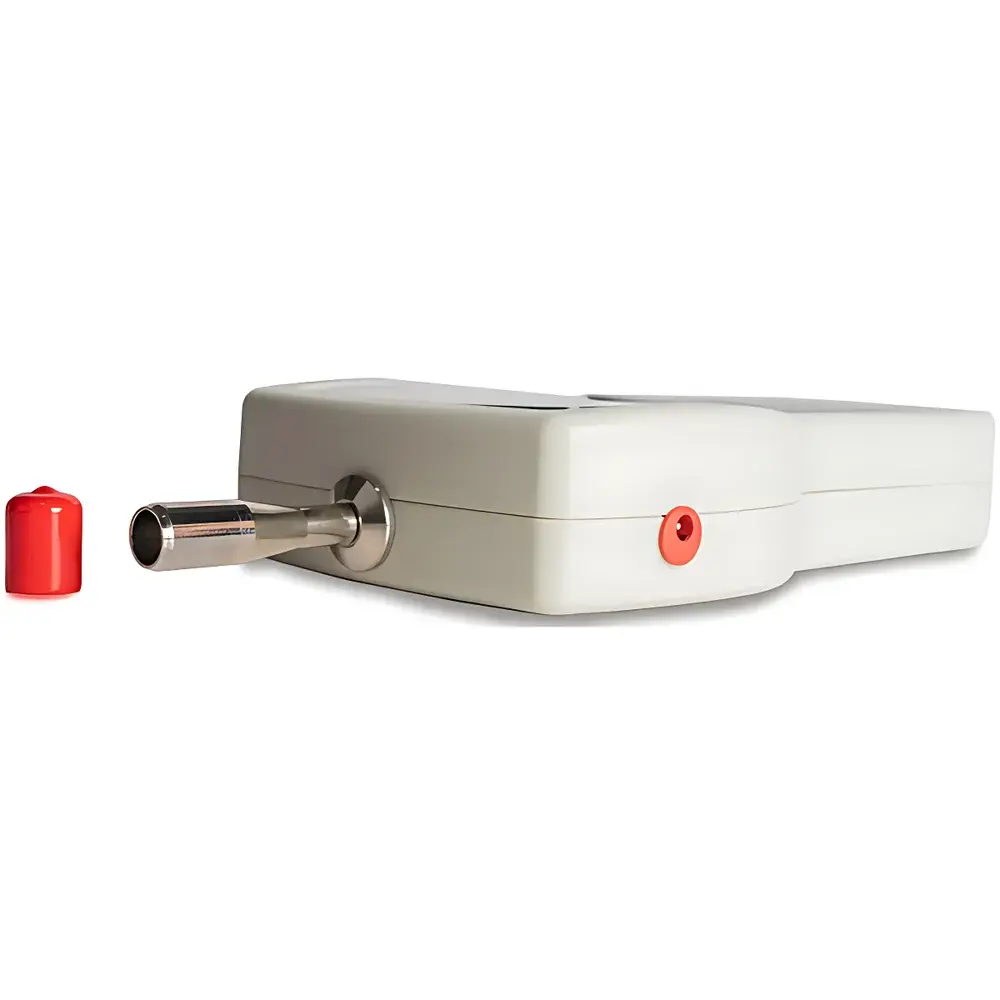
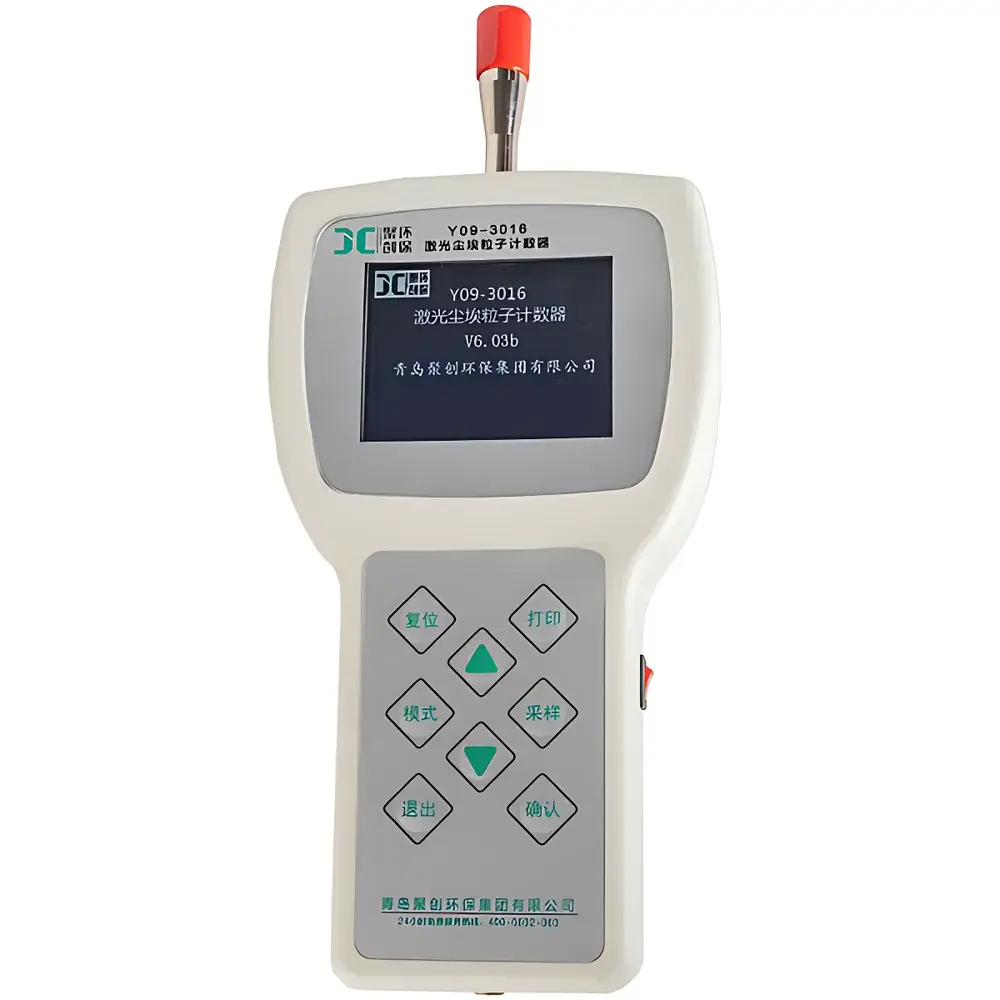
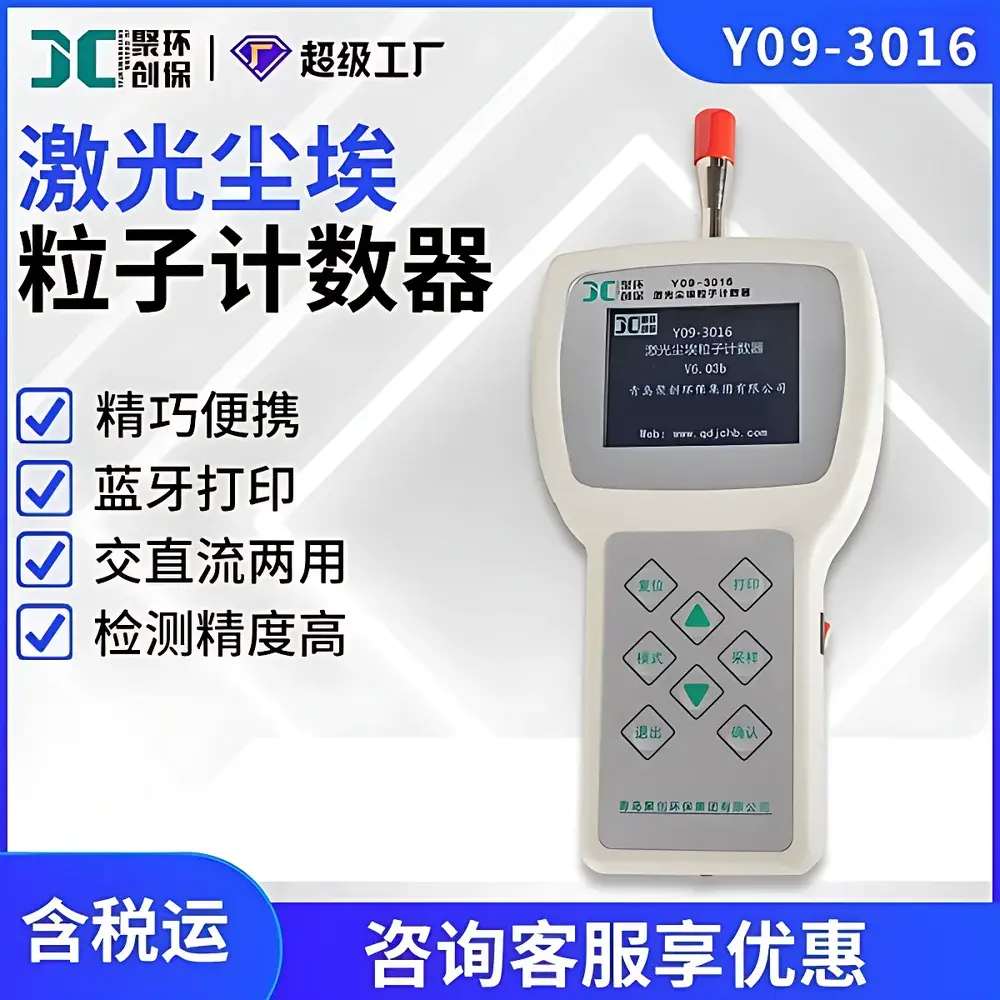
Ju Chuang Y09-3016 Handheld Laser Particle Counter
| Brand | Ju Chuang Environmental |
|---|---|
| Origin | Shandong, China |
| Manufacturer Type | OEM/ODM Manufacturer |
| Country of Origin | China |
| Model | Y09-3016 |
| Instrument Type | Handheld |
| Flow Rate | 2.83 L/min (0.1 ft³/min) |
| Particle Size Channels | 0.3, 0.5, 1.0, 3.0, 5.0, 10.0 µm (simultaneous six-channel detection) |
| Measurement Accuracy | ±5% FS |
| Counting Efficiency | ≥50% at 0.3 µm, ≥100% at ≥0.5 µm per ISO 21501-4 |
| Data Storage Capacity | 20,000 sample records (circular buffer, non-volatile memory) |
| Battery | Rechargeable Li-ion, 7.4 V / 2200 mAh, >6 h operation |
| Operating Environment | 10–40 °C, 20–90% RH (non-condensing), 86–106 kPa |
| Compliance | JJF 1190–2008, JJG 547–1988, ISO 21501-4, ISO 14644-1, GB 50073–2001, USP <788>, FS-209E, GMP Annex 1 |
Overview
The Ju Chuang Y09-3016 Handheld Laser Particle Counter is a portable, microprocessor-controlled instrument engineered for real-time quantification of airborne particulate contamination in cleanroom and controlled environments. It operates on the principle of light scattering—where particles drawn through a focused semiconductor laser beam generate scattered photons proportional to their size and refractive index. The detected signals are processed via pulse-height analysis to classify and count particles across six discrete size thresholds (0.3, 0.5, 1.0, 3.0, 5.0, and 10.0 µm) simultaneously. With a calibrated volumetric flow rate of 2.83 L/min (0.1 ft³/min), the device meets the optical detection sensitivity and counting efficiency requirements specified in ISO 21501-4 and JJF 1190–2008. Its compact form factor (230 × 130 × 45 mm), sub-600 g mass, and integrated lithium-ion battery support field-deployable operation in HVAC validation, filter integrity testing, pharmaceutical cleanroom certification, and microelectronics manufacturing process monitoring.
Key Features
- Simultaneous six-channel particle sizing (0.3–10.0 µm) with real-time concentration output in particles/m³
- High-stability 350,000-hour-life semiconductor laser source ensuring long-term measurement consistency
- Integrated environmental sensors (optional temperature/humidity module) with ±1 °C / ±5% RH accuracy
- On-device LCD display showing live counts, UCL (Upper Confidence Limit) calculations per ISO 14644-1, sampling duration, battery status, and location ID
- Configurable sampling protocols: single-cycle, continuous mode, or remote-triggered acquisition via USB or Bluetooth
- UCL-compliant reporting engine supporting A = 2–9 sampling points and L = 2–9 replicate measurements per location
- Non-volatile memory storing up to 20,000 complete datasets—including timestamp, ambient conditions, sample volume, and channel-specific counts—with power-loss protection
- Compliance-ready data export: USB 2.0 (9600 baud), direct U-disk dump, and PC software for Excel-compatible report generation and trend analysis
Sample Compatibility & Compliance
The Y09-3016 is validated for use in ISO Class 5–8 (Fed. Std. 209E Class 100–100,000) cleanrooms and critical process environments governed by GMP Annex 1, EU GMP, PIC/S, and FDA 21 CFR Part 11 (when paired with audit-trail-enabled software). Its particle counting performance adheres to national metrological verification standards JJF 1190–2008 and JJG 547–1988, and aligns with international reference methods including ISO 14644-1:2015, ISO 21501-4:2018, and JIS B9921:1997. The instrument supports both cumulative and differential counting modes, and its zero-count performance (<1 false count per 5 min at ≤2×10⁶ particles/ft³) satisfies stringent background noise requirements for high-purity applications. Optional isokinetic sampling probes ensure representative intake velocity matching duct or chamber airflow profiles.
Software & Data Management
Bundled Windows-compatible software enables full instrument configuration, remote acquisition control, and automated compliance reporting. Raw data files retain full metadata—date/time stamp, GPS-tagged location (if enabled), operator ID, calibration certificate ID, and environmental parameters—supporting GLP/GMP traceability. Reports are exportable in PDF and Excel formats, with built-in calculation of 95% UCL per ISO 14644-1 Annex D. Audit trail functionality logs all user actions (e.g., parameter changes, data deletion, calibration events), satisfying FDA 21 CFR Part 11 electronic record requirements when deployed with appropriate IT governance controls. Firmware updates are delivered via secure USB interface with version rollback capability.
Applications
- Pharmaceutical aseptic processing environment qualification (Grade A–D zones)
- HVAC system commissioning, routine monitoring, and filter leak detection (DOP/PAO scanning support)
- Medical device manufacturing cleanrooms (ISO 13485-aligned environments)
- Semiconductor fab tool exhaust and minienvironment verification
- Biotechnology incubator and isolator particle mapping
- Food and beverage packaging line air quality surveillance
- Aerospace component assembly clean booths and glovebox validation
- University and contract research laboratory airborne particulate research
FAQ
What calibration standards does the Y09-3016 conform to?
It is verified per JJF 1190–2008 (China National Metrology Institute) and traceable to NIST-traceable PSL standards; optional factory calibration certificate includes uncertainty budget.
Can the instrument perform ISO 14644-1 UCL calculations onboard?
Yes—the embedded firmware computes 95% Upper Confidence Limit automatically for multi-point sampling campaigns per ISO 14644-1 Annex D algorithms.
Is Bluetooth connectivity supported for real-time telemetry?
The Y09-3016 Bluetooth Edition supports bidirectional wireless communication with PCs and mobile devices for live streaming, remote start/stop, and alarm notification.
Does the device meet FDA 21 CFR Part 11 requirements?
When used with validated software featuring electronic signatures, audit trails, and role-based access control, it fulfills electronic record and signature criteria for regulated environments.
What is the maximum allowable relative humidity for operation?
Up to 90% RH non-condensing; condensation must be avoided to prevent optical path contamination and sensor drift.
How is isokinetic sampling achieved during duct testing?
An optional isokinetic probe kit (sold separately) maintains velocity-matched aspiration across variable airflow profiles, minimizing sampling bias per ISO 14644-3 Annex B.







