
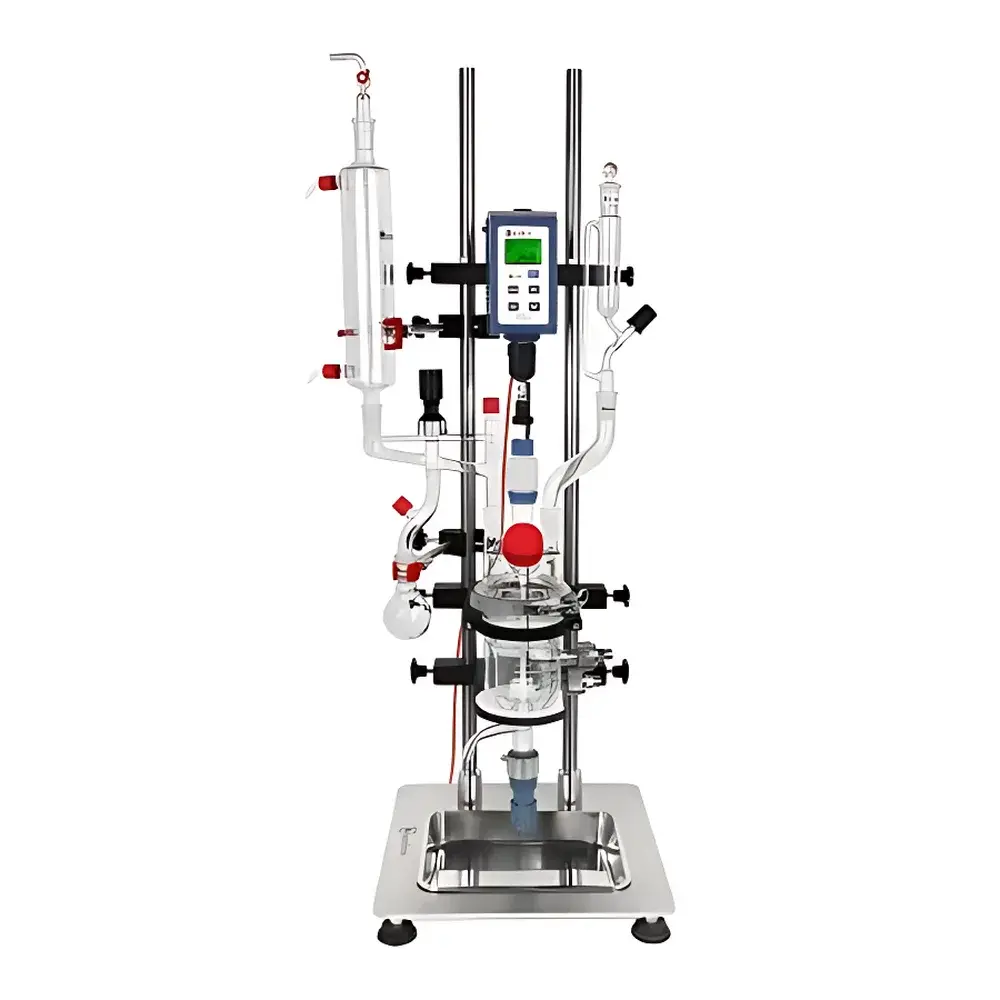
JULABO BTG Series Benchtop Glass Jacketed Reactor
| Brand | JULABO |
|---|---|
| Origin | Germany |
| Model | BTG250A / BTG500A / BTG1000A / BTG2000A / BTG5000A |
| Vessel Material | High-Purity Borosilicate Glass (DIN ISO 3585) |
| Temperature Range | −60 °C to +200 °C (with compatible JULABO heating/cooling circulator) |
| Pressure Rating | Ambient to −0.95 bar (vacuum) |
| jacket pressure rating | 0.5 bar |
| Jacket Inlet/Outlet | DN15 |
| Bottom Drain Valve | Adjustable bore 0–10 mm (optional 0–20 mm) |
| Lid Configuration | Five ports — one 24/40 standard taper stirrer port, three 24/40 side ports, one 45° angled GL45 threaded port |
| Wetted Materials | Borosilicate glass, PTFE, PFA |
| Compliance | Designed per DIN EN 61000-6-3 (EMC), CE-marked for laboratory use in EU |
Overview
The JULABO BTG Series Benchtop Glass Jacketed Reactor is an integrated, modular reaction system engineered for precise temperature-controlled synthesis, crystallization, polymerization, and catalytic studies under ambient, vacuum, or mild overpressure conditions. Built around a seamless borosilicate glass vessel (compliant with DIN ISO 3585 for hydrolytic class HGB 1 and thermal shock resistance ≥120 K), the BTG platform employs double-wall jacketed construction to enable rapid, uniform heat transfer via external circulation of thermal fluid—typically from a JULABO F26, PRESTO, or TR series heating/cooling circulator. Its operational temperature envelope spans −60 °C to +200 °C, contingent upon compatible circulator performance and thermal fluid selection (e.g., silicone oil, ethanol/water mixtures, or specialized low-temp fluids). Unlike metal-jacketed reactors, the all-glass wetted path ensures full chemical transparency, real-time visual monitoring of phase separation, precipitation, or emulsion formation, and inherent inertness toward strongly acidic, alkaline, or halogenated reagents.
Key Features
- Monolithic borosilicate glass vessel with ground-glass joints and stress-relieved geometry—designed for mechanical stability during prolonged stirring and thermal cycling
- Five-port reaction head: standardized 24/40 taper for overhead stirrer drive shaft; three additional 24/40 side ports for thermocouple insertion, gas inlet/outlet, or sampling; one 45° angled GL45 threaded port optimized for reflux condensers or vacuum manifolds
- Integrated bottom discharge valve with precision-machined PTFE/PFA seat and adjustable orifice (0–10 mm standard; optional 0–20 mm for high-viscosity or slurry handling)
- Jacket rated to 0.5 bar positive pressure—enabling safe operation with pressurized inert gas blankets or elevated-boiling-point solvent systems
- DN15 jacket inlet/outlet connections compatible with standard laboratory tubing and quick-connect couplings for rapid integration into existing thermal management infrastructure
- Modular scalability: identical flange and port geometry across BTG250A (250 mL), BTG500A (500 mL), BTG1000A (1 L), BTG2000A (2 L), and BTG5000A (5 L) models—facilitating method transfer and process intensification studies
Sample Compatibility & Compliance
The BTG reactor is suitable for batch reactions involving organic solvents (e.g., THF, DMF, DCM), aqueous electrolytes, organometallic precursors, and heterogeneous catalyst slurries. All wetted surfaces consist exclusively of borosilicate 3.3 glass (Corning Pyrex® equivalent), virgin PTFE, or perfluoroalkoxy (PFA) polymers—materials certified per USP Class VI and FDA 21 CFR 177.1550 for repeated contact with pharmaceutical intermediates. The system supports GLP-compliant workflows when paired with JULABO’s validated temperature control units featuring audit-trail-capable software (e.g., JULABO WinControl³ with 21 CFR Part 11 compliance option). It meets essential safety requirements under Directive 2014/30/EU (EMC) and 2014/35/EU (LVD), bearing CE marking for laboratory use within the European Economic Area.
Software & Data Management
While the BTG reactor itself is a passive, hardware-only platform, its thermal performance is fully controllable and documentable via JULABO’s ecosystem of programmable circulators and supervisory software. When operated with a PRESTO A40 or TR200 unit, users can define multi-segment temperature ramps, hold profiles, and dynamic setpoint adjustments synchronized with external events (e.g., reagent addition triggers). WinControl³ provides time-stamped logging of bath temperature, jacket inlet/outlet delta-T, flow rate (if equipped), and system alarms—with encrypted storage, user access levels, and electronic signature support for regulated environments. Raw data exports are available in CSV and PDF formats compatible with LIMS integration.
Applications
- Controlled-laboratory-scale synthesis of APIs and fine chemicals under reproducible thermal profiles
- Kinetic studies requiring simultaneous temperature modulation and real-time visual observation of reaction progress
- Catalyst screening under inert atmosphere with integrated gas purging and pressure monitoring
- Crystallization optimization—including anti-solvent addition, cooling rate variation, and nucleation onset detection
- Educational demonstrations of reaction engineering principles (e.g., heat transfer limitations, mass transfer coefficients, residence time distribution)
- Method development for downstream scale-up to pilot-plant jacketed reactors (e.g., 20–200 L vessels with analogous geometry)
FAQ
What thermal fluids are recommended for operation below −40 °C?
Ethanol/water mixtures (e.g., 30/70 v/v) or specialized low-temperature silicone oils (e.g., JULABO SIL 2000) are validated for use down to −60 °C. Avoid glycols below −20 °C due to viscosity-induced flow instability.
Can the BTG reactor be used under hydrogen atmosphere at 3 bar?
No. The vessel is rated only for ambient-to-mild vacuum (−0.95 bar) and jacket overpressure up to 0.5 bar. For high-pressure hydrogenation, consider JULABO’s HPR series or dedicated autoclave systems.
Is the bottom valve autoclavable?
The PTFE/PFA valve assembly is resistant to steam sterilization (121 °C, 2 bar), but repeated autoclaving may accelerate elastomer aging; validation per ISO 17665 is recommended for GMP applications.
How is temperature uniformity verified across the reaction volume?
JULABO recommends using calibrated Pt100 probes at multiple radial/axial positions during qualification. Typical axial ΔT ≤ ±1.5 °C and radial ΔT ≤ ±0.8 °C are achievable at steady state with proper circulator flow (>12 L/min for BTG1000A+ models).
Does JULABO provide IQ/OQ documentation for the BTG system?
Yes—factory-issued Installation Qualification (IQ) templates and Operational Qualification (OQ) test protocols are available upon request, aligned with ASTM E2500 and EU Annex 15 guidelines.



