
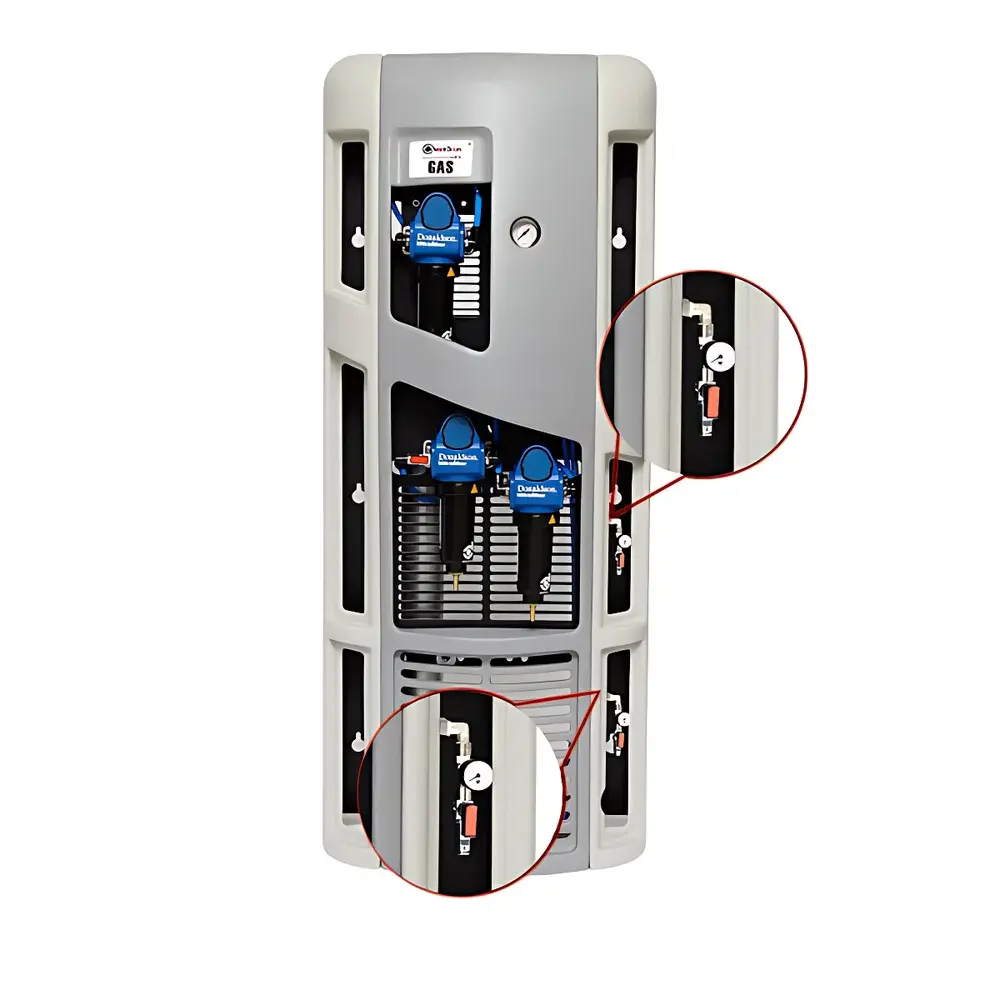
JULABO-Chemtron WHISPER Hybrid Nitrogen & Clean Air Generator
| Brand | JULABO-Chemtron |
|---|---|
| Origin | Germany |
| Generation Principle | Vacuum-driven Hollow-Fiber Membrane Separation |
| Nitrogen Flow Rate | 10–120 L/min |
| Nitrogen Purity | 98–99.9% |
| Nitrogen Dew Point | < −40 °C |
| Output Pressure | 7 bar (100 psi) |
| Air Flow (Dual Outputs) | up to 70 L/min @ 7 bar & 25 L/min @ 4 bar |
| Inlet Pressure | 8.5–10 bar |
| Pressure Drop | ≤1.5 bar |
| Particle Filtration | ISO 8573-1:2010 Class 1.2.1 |
| Operating Temperature | 15–35 °C |
| Certifications | CE, FCC, CSA, Factory-IQ/OQ Documentation Available |
Overview
The JULABO-Chemtron WHISPER Hybrid Nitrogen & Clean Air Generator is an engineered solution for laboratories requiring simultaneous, on-demand supplies of high-purity nitrogen and instrument-grade compressed air—without reliance on high-pressure cylinders or cryogenic liquid nitrogen. It employs vacuum-assisted hollow-fiber membrane separation technology, in which compressed feed air passes through asymmetric polymeric membranes with a selective separation layer (40 nm nominal pore size). Under controlled pressure differentials, oxygen, water vapor, CO₂, and trace hydrocarbons permeate preferentially through the fiber walls, while nitrogen—retained in the non-permeate stream—is delivered at consistent purity and flow. This physical separation method eliminates consumables, catalysts, or adsorbent beds, ensuring stable output across variable demand and ambient conditions. Designed specifically for analytical instrumentation—including LC/MS, GC, FTIR, and nitrogen blow-down systems—the WHISPER Hybrid delivers two independent gas streams: one high-purity nitrogen outlet (1/4″ G thread) and dual clean air outlets (1/8″ G and optional secondary port), each regulated to application-specific pressure and flow requirements.
Key Features
- Vacuum-driven hollow-fiber membrane system with 0.3 mm inner diameter fibers and 40 nm separation layer—enabling continuous, maintenance-free nitrogen generation without desiccants, PSA beds, or catalytic purifiers.
- Dual-output architecture: dedicated nitrogen stream (10–120 L/min @ 7 bar) plus two independently regulated clean air streams (up to 70 L/min @ 7 bar and 25 L/min @ 4 bar), supporting concurrent LC/MS nebulizer gas, drying gas, and auxiliary instrument air needs.
- No electrical power required for gas separation—only feed air compression input—eliminating electromagnetic interference, thermal drift, and background noise critical for sensitive mass spectrometry environments.
- Integrated ISO 8573-1:2010 Class 1.2.1 particle filtration (≤0.01 µm particles), coalescing and activated carbon pre-filtration, and dew point control (< −40 °C) ensure compliance with stringent instrumental air quality standards.
- Compact vertical footprint (480 × 1300 × 300 mm) supports benchtop or wall-mount installation; modular 6 mm PU or 1/4″ stainless steel outlet tubing accommodates direct integration with OEM interfaces.
- Factory-provided Installation Qualification (IQ) and Operational Qualification (OQ) documentation aligned with GLP and GMP laboratory practices; full CE, FCC, and CSA certification included.
Sample Compatibility & Compliance
The WHISPER Hybrid is compatible with all major LC/MS platforms (Agilent, Thermo Fisher, Waters, Shimadzu) via supplied adapter kits (1/4″ G to proprietary inlet fittings). Its nitrogen stream meets ASTM D6352–22 specifications for instrumental-grade nitrogen used in chromatographic carrier and collision gas applications. The clean air output satisfies ISO 8573-1:2010 Class 1.2.1 for solid particles, Class 2 for water (dew point < −40 °C), and Class 1 for oil content—making it suitable for pneumatic actuators, optical purge lines, and detector cooling circuits. All units ship with validated IQ/OQ protocols supporting FDA 21 CFR Part 11–compliant audit trails when integrated with laboratory information management systems (LIMS).
Software & Data Management
While the WHISPER Hybrid operates as a standalone, analog gas supply unit (no embedded microcontroller or digital interface), its mechanical design supports seamless integration into automated lab environments. Pressure and flow stability are monitored externally via calibrated inline sensors (e.g., Brooks 5850E or Alicat GCM series), with analog 4–20 mA outputs optionally available upon request. Full traceability is maintained through factory-issued IQ/OQ reports—including pressure decay testing, purity verification per ISO 8573-7, and dew point validation using chilled-mirror hygrometry—enabling straightforward inclusion in quality system documentation for ISO/IEC 17025 or CAP-accredited labs.
Applications
- LC/MS mobile phase nebulization and desolvation gas supply (primary nitrogen stream)
- Mass spectrometer curtain gas, sheath gas, and source drying gas (dual-air configuration)
- High-throughput nitrogen blow-down systems requiring >40 L/min sustained flow
- FTIR sample compartment purging and laser cavity inerting
- Gaseous standard dilution systems requiring stable, low-particulate nitrogen background
- Automated sample preparation workstations requiring synchronized N₂ and instrument air
FAQ
Does the WHISPER Hybrid require electricity to generate nitrogen?
No. Gas separation occurs solely via pressure-driven membrane diffusion; only the upstream air compressor requires power.
Can it replace both nitrogen cylinders and oil-lubricated air compressors?
Yes—provided the feed air meets ISO 8573-1 Class 2.2.2 specifications (oil-free, ≤0.1 ppm oil aerosol, dew point ≤3 °C), the system delivers cylinder-equivalent nitrogen and cleaner air than conventional compressors.
What maintenance intervals are recommended?
Pre-filters require replacement every 6–12 months depending on inlet air quality; membranes have a service life exceeding 15,000 operating hours with no scheduled replacement.
Is remote monitoring supported?
Not natively—but analog pressure and flow signals can be routed to SCADA or LIMS via third-party transducers compatible with 4–20 mA or 0–10 V interfaces.
How is purity verified during qualification?
Factory OQ includes real-time electrochemical oxygen analyser measurements (±0.01% O₂ detection limit) and chilled-mirror dew point validation per ISO 8573-4, documented in the final report.



