
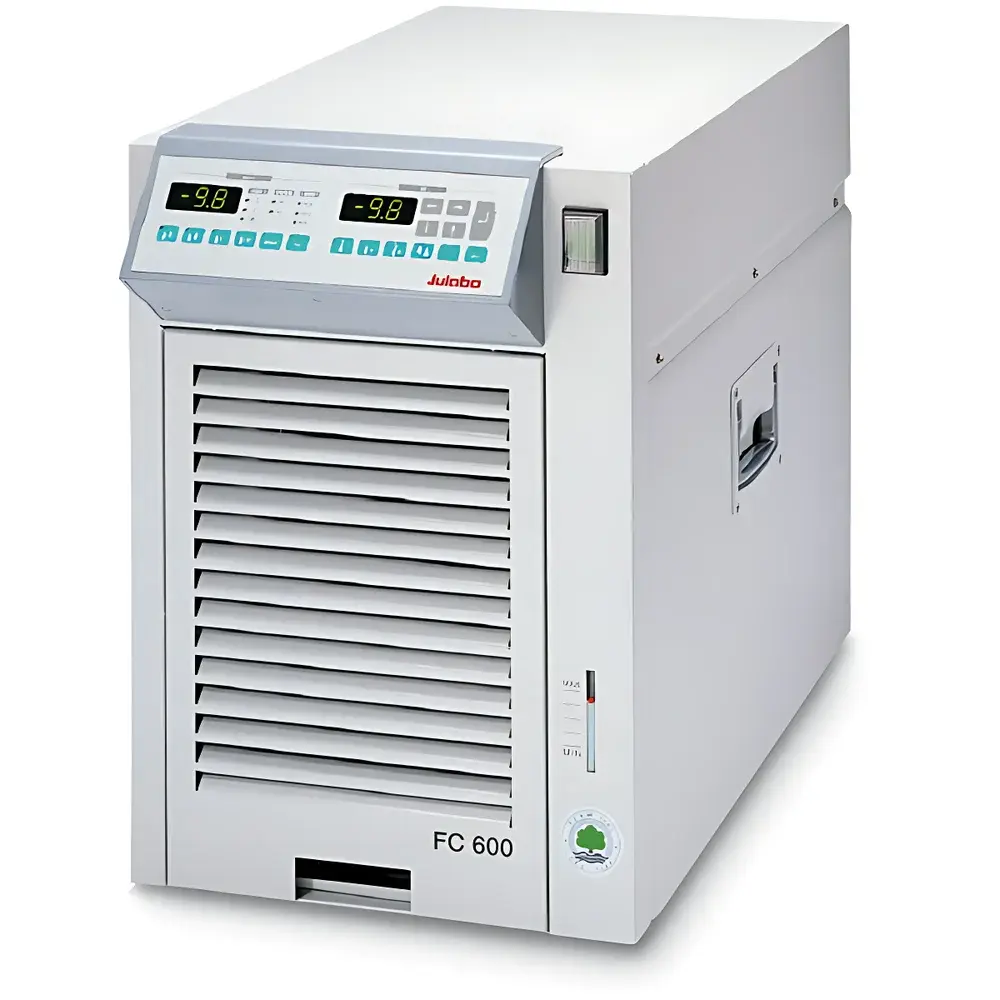
JULABO FC Series Circulating Chiller
| Brand | JULABO |
|---|---|
| Origin | Germany |
| Model Series | FC Series |
| Cooling Method | Air-Cooled |
| Temperature Range | –20 °C to +80 °C |
| Temperature Stability | ±0.2 °C |
| Refrigeration Capacity | 600 W (FC600) up to 2500 W (FCW2500T) |
| Heating Power | Up to 1.2 kW |
| Maximum Flow Rate | 20 L/min |
| Pump Pressure | 0.5 bar |
| Reservoir Volume | 6–11 L |
| Operating Mode | Continuous |
| External Pt100 Sensor Input | Yes |
| Analog Interface | 0–10 V / 4–20 mA |
| Dual LED Display | Standard |
| Top-Fill Reservoir Design | Standard |
| Liquid Level Indicator | Standard |
Overview
The JULABO FC Series Circulating Chillers are precision-engineered, air-cooled temperature control systems designed for demanding laboratory and industrial applications requiring stable, bidirectional thermal regulation. Unlike single-function cooling units, the FC Series integrates both refrigeration and electric heating in a single compact, self-contained chassis—enabling seamless operation across a broad temperature span from –25 °C to +80 °C. These chillers operate on vapor-compression thermodynamic principles, utilizing environmentally compliant R-410A or R-134a refrigerants (model-dependent), coupled with high-efficiency scroll or rotary compressors and PID-controlled resistive heating elements. Their primary function is to supply temperature-stabilized coolant—typically water or water-glycol mixtures—to external equipment such as spectrometers, laser sources, vacuum pumps, reactors, and analytical instrumentation. The system maintains setpoint accuracy via real-time feedback from internal PT100 sensors and optional external probe inputs, ensuring thermal consistency critical for reproducible experimental outcomes and process validation.
Key Features
- Integrated dual-mode temperature control: simultaneous refrigeration and heating within one unit, eliminating need for separate hot/cold sources
- Wide operational range: –25 °C to +80 °C (model-dependent), with factory-calibrated stability of ±0.2 °C at setpoint
- Modular scalability: 11 standard models (e.g., FC600, FC1200T, FCW2500T) offering refrigeration capacities from 600 W to 2500 W at 20 °C ambient
- High-flow circulation: adjustable flow rates up to 20 L/min with regulated pump pressure (0.5 bar nominal) and low-pulsation performance
- Intuitive dual LED display interface: independent readouts for outlet temperature and setpoint; status indicators for compressor, heater, and level alarm
- Top-access reservoir with integrated liquid level sensor and visual indicator—enabling safe, spill-free refilling without disassembly
- Analog I/O compatibility: 0–10 V or 4–20 mA input/output for integration with PLCs, SCADA systems, or external data loggers per IEC 61000-6-2/4 EMC standards
- External Pt100 sensor port for remote bath or process-loop temperature feedback, supporting cascade control configurations
Sample Compatibility & Compliance
The FC Series is compatible with aqueous and glycol-based heat transfer fluids (up to 30% ethylene or propylene glycol). It supports continuous-duty operation with inlet fluid temperatures up to 80 °C—critical for applications involving exothermic reactions or high-power laser diode cooling. All units comply with EU directives including CE marking under Machinery Directive 2006/42/EC, Low Voltage Directive 2014/35/EU, and EMC Directive 2014/30/EU. Refrigerant handling adheres to F-Gas Regulation (EU) No. 517/2014. Units meet ISO 17025-relevant environmental monitoring requirements when used in accredited testing laboratories and support GLP/GMP workflows through configurable event logging and password-protected parameter access.
Software & Data Management
While the FC Series operates autonomously via front-panel controls, its analog interface enables traceable temperature recording using third-party systems compliant with FDA 21 CFR Part 11 (when paired with validated software/hardware). Users may configure ramp-soak profiles externally and monitor real-time coolant temperature, flow status, and fault codes. Internal non-volatile memory stores operational history—including compressor runtime, thermal cycle counts, and alarm events—for maintenance planning and audit readiness. Optional JULABO LabSoft software (sold separately) provides USB-based configuration, trend visualization, and export to CSV for long-term QC documentation.
Applications
- Stabilization of high-power optical components (e.g., Ti:sapphire lasers, DPSS modules) requiring sub-0.3 °C thermal drift control
- Cooling of NMR console electronics and cryoprobes where consistent heat rejection prevents signal degradation
- Temperature regulation in HPLC column ovens, viscometers, and rheometers during method development and validation
- Process cooling in small-scale chemical synthesis reactors with integrated exotherm management
- Environmental stress screening of electronic assemblies under controlled thermal cycling protocols
- Support of ASTM D5276 (impact resistance), ISO 11357 (DSC calibration), and USP thermal analysis system qualification
FAQ
What is the maximum allowable inlet fluid temperature?
The FC Series accepts return coolant up to 80 °C—enabling integration with high-temperature processes without auxiliary pre-cooling stages.
Can the FC chiller maintain temperature stability during rapid load changes?
Yes. Its adaptive PID algorithm, combined with proportional heating/cooling actuation and thermal mass optimization, achieves recovery times under 5 minutes following ±5 °C step-load disturbances.
Is remote monitoring supported out of the box?
No built-in Ethernet or Wi-Fi; however, the analog interface (0–10 V / 4–20 mA) permits connection to industrial controllers or data acquisition systems for remote supervision and alarm relay.
What maintenance intervals are recommended?
Compressor oil and refrigerant integrity should be verified every 24 months under continuous operation; air filter cleaning is required quarterly in dusty environments per manufacturer’s service bulletin SB-FC-2023-01.
Does the FC Series support external safety interlocks?
Yes. Dry-contact terminals are provided for external emergency stop circuits and flow-loss detection, complying with EN 60204-1 Category 3 safety architecture requirements.



